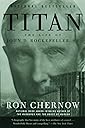

Desertcart purchases this item on your behalf and handles shipping, customs, and support to South Africa.
๐ Unlock the secrets of Americaโs richest enigmaโdonโt miss the story everyoneโs debating!
Titan: The Life of John D. Rockefeller, Sr. is a critically acclaimed, award-finalist biography by Ron Chernow that explores the complex life of the iconic industrialist. Spanning nearly a century, it reveals Rockefellerโs dual legacy as a ruthless business magnate and a generous philanthropist, based on exclusive access to his private papers. This balanced and elegantly written book offers deep insights into the origins of American capitalism and philanthropy, making it a must-read for professionals seeking to understand the forces that shaped modern America.


| Best Sellers Rank | #3,200 in Books ( See Top 100 in Books ) #3 in Company Business Profiles (Books) #4 in Economic History (Books) #10 in Biographies of Business & Industrial Professionals |
| Customer Reviews | 4.6 out of 5 stars 4,165 Reviews |
M**D
A book that will nudge you to think
This is my first ever experience with reading a Ron Chernow book. I was looking to read a biography on a prominent American and stumbled upon recommendations about TITAN during my research over internet. When I ordered this book, I did not know what to expect and how long Iโd be interested in continue reading. I have many unfinished books (fiction as well as non fiction) because I lost interest or figured out what the theme/story line will be for the remainder of the book or on some occasions simply because the writing style was not for me. But for me, this book is the best example of superior writing style. I got so impressed by the usage of a vast vocabulary and weaving of complex bits of stories without losing continuity and context that I had to look up other works by the author. Next in line for me is Hemilton, which I have already bought. There are many biographies on Rockefeller and those who are born and raised in the USA would have already known about this highly controversial figure, yet this book is a must read for all who wants to read an unbiased account of Rockefellerโs life and work. Ron Chernow has done an excellent job in researching and portraying the peripheral events and circumstances which certainly influenced the man and contributed towards shaping him into who he was. Reading this book helps one understand the brilliant and complex mind of Rockefeller which was hermetically sealed away even from his own children. It is a compact read that is choke full with information. This book not only portrays the unimaginable success story of rags to reaches but also helps the readers to glimpse at an era prior industrial revolution, how it all started and shaped America into who she is now - a global super power. This book created a new found respect in me for this powerful self made man who quietly kept giving to the humanity. Yet there is the other side, who came across as a secretive person determined to not let his early days of business and birth of Standard Oil resurface in public mind, which makes me wonder how ethical was he in his business approach, at least in the beginning? And these conflicting thoughts and debates in my mind were all introduced by the author. This is the tellatale sign of an extraordinary writer, in my humble opinion. Books should be informative, insightful and yet written in such an unbiased way that in the end the readers can debate different points and form their own opinion. And this book does exactly that. The narrative is from a person who saw Rockefeller neither as a protagonist or antagonist, nor did his story telling revealed any bias that might have formed based on historical accounts (from specific people) of life and work of this Great man named John Davison Rockefeller. How many can actually build something from scratch and then make it absolutely gigantic? That also after coming from a troubled unknown background and minimal education? How many can remain austere and simple in their approach to life even after being declared the richest man on this earth? How many can actually give silently? Needless to say, this book has created a great impact in my mind and influenced me for better. Read this book and decide for yourself.
M**N
Fascinating, well-balanced and it will make you want to reevaluate your own life.
I am a licensed tour guide in Saint Augustine, Florida. Rockefeller's close friend and business partner at Standard Oil was Henry Morrison Flagler who is known as the father of modern Florida and father of Florida tourism. His developments in Florida began with the Ponce De Leon Hotel here. I am also a Baptist like Rockefeller and am a member of Ancient City Baptist, whose building Flagler helped build. Rockefeller was often here and would die at his home in Ormond Beach, in Flagler County about 50 miles south of here. I also give guided tours of our historic church and Rockefeller had ties with several men in our church and in our area. He supported the missionary efforts of John E. Clough financially who was converted by one of our former pastors and of which we have a commemorative window. This book is extremely well-documented, very interesting and thought-provoking. The only thing I would disagree with is the author's view of the Northern Baptist movement at the time, they were strongly influenced by the doctrines of grace and believed that God could save anyone but certainly wasn't trying to save everyone. I definitely want to read more of this authors books as I read this. I may add more to my review later. This was Rockefeller's favorite hymn. 1. I've found a friend, O such a friend! Christ loved me ere I knew Him He drew me with the cords of love, And thus he bound me to Him; And round my heart still closely twine Those ties which naught can sever, For I am His, and Christ is mine, Forever and forever. 2. I've found a friend, O such a friend! He bled, he died to save me; And not alone the gift of life, But His own self He gave me; Naught that I have my own I call, I hold it for the Giver; My heart, my strength, my life, my all Are His, and His forever. 3. I've found a friend, O such a friend! All pow'r to Him is given, To guard me on my onward course, And bring me safe to heaven: Th'eternal glories gleam afar To nerve my faint endeavor; So now to watch, to work, to war, And then to rest forever. 4. I've found a friend, O such a friend! So kind and true and tender, So wise a counselor and guide, So mighty a defender! From Him who loves me now so well What pow'r my soul can sever? Shall life or death or earth or hell? No, I am his forever.
L**N
Inadvertently Makes the Case Against Anti-Trust Laws; Good Coverage of Non-Business Life
I recently read Thomas Sowell's Intellectuals and Society and noticed that Sowell had a much different opinion of Rockefeller and Standard Oil then those presented by Richard White in The Republic for Which It Stands: The United States during Reconstruction and the Gilded Age, 1865-1896 from the Oxford Series on United States History. To resolve the matter I resolved to do a basic "spot check" of Sowell's claims to see whose opinion was closer to the truth: at least at some point in time... After procrastinating on this, one day a message arrived in my Inbox informing me that Ron Chernow's biography of Rockefeller was on sale. Was this a sign that this was a book I was meant to read? Almost certainly it was merely a coincidence but it did seem like the book would present me with more than enough information to get to the bottom of the different views of the Gilded Age's "Robber Barrons". It would, however, require a bit more reading than the "spot check" I had originally intended... At the outset Chernow makes it clear that he wants to cover more aspects of Rockefeller's life than are typically covered by other books which tend to focus on Rockefeller's business career. Chernow decries the lack of coverage of Rockefellerโs long retirement years for instance. Indeed in his book Chernow gets to Rockefeller's somewhat early retirement by about half way through the book. Chernow's other big goal, as stated at the outset, is to try to explain the seeming "contradictions" in Rockefeller's personality and his resultant actions. In terms of covering much more of Rockefeller's life than his business career, Chernow definitely succeeds. Rockefeller's philanthropy takes up about as much space as his business career; Rockefeller's family is described in sometimes exquisite and sometimes excruciating detail; There is also a good deal of discussion of contemporaneous writings and feeling regarding Rockefeller. In terms of Chernow's second big goal---to explain the "contradictions" in Rockefeller's personality, Chernow definitely hits a home run. Chernow describes how devoutly religious Rockefeller was from a very early age and how he always tried to act in accord with Baptist principles. Rockefeller regarded his business success as a sign that he was acting in God's favor. Rockefeller also felt he was merely meant to be a good steward with the money he earned: his primarily obligation was to give it away to help better the world. The third crucial belief in explaining Rockefeller's actions was that he did not see competition as inherently good. In fact, his early experience in the oil fields---and he was fortunate enough to be working very close to the first discoveries---led him to believe that competition was not good: it just led to overproduction, most businesses going bust and harm from this that could spill over into lenders. Thus, in Rockefeller's mind, he was on a mission to dominate the oil markets, and replace competition with co-operation. His success showed to him that God favored him likely because he would follow his Christian duty to give away the resultant wealth. A surprising fact, given this, is that Rockefeller regarded Standard Oil's contribution to the world of making oil and derived products widely and cheaply available as a far greater accomplishment that his charitable work. Beyond his core beliefs, or more likely generating them, Chernow feels that Rockefeller's seemingly contradictory personality resulted from having parents who, in most ways, were quite opposite. Rockefeller's father was a literal frontier's conman reminiscent of those portrayed in The Adventures of Huckleberry Finn. Rockefeller's mother, by contrast, was a devout Baptist. Chernow sees Rockefeller's devotion to philanthropy, religion and family as arising from his mother's character and his ruthlessness in business as deriving from his father's anti-social aspects. Chernow mentions that pathological liars can miss out on great achievements they otherwise may be more capable of than most by getting caught up in their petty scams. Along these lines it is fascinating to think of Rockefeller and his conman father given that we now know that CEOs are more likely to exhibit "dark triad" traits than the general population. At the same time it is also hypothesized that personality disorders, such as anti-social personality disorder, run along a spectrum. In small amounts the traits are beneficial: e.g. a businessman pushing the rules as far as they will go but stopping just shy of going over. It is when they occur in too extreme amounts that they are harmful. Although Chernow's tales of Rockefeller's father make for exciting reading his other family members are rarely as interesting. Chernow, however, seems to be determined to devote space to all of them including in-laws. Thus all of Rockefeller's siblings are covered: all sisters and brothers in-law, all sons and daughters in-law, all children, and all grandchildren. In some places this coverage for the sake of completeness goes a little overboard: especially regarding in-laws. In some places, e.g. Edith Rockefeller, it can delve a bit into a gossipy/tabloid feel. Rockefeller Jr receives by far the most coverage. Although some of it is downright embarrassing, Jr is ultimately portrayed as a man with weaknesses but overall, although not rising to the level of his father, a competent heir able to come through in the most critical times and, in some cases, e.g. being able to acknowledge mishandling of the Ludlow Massacre, exceeding him. Overall Senior is portrayed as an extremely loving man devoted to his family. In the case of his brother Frank this was even despite the fact that Frank had grown to hate him, openly worked with his enemies against him, all while still maintaining a huge sense of entitlement to some of his brother's money. In terms of philanthropy, Chernow portrays it as ultimately consuming even more of Rockefeller's energies and worries than did Standard Oil. Chernow describes how Rockefeller wanted to affect the greatest good by supporting the most fundamental issues: for example lack of quality education for black people in the South and a lack of quality medical research facilities in the United States. Chernow describes how Rockefeller's goal was to create entities which would survive his death and exist long into the future. Chernow's coverage here is excellent. With the exception of going into a little too much detail about the founding of the University of Chicago it did not suffer the problem of coverage just for the sake of completeness that coverage of Rockefeller's family did at times. Overall Rockefeller is portrayed as an extremely and genuinely kind man who was genuinely modest in his dealings with people at all levels of society and always on guard for wealth harming his adherence to his Christian principles. Chernow has some anecdotes that are particularly successful in making this point. One anecdote is how Rockefeller, though he expected Junior to track every penny and never waste money, reacted when Junior had to inform him that he had lost $1 million dollars he did have in the stock market. The other describes Rockefeller's reaction to an employee, not knowing who he was, reacting to some exercise equipment that Rockefeller brought into the office. Overall I rate the coverage of Rockefeller's life outside of Standard Oil as 5/5: in some cases rather tedious but still excellent overall. Unfortunately, beyond explaining how Rockefeller's ruthlessness in business arose without causing him to feel any contradictions with his Christian principles I did not feel that Chernow's coverage of Standard Oil was as strong as the rest of the book: What seems to be the problem is that Chernow just takes it as a given that competition in business is a good thing as are anti-trust laws. A history book may not be the best place to get deep into an economic and ethical analysis but, although there is a consensus view that anti-trust laws are good in principle, it is by no means universally believed that the case is so axiomatic as to not require any discussion. I did not feel that Chernow did a good job of describing any net harm done by Standard Oil. Yes competition was suppressed but there is not enough detail or concrete examples to show how that was net detrimental to society. Standard Oil's anti-competitive practices did not seem to harm their innovativeness: new uses of petroleum products were constantly coming on the scene and Standard Oil could not and did not rest on its laurels. Rockefeller's perfectionism and desire to make as much money as possible to give away to charity would never have allowed for that. After Rockefeller stepped away Standard Oil did raise prices on domestic oil products to offset price cuts they had to make to compete overseas. At the same time, however, a tariff limited foreign competitors' ability to compete with US oil producers so was the problem really Standard Oil or was it government intervention limiting competition? Ultimately, although it took time, people did find ways to compete with standard oil such that Chernow admits that the ultimate Supreme Court decision to break up Standard Oil was like closing the barn door after the horses had already escaped. Indeed, it seemed that Rockefeller ultimately paid nothing in the way of "punishment" for his business practices. Indeed the breakup probably ultimately benefitted him as new managers were now needed making the way for young folks with fresh ideas to come into the business. Overall Chernow is supposedly emphasizing the "dual" character of Rockefeller and in the conclusion of the book thinks that maybe the good outweighed the bad and God may have allowed him into heaven. Presupposing the existence of a Christian God the case that it is even close does not seem to have been made. Indeed I thought the evidence presented showed that Standard Oil and its actions were clearly a net benefit to consumers with the added bonus that it was Rockefeller who ended up with the largest percentage of the money made in oil: If there had been more competition would his competitors have been as generous in philanthropy as he was? Chernow shows that Rockefeller was far and away the most generous philanthropist so the answer seems a clear "no". The strongest case against Rockefeller's business practices seems to be that of food and supply store owners who were told to carry Standard Oil products exclusively otherwise they would face Standard Oil backed competitors selling food and supplies unrelated to oil at cost or even a loss to drive them out of business. This does, indeed, seem unfair, hence some residual questions after reading the book forms were: Is the feeling that a business practice is unfair sufficient to justify anti-trust laws preventing it? In the case of food and supply stores were they done great harm by being forced to carry only Standard Oil products? If the business practices were bad but resulted in a net benefit to society then is the typical argument for anti-trust laws turned on its head? Now there is right to fair competition even if that does not result in the greatest economic benefit to society whereas the argument generally seems to be that the right to do what you want with your own property and through contracts is limited if it does a great net harm to society or, in principle, could have even if did not occur in your particular case. A final question is: did the United States just get lucky with Rockefeller? If his and Standard Oil's existence does make a case against anti-trust laws is this just one data point that runs contrary to the others?
D**N
A journey well worth taking
Though I read and enjoyed Chernowโs biographies of Washington, Hamilton and Grant, I found this biography of Rockefeller his best. I did not expect that. The bland grayish cover, which shows a grim, almost sadistic-looking Rockefeller against a sterile cityscape, does not inspire a potential reader to think of โenjoyable read.โ Likewise, the pre-book knowledge I had of Rockefellerโs founding of Standard Oil led me to think that this biography would involve a lot of dry reading about Rockefellerโs financial dealings. But I was completely wrong. This is a gripping story, much of it about an America we now live in but know little about the origins. Chernow is, as usual, an excellent stylist. The book can roughly be divided into two parts: 1) how Rockefeller got the largest fortune in American history at the time and 2) how Rockefeller gave most of that away in philanthropic work. He drove thousands of small businesses out of the market and put multiple thousands of workers out of work using ruthless and cutthroat techniques, many (not all) of which were legal at the time. Cooperation with him was always better than competition and woe to anyone who did not agree. His personality is fascinating and Chernow does an exceptionally good job at bringing that out. In fact, Rockefellerโs personality and character are central themes that run throughout the book โ how this pious Baptist who thought God wanted him to make as much money as possible so he could give it away could go through life with massive repression and apparent equanimity. His (and his sonโs) philanthropy is incredible, from founding the University of Chicago to Rockefeller University to the Rockefeller Foundation. Millions for this, multiple millions for that in late 19th century and early 20th century money! It is mind-blowing. The book begins with Rockefellerโs father, a patent medicine quack showman who kept two separate families and ends with Rockefeller giving more money to advance real medicine than any individual in history. The book expands the readerโs consciousness and is a fascinating and enjoyable read at the same time. Though Chernowโs Hamilton gets all the press these days, I learned more from this book about America and enjoyed it more. In my view it is a pinnacle of biographical writing - by any author.
H**N
an excellent bio
I greatly enjoyed myself reading about Rockefeller in Ron Chernow's Titan. The biography itself covers Rockefeller's life fairly completely. The book also spends a considerable amount of time on his only son, JDR, Jr, who received almost the entire fortune and who spends his entire life selflessly dedicated to his father and philanthropy. (Junior had 5 famous sons, the Rockefeller brothers, Nelson, David, Laurance, Winthrop, and John III.) Probably the biggest question about Rockefeller is where on the spectrum of good to evil he falls, and I think Chernow paints as sympathetic a picture as possible, doing a good job of getting beneath how the press betrayed him. For me, the most fun part of Rockefeller's life to read about was the last stage where he more or less became a happy go lucky "codger" (as Chernow calls him), though I have a feeling that Chernow's research on his early life and how his early life pervades the rest of his life is probably Chernow's most important contribution to posterity. The most exciting part of the book was obviously how Rockefeller got his start. Picking up the story after Rockefeller's death, I started to read the life memoire of David Rockefeller, written in 2003. Chernow actually spoke with David before writing Titan. Curiously, the chapters in David Rockefeller's memoire that deal with his father (Junior) and grandfather (Senior), published 7 years after Chernow's book came out, almost seem lifted from Chernow's book. There's almost nothing written solely on Jr, except a bio by Raymond Fosdick. (Fosdick was closely associated with Junior for 40 years.) Abby Aldrich Rockefeller (Junior's wife) also seems interesting (she is responsible for the MoMA), and there is a bio of her by Bernice Kert. I can't wait till the spring to visit Kykuit! The research was top rate, and the book read effortlessly. I had a hard time putting the book down. The only problem I had was that the Kindle version footnote links did not work.
V**0
great
Very much enjoyed. Great perspective and storytelling. Lessons and themes abound. This book is worth a read. Thank you to the author.
J**N
A More Complete Understanding.
After completing a history of Butte, MT, I wished to gain a better understanding of Standard Oil's role in the formation of Anaconda Copper. When I found that Mr. Chernow had written a biography of John D. Rockefeller, I knew I would learn how Standard Oil and Anaconda Copper fit together. Titan did not disappoint. The nexus of Standard Oil to Anaconda was actually through the investment of individual officers of Standard Oil and not the actual "evil" corporation. In addition, John D. Rockefeller had literally nothing to do with the Anaconda creation as he had already "retired" from the daily management of Standard Oil. The Butte history I recently read was written in about 1933 and did a poor job of explanning the Standard Oil nexus. Ron Chernow is a thorough researcher and provides substantial detail in bringing his subjects to life. I ratesd this book as a four star selection only in as much as some of the details of Rockefellers children and grandchildern became a little tedious. I am not sure I really was looking for as detailed a history of all the decendant's nerouses. Major learnings from Mr. Chernows work were 1. Rockefeller's strick adherence to fundamentalist Baptist faith. 2. Rockefeller's role in developing the Mesabi Iron Range, something I knew nothing about before reading this book. 3. The role of questionable ethics used in growing Standard Oil and not violation of law. 4. The fact that Rockefeller made almost all of his petroleum fortune before the "invention" of the automobile and subsequent demand for gasoline. Kerosene for lighting drove his fortune. 5. The role John D. Rockefeller, Jr. played in establishing Grand Tenton, Smokey Mountain, Acadia National Parks and Colonial Williamsburg. 6. The life view John D. Rockefeller had on philanthropy as he really had a life long commitment to spend his wealth for the benefit of others. He died with an estate of less than $30 million dollars at 97 years of age, about 2 1/2 years short of his life-long goal of living to 100 having given away over $500 million (estimated at $30 billion in current dollars). 7. Rockefeller's role in the creation of the University of Chicago and its early growth to one of the country's elite schools. As with previous Chernow biographies I have read, this book left me with a feeling that I had gain a pretty exhaustive view of the man and his times.
G**R
The โTitanโ was all of that, but a conflicted man.
This book could be considered controversial if you get knotted up over capitalism. That is a serious subject. But the story is fascinating. The writing is wonderful. With one exception, every chapter gets better; a new twist or turn, an industry changing invention or approach that challenges the mind of the many. Sometimes with worldwide impact. Periodically I forgot that the nearly 800 page book is a biography of John D. Rockefeller. Did I mention the extensive research? It still leans more in the direction of a novel.
C**N
Jesรบs Talamantes
Existen muy pocas biografรญas tan bien documentadas como esta. Escogรญ este libro por conocer la forma de pensar de quien fuera el mรกs grande empresario de sus tiempos y, que la a fecha, han perdurado sus empresas, renombre y prรกcticas. Recomendado para emprendedores
G**C
Top
Top
G**Y
huge, full account of the richest man of all time...
don't be put off by the size of the book - it's huge. saying that it is thoroughly well researched and a great insight into the life story of the richest man the world has ever seen. i give this book 5 stars because it's written really well and i found that i couldn't put it down. if you are interested into the life story of rockefeller this is possibly the best book on the subject...
J**O
Excellent
All about the life of this tycoon.
W**N
Great Read
I really enjoy reading the in-depth research Ron Chernow brings to historical characters. After reading the life of Rockefeller, I could draw distinctive parallels between his life and how he built Standard Oil and that of Bill Gates and Microsoft. I would highly recommend this book and others I have read from this author. The detail, the events, the history and the story make it a hard book to put down
Trustpilot
5 days ago
3 weeks ago