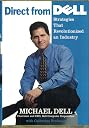
Direct from Dell: Strategies That Revolutionized an Industry
Product ID: 196081008
📈150,000 first printing copies
📚Deep dive into computer business history
🧠Insights from a top tech capitalist
Desertcart purchases this item on your behalf and handles shipping, customs, and support to South Africa.
🚀 Revolutionize your strategy with the playbook of a tech titan!
Direct from Dell: Strategies That Revolutionized an Industry offers a compelling insider’s look at how Michael Dell built a multi-billion dollar tech empire through innovative, customer-focused strategies. With 150,000 copies in its first printing and a 4.4-star rating from over 200 readers, this book is essential for professionals eager to master entrepreneurial grit and strategic innovation in the competitive computer business landscape.
| Best Sellers Rank | 1,285,239 in Books ( See Top 100 in Books ) 10,603 in Computer Science (Books) |
| Customer Reviews | 4.4 out of 5 stars 203 Reviews |
A**E
As described
A book as described.
A**R
Get into the Mind of a Capitalist
The thoughts derived from this book could help anyone access to Michael Dell, one of the greatest capitalists of all time. Here Mr. Dell makes his efforts in his journey seem somewhat "easy" to do. Nothing could be more further than the truth. It takes a lot of persistence, experimentation, courage and a keen eye to spot opportunities to create a multi-billion global empire from scratch(Maybe he is just downplaying his success, or maybe he knows something which we don't?) Yet in the midst of that, what stands out like the candle in the night is his ability to craft the most successful strategies. Underpinned by common sense and knowledge about customers needs, the master stratagem were able to create massive value in the market. It is somewhat in his genetic makeup or upbringing(his mother was a stockbroker) that made him that way. For instance, even at the tender age twelve, he managed to earned $2,000 just by selling stamps. At sixteen, $18,000 by selling newspaper subscriptions in just one year(What were most of us doing at his age?) Thus it is a good book, one which should be possessed and read upon by those who wish to get into the mind of a Capitalist.
G**O
Four Stars
Great book, and it was in a real good fit
M**S
Five Stars
Great story. Very interesting. Easy to read.
D**L
USE GREAT COMMUNICATIONS FOR FANTASTIC SUCCESS
This book adds a valuable case history about coupling lean manufacturing (custom-built, high quality products, rapidly built using just-in-time inventory -- see Lean Thinking) with great communications (to and from customers, employees, suppliers, technology developers, and product planners). I have read every published article I can find about Dell Computer and every published speech by a Dell executive, and I learned a lot about what Dell did (and when), why, and what the results have been. I came away with a much higher opinion of Dell Computer as a communications model for other companies. They reduce errors because they listen and act quickly. This is one of the biggest weaknesses of most organizations. Recently, I had the chance to spend a day at Dell on a site visit and came away even more impressed with how well they communicate. Everyone I met had a thorough understanding of the company's vision, strategy, and business model. I have never experienced that before in any company of any size. You may be tempted to ignore Dell Computer now that their growth and that of personal computers is slowing in 2000. That should affect your stock investing, not your best practices learning. To the Dell model, you can further improve by considering best practices that Dell does not do enough of yet such as scanning the business environment to locate best practices that it does not yet use. You can also consider the ideal best practice, which is to replace your product with a service that is better and less costly to the customer. In Dell's case, this would mean turning the network into the computer without the need for a computer in the first place. Since Dell recently announced it will be doing more with servers and services, that may well be in the company's future. Dell Computer has also been very effective at overcoming the other sources of stalled performance at most organizations: Tradition, Misconceptions, Disbelief about new thngs and ideas, Bureaucracy, Avoiding the unattractive (such as angry customers), and Procrastination. You can use an 8 step process involving measurements, anticipating the future best practice, exceeding that future best practice using best practices in new combinations, identifying the ideal best practice and approaching it, employing the best employees and incentives to create the results you want, and repeating this process. Then you will run rings around Dell Computer, unless Dell Computer begins to use this process before you do. Buy, read, think about, decide how to apply the lessons of the book, and act. You will be glad you did. Michael Dell spends 40% of his time with customers. A lot of the rest goes into designing improved ways to listen to customers. Should you be doing the same?
M**.
If you want to know about Dell, this is the best book
The only reason I give this 4 stars out of 5 is because I have no other books about Dell to compare it too. But as I was writing my dissertation based on how Dell and Amazon made it to the top of their respective industries, I needed a book that could help me find similarities between the two formulaes for success. This book helped me to do that, not only does it give you alot of information into how Dell became what he is today, but also gives you crucial business ideas in potential ways of running your own business and essential assets within your business that you should definitely invest in if you want a chance to make it big. Perhaps even as big as Dell.
M**T
Direct From Dell, paperback
Bought as present expecting a new book. Many corners tuned over when present opened. Could not possibly be a new book.
R**I
Useful insights from Dell's direct sales success story
If you are in the computer business, or in sales, you already know the Dell story. It's about a driven man, Michael Dell, who came up with a simple idea - direct sales - and then expanded his company into the world's second biggest manufacturer of personal computers. Dell's personal story is inseparable from the story of his company, and his book gives readers his unfiltered, first-person perspective. He covers his company's history, challenges, problems and successes in an unvarnished, matter-of-fact style. We highly recommend this book to anyone in the computer industry, to entrepreneurs and to managers who want to make their small businesses grow.
J**O
Mr Dell se adelantó 40 años a la forma de venta directa que hoy es común
Como cultura de negocios Hay que leer a los visionarios
D**E
Direct from Dell
Let me tell you a story. There was this kid, 12 years old, who saw that his local post office was raising money by organizing a stamp auction. This kid had a truck load of old stamps with him, as stamp collection was his hobby. So he goes out and organizes an auction of his own and raises $2,000 at the end of the event. Over the next few years his entrepreneur skills keep growing. Next at age 16, he takes a summer job of selling a local newspaper subscription. After a few days, he analyses the trend of the sell and finds that his major customers are either newly married couples or those who have recently bought a house. So he stops making random calls, finds the list of people who are going to be married from the local marriage registrar office and reaches out to them, similarly he finds details of those who are looking to buy a new house and reaches to them directly. At the end of the summer this kid had $18,000 in his kitty, more than his teacher had made that year. This kid was none other than Michael Dell. Armed with these skills, Michael, found out that during the initial computing days when he was still finishing school, the big computer companies were selling standard configurations and at much higher cost. So he started a business out of his dorm room, of assembling computers according to the requirements of his customers and started selling assembled computers at a much cheaper rate and importantly giving the customers what they wanted. This initial experience thought Michael that there are two things he had to stick to, if he had to succeed: 1) Give the customer what they want, not what you have 2) Sell directly to the customer These two became the guiding principles for Dell Computers which experienced amazing growth of more than 50% every year. In "Direct from Dell" Michael has given very minute details of how Dell actually grew from a $1000 out of the dorm room company to a $60 Billion company. The book is exceptionally detailed, to an extent that I was surprised that a CEO will provide such details of his company. But clear communication is something that Michael has stressed on right from his initial days. This book also details at length about the learning's Dell gathered from their mistakes. One of the learning's which attracted me was Dell's organizational structure. Dell was growing at an exceptional rate and while everybody was busy catering to the customer demands, the internal organization (People & Infrastructure) was stretched and disorganized. Michael then got some outside help and redefined the organization and came up with "Segmentation". What it meant was that, to run the company smoothly, it was broken down into smaller companies each with their own support and sales structure. Since Dell was always a customer centric company, sticking to its principles, the segmentation was done according to the customers. So a customer like GE had its own small Dell company dedicated to it. I have personally worked in one such segmented organization in the past and can vouch for it. Dell was one of the pioneers of the "Direct" selling model wherein they eliminated the resellers and sold directly to the customer. The results of this model were multiple: 1) Savings were passed to the customer. Other companies used to sell through the resellers, which meant increased cost 2) Customer feedback was immediate. Other conventional companies had very few ways to find what the customer actually felt about their products. 3) Online retail thrived. Prior to Dell selling computers on the internet, retail through internet was very limited. Dell however opened up a whole new line of retail which is now exploited by wide range of businesses This book also outlines how Dell came up with the "Build to Order" model and further reduced the computer costs and passed the savings to the customer. By working in close contact with the three integral pieces, Customer, its employees & Suppliers Dell came up with ways to reduce inventory to as low as "8" days while other companies had inventory as high as "40" days. What this meant, is that, if there was a change in technology or customer demands which is very prevalent in computer industry, Dell was ready to react while other companies were behind by at least 32 days. Other companies would adjust their inventory losses by increasing the cost of other products while Dell would pass the entire savings to its customers. This was possible however by working very closely with the Suppliers in particular. Overall this book can be a blueprint for starting a new business. This is going on my good books shelf.
P**G
Ótimo!
Em perfeito estado! Adorei!
S**.
Great and must read
The greatest likes about the book is how unconventional thinking boosts a business.
N**L
Amazing story about an amazing leader
Tremendous read. MSD for POTUS
Trustpilot
1 month ago
1 month ago