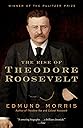
The Rise of Theodore Roosevelt (Modern Library (Paperback))
Product ID: 1609967
🏆Pulitzer & Nat'l Book Award winner
📚14 authored books by TR
⚔️Led Rough Riders in Spanish-American War
Desertcart purchases this item on your behalf and handles shipping, customs, and support to South Africa.
📖 Dive into the ultimate rise of a legend—don’t miss the biography that everyone’s talking about!
The Rise of Theodore Roosevelt by Edmund Morris is a Pulitzer Prize-winning biography that chronicles the extraordinary life of the 26th U.S. President. From overcoming childhood frailty to leading the Rough Riders and transforming American politics, this definitive and engaging narrative captures Roosevelt’s multifaceted legacy with unmatched depth and style. A must-read for history buffs and leaders seeking inspiration.
| Best Sellers Rank | #17,066 in Books ( See Top 100 in Books ) #37 in US Presidents #37 in Public Affairs & Policy Politics Books #117 in Military History (Books) |
| Customer Reviews | 4.7 out of 5 stars 3,474 Reviews |
J**E
The Romantic Roosevelt Who Doggedly Courted Alice Hathaway Lee
I wanted to learn more about the character of the presidents of the United States and selected "The Rise of Theodore Roosevelt" by Edmund Morris because Morris won the Pulitzer Prize and received rave reviews for this biography. Mark Deakins, a most excellent narrator, held my interest for more than twenty-six hours. I loved how Deakins crisply enunciated Roosevelt’s speeches in Chapter 6 as Roosevelt the assemblyman’s “teeth would knock together as the words fought their way out.” Deakins expertly spat out each word and syllable in his narration, and I visualized fellow assemblymen stepping back and out of the line of fire of Roosevelt’s words hurled from the corner of his lips. Morris evoked my compassion toward Roosevelt in numerous chapters where I learned how much of Roosevelt’s life included overwhelming struggles against asthma, stuttering, sickliness, and, in many respects, his own quick-thinking mentality and tendency to unload his opinion on occasion, before moments of long-suffering reflection. Because Roosevelt was a man of action, his can-do spirit gave me renewed strength against struggles that hitherto appeared enormous, until I compared them to the struggles of this great politician. Throughout the historical narration, I learned a great deal about Theodore Roosevelt that I had never discovered and, much to my delight, understood why so many fellow leaders and acquaintances admired his determination, hard work, and sheer resolve against all odds. What I thought of this book is well beyond the scope of a short book review. In Morris’s work, I had the privilege of spending quality time with a masterful researcher who not only included an extensive appendix of research notes and documentation, but also took me on horseback rides through the Badlands, up mountains, and on hunting trips for buffalo; introduced me to The Saga of King Olaf by Longfellow; and allowed me to sit next to Roosevelt as the young boy and man cataloged hundreds of insect and animal species as a naturalist and pioneer of zoological studies. Moreover, I learned about the romantic Roosevelt who doggedly courted Alice Hathaway Lee. He took her for horse-drawn dog-cart rides where she sat perched beside him, and they frequently played tennis and danced together. If you like historical biographies, narratives, and character transformation, "The Rise of Theodore Roosevelt" by Edmund Morris may be an excellent choice. Other insightful historical reads include "The Narnian: The Life and Imagination of C. S. Lewis" by Alan Jacobs and "Surprised by Joy: The Shape of My Early Life" by C. S. Lewis. If you also enjoy historical fiction, I recommend "The Women," "The Nightingale," "The Great Alone," and "The Four Winds" by Kristin Hannah; and "Alaska" by James A. Michener.
M**S
"When the wolf rises in the heart..."
Theodore Roosevelt... Harvard graduate, historian, New York state assemblyman; rancher, Civil Service Commissioner, New York City Police Commissioner, Assistant Secretary of the Navy; Commanding officer of the "Rough Riders;" war hero; Governor of New York; Vice President, and then President of the United States. All of these accomplishments by the time this extraordinary man reached 42 years of age. Theodore Roosevelt's historical achievements are indeed most impressive! In his Pulitzer Prize-winning biography "The Rise of Theodore Roosevelt," biographer Edmund Morris masterfully chronicles the life of this mercurial, complex, and paradoxical man who became the 26th President of the United States. Morris's brilliant narrative depicts Theodore Roosevelt as a man who towered over his world. Yet who would have guessed at future greatness for this, the oldest son of one of New York's wealthiest and most respected families? A sickly child, afflicted with constant bouts of asthma and chronic diarrhea, he is seen by his parents as a child "with the mind, but not the body..." for high achievement. But the young Roosevelt senses his own potential for greatness and resolves to strive mightily to achieve it... Throughout his life, TR is a man of many paradoxes. Largely self-educated, he eventually attends Harvard University, from which he graduates magna cum laude in 1880 with a Phi Beta Kappa key in one hand and a membership in Porcellain, Harvard's most prestigious social club, in the other. The son of a wealthy philanthropist, he eschews the traditional, genteel, upper-class lifestyle in favor of the rough-and-tumble of New York politics. A member of the Republican party, he champions progressive reform. By age 26, he has served two terms in the New York state assembly; has earned the begrudging respect of his colleagues; and has authored several significant pieces of reform legislation. After the death of his first wife, Alice Lee Hathaway Roosevelt, and his mother, Mittie (both women die on the same day, in the same house) TR flees New York, heading to the harsh, uncompromising Dakota Badlands to earn his living as a cattle rancher and writer of history books. Here, in this barren country, a startling transformation takes place. The thin, sickly youth of sallow skin and frail constitution becomes the muscular, tanned, robustly healthy man known to history. "The Rise of Theodore Roosevelt" vividly demonstrates how this intensely energetic politician used his forceful personality in the cause of badly needed reform at all levels of American government. As Morris points out, Roosevelt puts his personal stamp on nearly everything he undertakes. As Civil Service Commissioner during the Harrison administration, he publicly - some say bumptiously - investigates claims of graft and corruption within the Civil Service. He alienates many colleagues, but achieves lasting results. During his tenure, the Civil Service expands dramatically, despite fierce political opposition. The same holds true for TR's tenures as president of the New York City Police Commission (1895-97) and Assistant Secretary of the Navy (1897-98.) In 1898 a series of unexpected events propels TR to national prominence. When war breaks out between the United States and Spain, TR asks for and receives commission in the New York National Guard. Soon he has assembled a tough group of cavalrymen called the "Rough Riders" - friends from his days at Harvard and in the old west. On July 1, 1898, TR and his grizzled band of soldiers will enter the pantheon of American heroes at a place in Cuba called San Juan Hill... After the Spanish-American War, TR returns to New York and runs for Governor. After a tough, closely fought campaign that features former "Rough Riders" endorsing their candidate, TR is elected by a razor-thin margin of 18,000 votes out of nearly 1.1. million votes cast. TR will only spend a year in the governor's mansion, though. By 1900, New York's "old pols" have had enough of Roosevelt's attempts to force progressive reforms through a recalcitrant, conservative New York legislature. Considering TR "too dangerous" to keep on as governor, they make an arrangement to get Roosevelt on the national ticket. McKinley agrees, and an Roosevelt enthusiastically becomes McKinley's running mate. In November 1900, McKinley easily wins re-election and Theodore Roosevelt becomes Vice President of the United States. Ten months later, on September 6, 1901, at the Pan-American Exposition in Buffalo, New York, President William McKinley is gunned down by a young anarchist... Not since I read William Manchester's two-volume "The Last Lion" biography of Winston Churchill have I read a book that's as good as "The Rise of Theodore Roosevelt." Make no mistake: this book is as good as biography gets! Here is the powerfully eloquent story of one of the most gifted and controversial men of the twentieth century, and perhaps even of all time. "The Rise of Theodore Roosevelt" reads almost like a novel. I haven't found a single part of this book that I would classify as "dry" or boring. In fact I found it pretty hard to put down once I started reading it. Part of the reason for that, I suppose, is because TR's life was so darned fascinating to begin with; but give Edmund Morris his due. He has told the story of Theodore Roosevelt with tremendous style and panache. "The Rise of Theodore Roosevelt" is a fair and balanced biography, although Edmund Morris displays an obvious affection for his subject. Morris combines an intellectually stimulating and literate historical narrative with brilliantly insightful historical analysis. Roosevelt's less attractive qualities - his impulsiveness, his emotionalism, and his attempts at self glorification among others - all receive full coverage in this masterful book. Edmund Morris has written an extremely readable, highly entertaining, and factually sound biography. In "The Rise of Theodore Roosevelt," he completely captures the essence of this towering early twentieth century figure, making him totally relevant to today's readers. "The Rise of Theodore Roosevelt" is a biography that's indeed very well worth reading!
O**S
An Intriguing read, well written
Teddy Roosevelt is one of the most charismatic people to have taken the office of the President. This well written biography covers the years that would mold him into the man who would take the Presidency by the hand and lead it into the 20th century. As a budding critic of historical analysis, the book seems to me to be fair in its treatment and reveals much of the duality that developed in Theodore Roosevelt's policies and world views. Morris paints a picture of a man who knows the power of the people and sought to understand those values as to shape a new image of America in the 20th century. His meteoric rise is not as meteoric as a brief view of history would lead us to believe, but it still was an aggressive and rapid ascent up the ladder of political power. A very good read and I would suggest it to those who would understand Theodore Roosevelt or the culture of America during the turn of the 20th century.
S**.
Roosevelt the Inspirational Man and Leader
There's a lot to like here...this is a very well-written book. 770+ pages is not quick to read, but the reading is easy. The author doesn't challenge the reader with many ponderous questions and perhaps the subject doesn't either. Roosevelt is a straightforward dude (he's even called a 'dude' in some places, leading me to be surprised they used such language in the 1800's). What I liked most about this book is the inspirational character himself. Roosevelt was a stand-up guy who almost always did (or tried to do) the right thing. The fact that he was often successful just highlights his moral qualities. His failures too - and there were many - make him simultaneously more human and relatable. As a 38 year old writing this review I found myself thinking: I don't think we've ever had a truly GREAT president in my life time. Without getting political, I know Reagan and Clinton and Obama have their admirers...but were any of them truly inspirational characters? Personally I haven't felt it. Roosevelt makes you FEEL the inspirational quality. Not just his moral character, which was very strong, but his numerous actions, and the way he lived his life, and the things he did, whether you agree with them or not (such as killing for sport), was very inspirational. I found myself wondering about other past presidents I know little about and how I'd like to learn more about their lives too, especially George Washington who is such a revered (and yet unknown) president. You do learn a bit about some past presidents in this book as well including Grover Cleveland and William McKinley and Benjamin Harrison. Harrison was the worst of the three, although Cleveland wasn't much better (although he seems to have been very clever). McKinley was probably the best president of the three, but certainly not a stellar figure. The book doesn't talk at all about Roosevelt as president (hence, 'the rise of'), so we don't get to learn about what he actually did as the boss man in this massive tome. So that was a bit of a disappointment, but certainly not a reflection on the quality of the book itself. The book is VERY detailed and sometimes I found myself getting a bit bored with some of the details of passing legislation as Roosevelt the assemblyman, and those kinds of things, but you can skim the book in parts and still get a very vivid idea of the man. Honestly I didn't skim as much of the book as I could have just because it was mostly so interesting to me, but it would certainly be possible if you wanted to save time. I recommend this book if you want to learn about one of the truly great Americans that ever lived. If you want to be inspired to live your life to the fullest and to maximize your potential, well this book is a detailed examination of how to make that happen - more so than any self-help guide on the matter in my opinion.
I**N
Fantastic. Would Make for a Great History Course
I never truly understood what a great man Roosevelt was or why until I read this book. While the early going is a little slow (i.e. his childhood years) and redundant in spots, once he reaches young adulthood the story takes off and all I can say is, if you're not taken in by this man's Character and what I'd call his "constructive aggressiveness" then maybe historical books aren't for you. : ) It's not difficult at all to understand (especially when taken in combination with later accomplishments described in the 2nd volume) how Roosavelt ended up on Mt. Rushmore, even though he came along so much later than the other three. He did a tremendous amount of good for this country and struck a balance arguably never before achieved and never achieved since, acting both as a someone who helped businesses and the country to grow and expand, and who helped protect workers, consumers, and so many of our natural resources. A hunter who understood the value of preserving wild resources, a fighter who always let fighting be his last resort (self-education and finding means of cooperation were his main weapons)... ...I would say the best thing that could happen to America today, would be a man or woman in the mold of TR, refusing to go along with all the nonsense narratives about "pro business is anti-social and pro social is anti-business", who is religious but not interested in using the office as a religious platform, and lead through strength, wisdom and compromise. This type of person would have wide appeal to both Democrats and Republicans (and let's acknowledge that whatever Trump is, he's not a Republican and whatever Bernie Sanders and AOC and their type are, they're not Democrats). In fact I believe such a person would not even claim a party, seeing what those parties have become, inflexible and toxic. For sure he was not perfect; like all of us he was a product of the age in which he lived. This meant while he did not believe in social Darwinism and was not a racist by any reasonable definition, he did have some flaws that today we'd categorize as an acquired bias (from his parents and society) towards non-whites. But he nevertheless openly stated the obvious fact that a person's childhood environment and opportunities makes all the difference, that there were men and women of color who if they had been given the same chances he had as a boy, could be just as successful and worthy of everyone's respect. Put another way, he believed in competition and rewarding those who excel, but understood clearly it only meant something if everyone who's being "evaluated" by society started from the same place. And he openly acknowledged that was not happening for some groups. At any rate a great man, a very interesting man and life story, and extremely well researched and written. Highly recommended.
L**O
Like a novel
This is an insanely good biography. I love biographies, and this may be the best one I have ever read. It reads more like a novel, and you cannot resist being constantly inspired by Roosevelt's charisma. I sent it over to a friend because I liked it so much. There are a few dry sections throughout the book, FAR less than other biographies. 75% of the book was page-turner quality that just left you wanting to know more about Roosevelt's life. He was truly a larger-than-life person who only comes around every once in awhile. It was a bit melancholy to read as it really put today's politics and patriotism in the spotlight since you would be VERY hard pressed to name a politician with a more hopeful outlook for America and more committed to making the country a better place than Roosevelt in the last few decades. Part of that is the country becoming more mature and taking on the role Roosevelt dreamt of, and part of that is the desire of talented, intelligent dooers seeking to take their talents into industry as the public spotlight in politics is a very, very tough one to live under today. Overall, I really enjoyed this book and plan on reading the whole trilogy (I believe) as Theodore is truly one of the most interesting biographies I have read and I am fascinated to learn how his rise compares to his time as president, and then his "fall". And no, this book does NOT cover Teddy's time as president, rather, everything up until that point. That is something I did not know going into the book that didn't really change anything for me. I was pretty bummed when I finished the book though, when it was only around 75% done on my Kindle because the rest of the book was footnotes! That caught me by surprise but you couldn't write a better ending. I just wanted to keep going.
G**M
Very good
Listened to this on way to Theodore Roosevelt presidential library. Great way to fully understand TR.
M**S
Wow, do I love reading about Teddy
Wow, do I love reading about Teddy Roosevelt. He is such an inspirational and interesting character. This is a very good book, and I’m very happy to be reading this series. But allow me to warn you, it is quite an investment. This book is about 1,000 pages, and it’s only volume 1 of 3! I do wish that we had delved deeper into TR’s Governorship and I guess there’s really very little to say about his Vice Presidency, but I am looking forward to starting volume 2 in a week or two!
R**A
Excellent
There's a recent trend - perhaps a wave - of books on stoicism. With the help of social media, some authors have made a career only of divulging the matter. Ryan Reynolds and James Clear, to name just two writers, come to mind. The only problem is that 90% of the content of said authors has already been written, and their books are a melange of what the stoics originally wrote, only edited (often poorly), revisited and repeated. And then Mr Reynolds and Mr Clear books sell by the million, but when a superb edition of the complete works of Epictetus (a key Stoic who hugely inspired Marcus Aurelius and Seneca) was issued quite recently - 2022 -, it received almost no attention and sold poorly. The point I'm making is that to really know the Stoics it is better to read and study them directly. Or to read books like this one, "The Rise of Theodore Roosevelt". At almost 1,000 pages it makes for a harder read than those "Wisdom of the Stoics" platitudes I mentioned before, but it is far more rewarding, and worthy. It is, in the end, a true lesson of life. It is the life of a true Stoic. And then the book is superbly well written, with superb prose that at the same time watches every detail and paints the larger pictures. And it's set perfectly to the era: one can almost feel the USA at the end of the XIX century, right after the failed reconstruction, wiped away in large parts by cold storms, with the West still to explore and be won, and with the first magnates (Morgan, Rockefeller) defining and at the same time enlarging capitalism. To finish, I'll come back to my initial point: to learn how to lead a happy life, to gain control of yourself, etc., etc., read the Stoics first hand; or "The Rise of Theodore Roosevelt".
D**R
Excelente obra biografica
Edward Norris não poupou esforços para compilar a ascensão de "Teddy" - como ele não gostava de ser chamado por outros que não seu circulo mais intimo - em uma narrativa fluída e generosa em detalhes, todavia não cansativa. Ao final do livro ficamos na expectativa de continuar lendo e lendo e lendo.. Recomendo ao máximo.
J**S
Favourite biography ever
This three-part biography is my favourite non-fiction book ever. It blew my mind and I was riveted the whole time. I've recommended it even to people who don't typically read biographies and they've loved it (evident by their completion of all three volumes!). He was a super interesting man who had a super interesting life. He was a powerhouse of both mind and body, which is exceedingly rare. I can only boast of being a powerhouse of neither.
J**U
Makes you waking to live like he did, strong man.
Excellent, life changing
J**L
Good book
Long but good book
Trustpilot
2 weeks ago
2 months ago