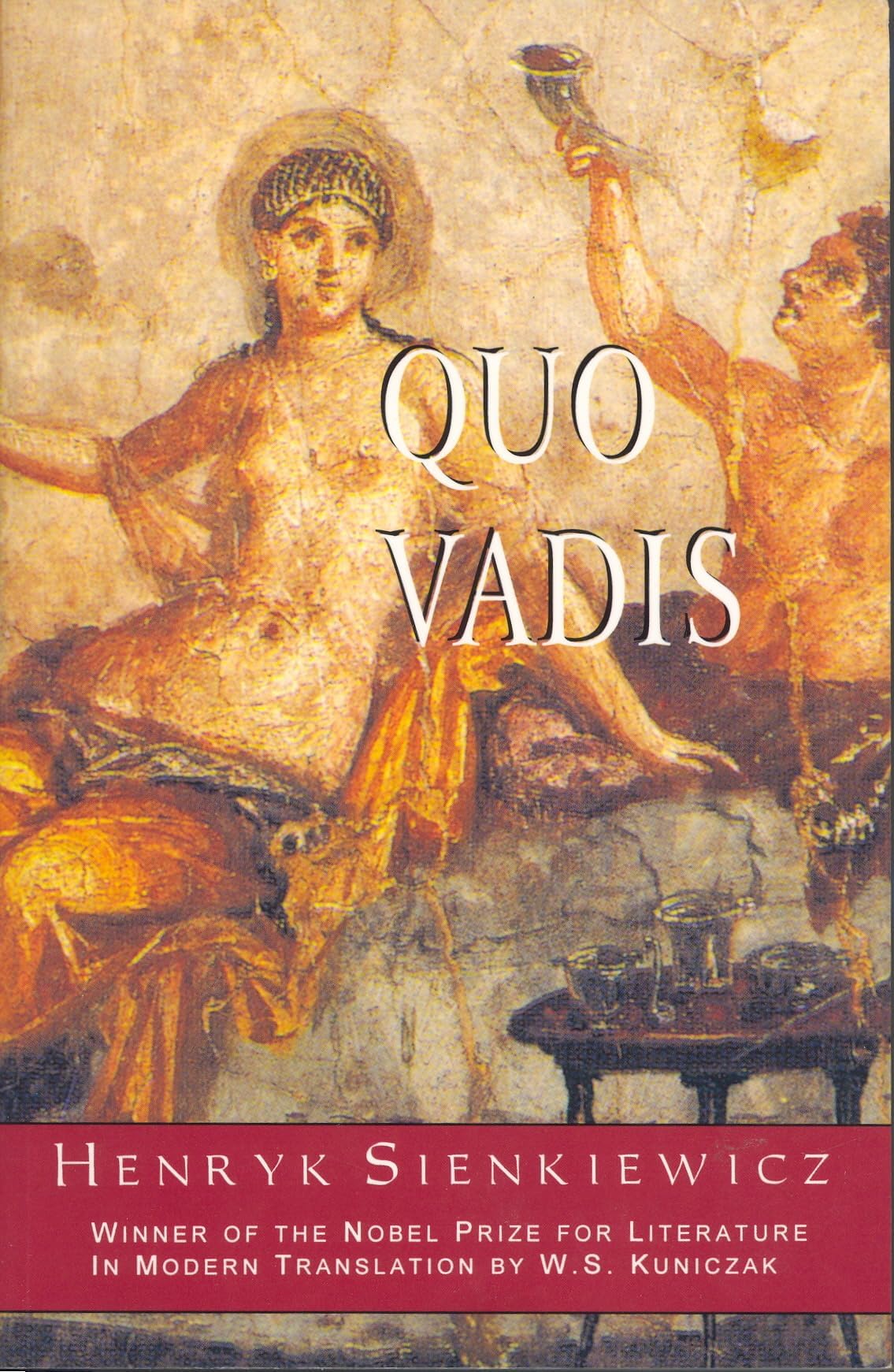
Quo Vadis
Product ID: 15252954
Desertcart purchases this item on your behalf and handles shipping, customs, and support to South Africa.
Quo Vadis [Sienkiewicz, Henryk, Kuniczak, W.S.] on desertcart.com. *FREE* shipping on qualifying offers. Quo Vadis Review: Fascinating... - First, I want to be clear about which edition of "Quo Vadis" I am reviewing here: it is the edition from Hippocrene Books, ISBN 0781805503, translated by W.S. Kuniczak. I spell this out because I believe the translation is of great importance. Kuniczak already cut his teeth with a splendid version of Sienkiewicz's "trilogy." I really ordered this book out of curiosity. "Quo Vadis" was the generally-accepted American view of Nero's Rome and the rise of Christianity when I was a boy: the mammoth film spectacle was released in 1951. Yet it seems pretty certain that the "narrative" presented by "Quo Vadis" --- "Christianity good, Roman paganism bad" --- is pretty much dead in the water (or, even worse, a laughingstock) by the early years of the 21st century. I was also curious to look at one of the very first global best-sellers: "Quo Vadis" was translated into 40 languages, and sold millions of copies. What surprised me was that reading just the first five or ten pages really hooked me. The book starts out as a passionate love story: the patrician pagan Vinicius, by all accounts a phenomenally handsome man who lives at the top of the pagan status-heap, is stricken by a fatal love-at-first-sight for a girl he does not even know. A few more pages, and canny readers will understand that the girl, Lygia, is a secret Christian --- and then you start wondering how all this is going to work out. Besides that, the novel's most memorable character is Petronius, who is master of the revels for the megalomaniac Nero. He is at first scornful of Vinicius's "total love" for Lygia, but he is a very intelligent (if cynical) man who is finally forced to admit that, in this case (as in others) Aphrodite and Eros are the supreme gods guiding human affairs. And then Sienkiewicz begins raising the question --- sometimes gently, and sometimes forcefully --- a question which boils down to "which side are you on?" Despite all of our sentimentality about "the grandeur of Rome," is it not finally self-evident that Rome had to be destroyed, and replaced? If you doubt that, then reflect on the massive amount of slavery, tyranny, sadism, and cruelty which was the daily fare in Rome. Even if you have only seen "Gladiator," you have a good idea of what the Romans considered to be a good show --- men and beasts slaughtering one another to entertain the masses. Sienkiewicz also provides good insights into pagan philosophy (mostly via Petronius). On the other side, you meet the secret and persecuted community of Christians, along with memorable portraits of St. Peter and St. Paul. In sum: I found this to be a fascinating and very well researched historical novel. Biased? Of course it's biased. Everyone who picks this book up will probably be biased as well. But biased towards which side? :-) If you are a fan of Gibbon's "Decline and Fall of the Roman Empire," this is probably a good volume to read at the same time. And it's a fascinating story. Review: That Greater Love - At no time in the annals of human history has there ever been any achievement to equal, let alone surpass, the growth and development of Christianity. Nor has there been any writer able to describe more vividly and accurately its emergence and steady momentum just thirty years after the death and Resurrection "of a certain man whose growing number of adherents to a new religious sect in Rome increased daily during the despotic reign of emperor Nero, and whose followers considered him as God" than the Polish historian, Henryk Sienkiewicz for his powerful work entitled "Quo Vadis." Having received the Nobel Prize for literature in 1905, this man's remarkable book has been translated into more than forty languages. The book tells of the love that developed between Marcus Vinicius, a Roman patrician, and Lygia, a young Christian girl. And so much more! What was particularly noteworthy was how Vinicius' love for Lygia gradually led him to a greater love for God. This all begins when, for the first time, Vinicius "saw people calling on a divinity with hymns -- not to carry out a fixed ritual, but calling from the bottom of the heart, with the genuine yearning which children might feel for a father or a mother. One had to be blind not to see that those people not only honored their God, but loved Him with the whole soul." (p. 124) Then after listening to Peter, a fisherman, the foremost disciple of Christ, the head of this new sect, Vinicius, "sunk in listening" with the crowd of listeners, was told that "not that he would have peace during life, but that he might live eternally with Christ after death, in such joy and such glory, in such health and delight, as no one on earth had attained at any time. (p. 125) His greatest astonishment came when Peter "declared that God was universal love also; hence he who loves men fulfills God's supreme command. It is not enough to love men of one's own nation, for the God-man shed his blood for all, and found among pagans such elect of his as Cornelius the Centurian; it is not enough either to love those who do good to us, for Christ forgave the Jews who delivered Him to death, and the Roman soldiers who nailed Him to the cross; we should not only forgive but love those who injure us, and return them good for evil; it is not enough to love the good, we must love the wicked also, since by love alone is it possible to expel from them evil." To the patrician this was madness. "But at the same time he had a feeling that in that madness itself there was something mightier than all philosophies so far. He thought that because of its madness it was impracticable, but because of its impracticability it was divine." (p, 126) But he soon realized that the love that Lygia had for him would never be enough for her to sacrifice any of her Christian truths for him. When the patrician saw that her religion was what separated him from her "he hated it with all the powers of his soul." (p.167) However, after admitting to himself that it was her religion that "adorned Lygia with that exceptional unexplained beauty which in his heart produced, besides love, respect, besides desire and homage, a being dear to him beyond all others in the world," he could no longer remain indifferent. Much of the indifference was dispelled by the way in which he saw how the Christians lived their ordinary daily lives: "See how they love one another," the pagans would say. He noticed that the followers of this new religion despised falsehood so much and were too trustworthy to let him suppose that they were telling him things that had not happened such as Christ's supernatural origin, His resurrection and other miracles. (167) Later contacts with Christians, not the least of whom were Peter and Paul of Tarsus, had "put into the soul" of Vinicius new principles which, not the least for him, was perhaps the "desire for religion for its own sake through love of Christ, not for other objects." (p. 177) It was not long after, that he was moved by both his reason and his heart --two such forces that proclaimed to him that this new religion was divine -- to seek and attain baptism l Henceforth, all that Vinicius did he did for the greater honor and glory of God, not the least of which was a life and love he cherished for Lygia and the same life and love that she had for him: " life to love and cherish each other, to look at the sea together, to look at the sky together, to honor together a kind God, to do in peace what is just and true." ( P. 226) I leave to the reader to relish the other numerous selections that are his or hers to enjoy as they delve into this classic work.
| Best Sellers Rank | #175,308 in Books ( See Top 100 in Books ) #378 in Christian Historical Fiction (Books) #2,969 in Classic Literature & Fiction #6,368 in Literary Fiction (Books) |
| Customer Reviews | 4.5 4.5 out of 5 stars (449) |
| Dimensions | 6.25 x 1.25 x 9.25 inches |
| Edition | Revised |
| ISBN-10 | 0781805503 |
| ISBN-13 | 978-0781805506 |
| Item Weight | 2.31 pounds |
| Language | English |
| Print length | 589 pages |
| Publication date | May 1, 1997 |
| Publisher | Hippocrene Books |
G**H
Fascinating...
First, I want to be clear about which edition of "Quo Vadis" I am reviewing here: it is the edition from Hippocrene Books, ISBN 0781805503, translated by W.S. Kuniczak. I spell this out because I believe the translation is of great importance. Kuniczak already cut his teeth with a splendid version of Sienkiewicz's "trilogy." I really ordered this book out of curiosity. "Quo Vadis" was the generally-accepted American view of Nero's Rome and the rise of Christianity when I was a boy: the mammoth film spectacle was released in 1951. Yet it seems pretty certain that the "narrative" presented by "Quo Vadis" --- "Christianity good, Roman paganism bad" --- is pretty much dead in the water (or, even worse, a laughingstock) by the early years of the 21st century. I was also curious to look at one of the very first global best-sellers: "Quo Vadis" was translated into 40 languages, and sold millions of copies. What surprised me was that reading just the first five or ten pages really hooked me. The book starts out as a passionate love story: the patrician pagan Vinicius, by all accounts a phenomenally handsome man who lives at the top of the pagan status-heap, is stricken by a fatal love-at-first-sight for a girl he does not even know. A few more pages, and canny readers will understand that the girl, Lygia, is a secret Christian --- and then you start wondering how all this is going to work out. Besides that, the novel's most memorable character is Petronius, who is master of the revels for the megalomaniac Nero. He is at first scornful of Vinicius's "total love" for Lygia, but he is a very intelligent (if cynical) man who is finally forced to admit that, in this case (as in others) Aphrodite and Eros are the supreme gods guiding human affairs. And then Sienkiewicz begins raising the question --- sometimes gently, and sometimes forcefully --- a question which boils down to "which side are you on?" Despite all of our sentimentality about "the grandeur of Rome," is it not finally self-evident that Rome had to be destroyed, and replaced? If you doubt that, then reflect on the massive amount of slavery, tyranny, sadism, and cruelty which was the daily fare in Rome. Even if you have only seen "Gladiator," you have a good idea of what the Romans considered to be a good show --- men and beasts slaughtering one another to entertain the masses. Sienkiewicz also provides good insights into pagan philosophy (mostly via Petronius). On the other side, you meet the secret and persecuted community of Christians, along with memorable portraits of St. Peter and St. Paul. In sum: I found this to be a fascinating and very well researched historical novel. Biased? Of course it's biased. Everyone who picks this book up will probably be biased as well. But biased towards which side? :-) If you are a fan of Gibbon's "Decline and Fall of the Roman Empire," this is probably a good volume to read at the same time. And it's a fascinating story.
R**R
That Greater Love
At no time in the annals of human history has there ever been any achievement to equal, let alone surpass, the growth and development of Christianity. Nor has there been any writer able to describe more vividly and accurately its emergence and steady momentum just thirty years after the death and Resurrection "of a certain man whose growing number of adherents to a new religious sect in Rome increased daily during the despotic reign of emperor Nero, and whose followers considered him as God" than the Polish historian, Henryk Sienkiewicz for his powerful work entitled "Quo Vadis." Having received the Nobel Prize for literature in 1905, this man's remarkable book has been translated into more than forty languages. The book tells of the love that developed between Marcus Vinicius, a Roman patrician, and Lygia, a young Christian girl. And so much more! What was particularly noteworthy was how Vinicius' love for Lygia gradually led him to a greater love for God. This all begins when, for the first time, Vinicius "saw people calling on a divinity with hymns -- not to carry out a fixed ritual, but calling from the bottom of the heart, with the genuine yearning which children might feel for a father or a mother. One had to be blind not to see that those people not only honored their God, but loved Him with the whole soul." (p. 124) Then after listening to Peter, a fisherman, the foremost disciple of Christ, the head of this new sect, Vinicius, "sunk in listening" with the crowd of listeners, was told that "not that he would have peace during life, but that he might live eternally with Christ after death, in such joy and such glory, in such health and delight, as no one on earth had attained at any time. (p. 125) His greatest astonishment came when Peter "declared that God was universal love also; hence he who loves men fulfills God's supreme command. It is not enough to love men of one's own nation, for the God-man shed his blood for all, and found among pagans such elect of his as Cornelius the Centurian; it is not enough either to love those who do good to us, for Christ forgave the Jews who delivered Him to death, and the Roman soldiers who nailed Him to the cross; we should not only forgive but love those who injure us, and return them good for evil; it is not enough to love the good, we must love the wicked also, since by love alone is it possible to expel from them evil." To the patrician this was madness. "But at the same time he had a feeling that in that madness itself there was something mightier than all philosophies so far. He thought that because of its madness it was impracticable, but because of its impracticability it was divine." (p, 126) But he soon realized that the love that Lygia had for him would never be enough for her to sacrifice any of her Christian truths for him. When the patrician saw that her religion was what separated him from her "he hated it with all the powers of his soul." (p.167) However, after admitting to himself that it was her religion that "adorned Lygia with that exceptional unexplained beauty which in his heart produced, besides love, respect, besides desire and homage, a being dear to him beyond all others in the world," he could no longer remain indifferent. Much of the indifference was dispelled by the way in which he saw how the Christians lived their ordinary daily lives: "See how they love one another," the pagans would say. He noticed that the followers of this new religion despised falsehood so much and were too trustworthy to let him suppose that they were telling him things that had not happened such as Christ's supernatural origin, His resurrection and other miracles. (167) Later contacts with Christians, not the least of whom were Peter and Paul of Tarsus, had "put into the soul" of Vinicius new principles which, not the least for him, was perhaps the "desire for religion for its own sake through love of Christ, not for other objects." (p. 177) It was not long after, that he was moved by both his reason and his heart --two such forces that proclaimed to him that this new religion was divine -- to seek and attain baptism l Henceforth, all that Vinicius did he did for the greater honor and glory of God, not the least of which was a life and love he cherished for Lygia and the same life and love that she had for him: " life to love and cherish each other, to look at the sea together, to look at the sky together, to honor together a kind God, to do in peace what is just and true." ( P. 226) I leave to the reader to relish the other numerous selections that are his or hers to enjoy as they delve into this classic work.
L**A
All time favourite...gave it as a gift and now everyone wants one :) fascinating love story in a troubled historical time. Truly engaging even for non Christians
G**Z
ESTE LIBRO LO SOLICITE EN ESPAÑOL, ME LO ENVIARON EN INGLES. Que posibilidad habrá para que me lo enviaran en español.
M**R
Wonderful story, beautifully executed, full of remarkable portraits of different extremes in human nature, and a breath-taking accomplishment of seeking (and achieving) accuracy in historical fiction. It is an exquisite portrayal of the radical clash between the pre-Christian world and Christendom. Truly, an exceptional product.
F**D
This film seeks to give us some idea of what faced Christians in early Church history.
P**C
Found this a truly excellent read. As another reviewer points out in almost forecasts the horrors of ethnic cleansing, mass destruction and conflict on a grand scale. The juxtaposition between decadent Romans and spiritual Christian is deliberatley depicted as a yawning gap. Petronius acts as a conduit between both sides and in many ways is the moral judge of both groups. The pace of the novel is gripping and engaging, the language enthralls and when Ursus defeats the beast in the arena one can almost hear its' neck crack. Would thoroughly recommend this book and having seen the film version with Robert Taylor and Peter Ustinov which in itself is reasonably entertaining, I would have to say that on this occasion the book definitely surpasses the film!
Trustpilot
1 week ago
1 day ago