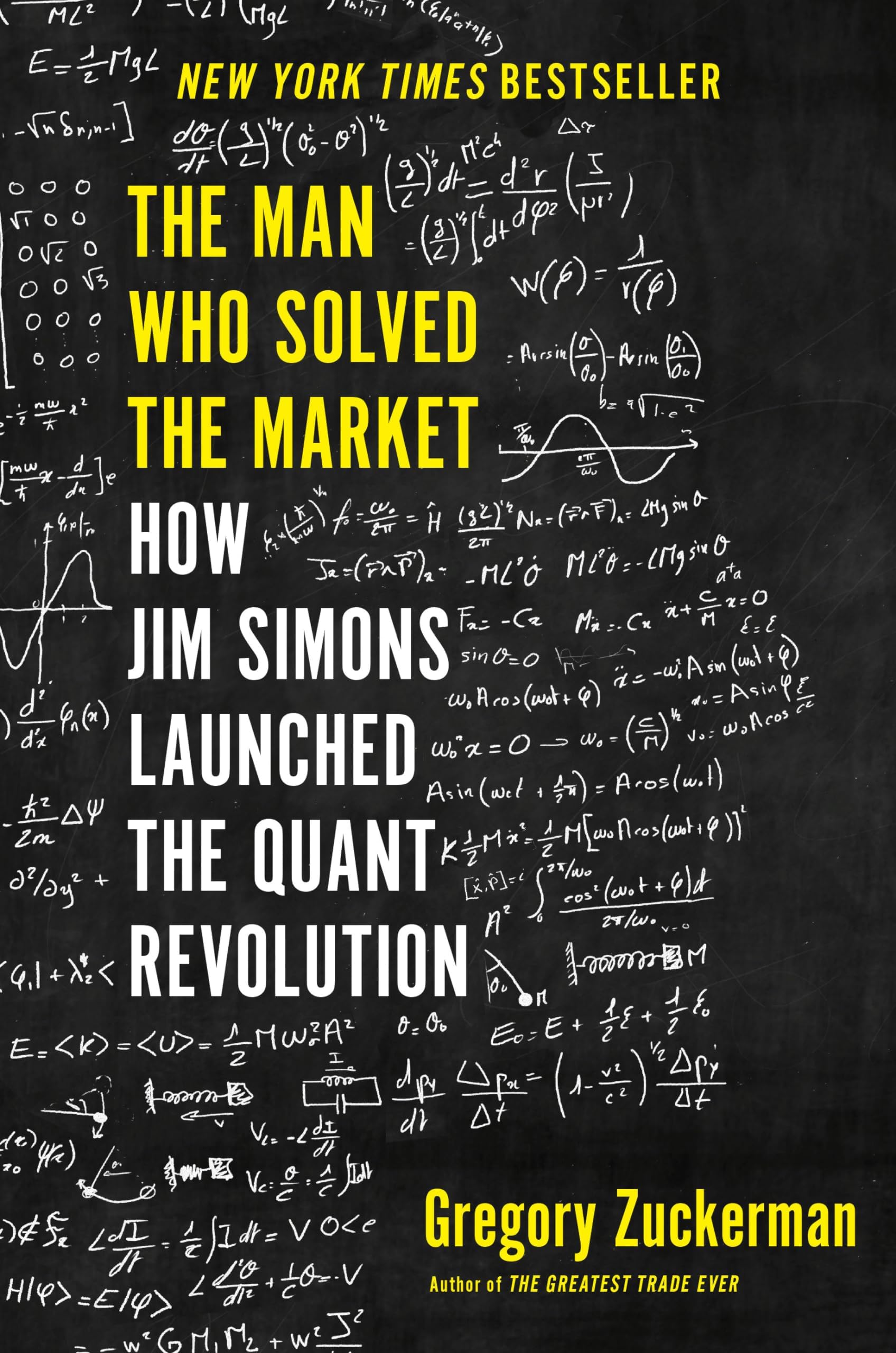
The Man Who Solved the Market: How Jim Simons Launched the Quant Revolution
Product ID: 141312597
Desertcart purchases this item on your behalf and handles shipping, customs, and support to South Africa.
NEW YORK TIMES BESTSELLER Shortlisted for the Financial Times /McKinsey Business Book of the Year Award The unbelievable story of a secretive mathematician who pioneered the era of the algorithm–and made $23 billion doing it. The greatest money maker in modern financial history, no other investor–Warren Buffett, Peter Lynch, Ray Dalio, Steve Cohen, or George Soros–has touched Jim Simons’ record. Since 1988, Renaissance’s signature Medallion fund has generated average annual returns of 66 percent. The firm has earned profits of more than $100 billion, and upon his passing, Simons left a legacy of investors who use his mathematical, computer-oriented approach to trading and building wealth. Drawing on unprecedented access to Simons and dozens of current and former employees, Zuckerman, a veteran Wall Street Journal investigative reporter, tells the gripping story of how a world-class mathematician and former code breaker mastered the market. Simons pioneered a data-driven, algorithmic approach that’s swept the world. As Renaissance became a market force, its executives began influencing the world beyond finance. Simons became a major figure in scientific research, education, and liberal politics. Senior executive Robert Mercer is more responsible than anyone else for the Trump presidency, placing Steve Bannon in the campaign and funding Trump’s victorious 2016 effort. Mercer also impacted the campaign behind Brexit. The Man Who Solved the Market is a portrait of a modern-day Midas who remade markets in his own image, but failed to anticipate how his success would impact his firm and his country. It’s also a story of what Simons’s revolution will mean for the rest of us long after his death in 2024. Review: Great book that revealed many secrets of Simons’s unprecedented success - I have been live-trading, with my Fidelity IRA account, using the signals generated by the models as introduced in Forecasting and Timing Markets: A Quantitative Approach (ASIN:B0875JBWBQ ). Started from March 09 this year, I have achieved a net profit of 24.54% as of April 24, which is impressive given the market volatility induced by the COVID-19. Coincidentally, I learned from an online post that Simons’s Medallion Fund also achieved an over 24% return during this same period of time. I was motivated to find out more about his Medallion Fund and thus bought this book. I eagerly read through the entire book so that I could assess how different his quantitative approach is against the AlphaCovaria System I have been relying on as mentioned above. I am so grateful for Mr. Zuckerman who dug out so many details about how Simons’s models have been built. Here is a summary of what I have learned from a quantitative trader’s perspective: (1) First, a little background. While at IDA during his earlier career, Simons and his colleagues wrote a research paper that determined that markets existed in various hidden states that could be identified with mathematical models. At IDA, they built computer models to spot "signals" hidden in the noise of the communications of the United States' enemies. This was the precursor to Simons’s later persistent pursuit to testing the approach in real life. (2) Performance-wise, Simons has been the most successful one in trading, given the performance comparisons of this list: Jim Simons (Medallion) 39.1%, George Soros (Quantum Fund) 32%, Steven Cohen (SAC) 30%, Peter Lynch (Magellan Fund)29%, Warren Buffett (Berkshire Hathaway) 20.5%, and Ray Dalio (Pure Alpha) 12%. One of the factors that Simons could succeed so much is that he is a strongly principled person with a strong belief in "Work with the smartest people you can, hopefully, smarter than you... be persistent, don't give up easily." So he is not only a great mathematician but also a great visionary and business manager. (3) Their model dev process: By 1997, Medallion's staffers had settled on a three-step process to discover statistically significant moneymaking strategies, or what they called their trading signals: (1) Identify anomalous patterns in historic pricing data, (2) make sure the anomalies were statistically significant, consistent over time, and nonrandom , and (3) see if the identified pricing behavior could be explained in a reasonable way. (4) Trading frequency: Medallion made between 150,000 and 300,000 trades a day, but much of that activity entailed buying or selling in small chunks to avoid impacting the market prices. (5) Data granularity: They use five-minute bars as the ideal way to carve things up. Their data hunter Laufer's five-minute bars gave the team the ability to identify new trends, oddities, and other phenomena, or, in their parlance, nonrandom trading effects. (6) Holding period: Medallion still held thousands of long and short positions at any time. Its holding period ranged from one or two days to one or two weeks. The fund did even faster trades, described by some as high-frequency, but many of those were for hedging purposes or to gradually build its positions. Renaissance still placed an emphasis on cleaning and collecting its data, but it had refined its risk management and other trading techniques. (7) Their performance as measured by Sharpe ratio. 1990s, Medallion had a strong Sharpe ratio of about 2.0, double the level of the S&P 500. But adding foreign-market algorithms and improving Medallion's trading techniques sent its Sharpe soaring to about 6.0 in early 2003, about twice the ratio of the largest quant firms and a figure suggesting there was nearly no risk of the fund losing money over a whole year. No one had achieved what Simons and his team had-a portfolio as big as $5 billion delivering this kind of astonishing performance. In 2004, Medallion's Sharpe ratio even hit 7.5, a jaw-dropping figure. Medallion had recorded a Sharpe ratio of 2.5 in its most recent five-year period, suggesting that the fund's gains came with low volatility and risk. (8) Their portfolio composition. They started with commodity, bond, and currency, but later expanded into equities, which became the major source of profits after many years of efforts. (9) Does Simons strictly stick to their models? In general, yes, but he made calls when he saw models were malfunctioning due to extreme market conditions. (10) How have their models worked under various market conditions? Their models are mostly neutral, which was made possible by making quick trades only to eliminate unforeseeable events. They claimed that they could make models that would work with long-term investments, but it seems that they have not done so. (11) What is the most secret juice with their models? Medallion found itself making its largest profits during times of extreme turbulence in financial markets. They believed investors are prone to cognitive biases, the kinds that lead to panics, bubbles, booms, and busts. "We make money from reactions people have to price moves." They look for smaller, short-term opportunities-get in and get out. The gains on each trade were never huge, and the fund only got it right a bit more than half the time, but that was more than enough. "We are right 50.75 percent of the time... but we're 100 percent right 50.75 percent of the time," Mercer told a friend. "You can make billions that way." (12) How long was their learning curve? Simons spent 12 full years searching for a successful investing formula, without much success until he and Berlekamp built a computer model capable of digesting torrents of data and selecting ideal trades, a scientific and systematic approach partly aimed at removing emotion from the investment process. (13) Size of their computing infrastructure. On page 248, it says their computer room was the size of a couple of tennis courts. I arrived at a guestimate that they might have about ~13,000 servers, computed like this: 2x78x27 (two tennis courts) x 0.6 (total area occupied by racks) / (2x4 (rack area)) x 40 (servers per rack) = 12,636. This should not be too far away from what they have. I strongly encourage every serious quant to read through the entire book for a lot of other secret juices. Review: Worthwhile Investment History - I enjoyed Mr. Zuckerman’s effort very much - it was a book I didn’t particularly want to put down and it makes for a fun and quick read. Think folks would do well to consider their perspectives/objectives for the book. I’m not primarily a professional money manager, have an M.S. in finance but no advanced training in complex mathematics. I think quantitative rules-based investing systems have significant value. I came to the book under no illusion that it was going to reveal any “secrets” that could be put into action and that held true. But I found it to be a nicely done history of quantitative investing & how technology enabled the scale and complexity. Here are some specific notes: 1. I’m not sure the title does justice to the book or to participants. There’s no doubting the obscenely amazing performance of the Medallion funds. Mr. SImons, as founder and CEO, certainly has earned a large place in financial history. But while the book does a terrific job communicating Mr. Simons’ early work as a cryptographer & his academic achievements in respect of geometers etc., it seems to describe a man who had a vision for how the market might be solved & drove the funding/infrastructure for realization - but not a man who actually developed the specifics of the fund’s model. It really seems to be several of the other key characters who poured endlessly over pricing history, identified & tested anomalies and wrote the algorithmic codes (beginning with commodities & fixed income, equities later on). 2. The author does a very good job, IMHO, of discussing concepts like factor investing, statistical arbitrage, paired trades, hedges, market neutral, etc. And he takes the time to nicely reference some of the underlying math for those who have the interest, touching on concepts ranging from differential equations to mean reversion to Brownian motion to embedded Markov processes. The author doesn’t purport to try and teach readers how they might use those ideas - appropriately so - but it’s meaningful perspective. 3. Not surprisingly, there’s a dichotomy re “how” the market was “solved.” There won’t be much new here for traders. At the broadest level of generality, certain pricing anomalies were identified & incorporated into algorithms that turned the raw data into trading signals. Harnessing computing power, the fund trades a ton, such that it doesn’t need to make much on each trade and only needs to get it right a bit over half the time - returns are then amplified by liberal employment of leverage; the systematic model is trained - application of machine learning - to continue to improve precision on its own and to determine trades/positions. Beyond that, though - & it shouldn’t be folks’ expectation- the book doesn’t go granular on the model’s inputs. It can’t and doesn’t give away the particulars of the black box. The author should be credited for his tackling of the funds’ initial problems with slippage and for reporting on how the funds had no choice but to move into equities in order to attain such massive AUM. Also great history on early and superior efforts to obtain/recreate pricing data & good discussion of the core fund’s preference for extremely short holding periods. 4. There’s some pretty riveting investing history here, ranging from early developments in technical analysis to the long and steady rise of fundamentals-based investing to the profound skepticism with which systematic quant trading was treated for an exceptionally long time. 5. The narrative is at times beautiful , at others choppy and abrupt. Probably too many cases of basically “the fund was in trouble” to “the fund was thriving”. It’s like, “oh, that’s good” 6. In terms of personal biography, my understanding is that Mr. Simons is intensely private - under those constraints, the author does well in tracing his life and career, though for me, a truly strong and well developed portrait remains elusive. The author comes closer to that mark in telling the stories of several of the other key participants in the firm’s rise over time. 7. Later in the book, a ton of space is devoted to Robert Mercer’s public politics and how it impacted the firm. I thought it was interesting stuff, but some may find it loses focus, e.g. there’s quite a bit on Rebekah Mercer that just doesn’t have much relation to the core story. This was an ambitious endeavor and Mr. Zuckerman should be credited for that. As personal biography, it’s s fine effort. As financial history, I’d characterize it as informative, accessible and entertaining. But I’m not sure I’d say it’s of huge importance. The telling of the story isn’t, in my view, likely to have any real impact on the methods and practice of finance. But for finance junkies, there’s a ton of on point info, perspective, teaching and fun. Thanks much to the author.


| Best Sellers Rank | #33,560 in Books ( See Top 100 in Books ) #45 in Biographies of Business & Industrial Professionals #68 in Finance (Books) |
| Customer Reviews | 4.5 out of 5 stars 5,328 Reviews |
Y**N
Great book that revealed many secrets of Simons’s unprecedented success
I have been live-trading, with my Fidelity IRA account, using the signals generated by the models as introduced in Forecasting and Timing Markets: A Quantitative Approach (ASIN:B0875JBWBQ ). Started from March 09 this year, I have achieved a net profit of 24.54% as of April 24, which is impressive given the market volatility induced by the COVID-19. Coincidentally, I learned from an online post that Simons’s Medallion Fund also achieved an over 24% return during this same period of time. I was motivated to find out more about his Medallion Fund and thus bought this book. I eagerly read through the entire book so that I could assess how different his quantitative approach is against the AlphaCovaria System I have been relying on as mentioned above. I am so grateful for Mr. Zuckerman who dug out so many details about how Simons’s models have been built. Here is a summary of what I have learned from a quantitative trader’s perspective: (1) First, a little background. While at IDA during his earlier career, Simons and his colleagues wrote a research paper that determined that markets existed in various hidden states that could be identified with mathematical models. At IDA, they built computer models to spot "signals" hidden in the noise of the communications of the United States' enemies. This was the precursor to Simons’s later persistent pursuit to testing the approach in real life. (2) Performance-wise, Simons has been the most successful one in trading, given the performance comparisons of this list: Jim Simons (Medallion) 39.1%, George Soros (Quantum Fund) 32%, Steven Cohen (SAC) 30%, Peter Lynch (Magellan Fund)29%, Warren Buffett (Berkshire Hathaway) 20.5%, and Ray Dalio (Pure Alpha) 12%. One of the factors that Simons could succeed so much is that he is a strongly principled person with a strong belief in "Work with the smartest people you can, hopefully, smarter than you... be persistent, don't give up easily." So he is not only a great mathematician but also a great visionary and business manager. (3) Their model dev process: By 1997, Medallion's staffers had settled on a three-step process to discover statistically significant moneymaking strategies, or what they called their trading signals: (1) Identify anomalous patterns in historic pricing data, (2) make sure the anomalies were statistically significant, consistent over time, and nonrandom , and (3) see if the identified pricing behavior could be explained in a reasonable way. (4) Trading frequency: Medallion made between 150,000 and 300,000 trades a day, but much of that activity entailed buying or selling in small chunks to avoid impacting the market prices. (5) Data granularity: They use five-minute bars as the ideal way to carve things up. Their data hunter Laufer's five-minute bars gave the team the ability to identify new trends, oddities, and other phenomena, or, in their parlance, nonrandom trading effects. (6) Holding period: Medallion still held thousands of long and short positions at any time. Its holding period ranged from one or two days to one or two weeks. The fund did even faster trades, described by some as high-frequency, but many of those were for hedging purposes or to gradually build its positions. Renaissance still placed an emphasis on cleaning and collecting its data, but it had refined its risk management and other trading techniques. (7) Their performance as measured by Sharpe ratio. 1990s, Medallion had a strong Sharpe ratio of about 2.0, double the level of the S&P 500. But adding foreign-market algorithms and improving Medallion's trading techniques sent its Sharpe soaring to about 6.0 in early 2003, about twice the ratio of the largest quant firms and a figure suggesting there was nearly no risk of the fund losing money over a whole year. No one had achieved what Simons and his team had-a portfolio as big as $5 billion delivering this kind of astonishing performance. In 2004, Medallion's Sharpe ratio even hit 7.5, a jaw-dropping figure. Medallion had recorded a Sharpe ratio of 2.5 in its most recent five-year period, suggesting that the fund's gains came with low volatility and risk. (8) Their portfolio composition. They started with commodity, bond, and currency, but later expanded into equities, which became the major source of profits after many years of efforts. (9) Does Simons strictly stick to their models? In general, yes, but he made calls when he saw models were malfunctioning due to extreme market conditions. (10) How have their models worked under various market conditions? Their models are mostly neutral, which was made possible by making quick trades only to eliminate unforeseeable events. They claimed that they could make models that would work with long-term investments, but it seems that they have not done so. (11) What is the most secret juice with their models? Medallion found itself making its largest profits during times of extreme turbulence in financial markets. They believed investors are prone to cognitive biases, the kinds that lead to panics, bubbles, booms, and busts. "We make money from reactions people have to price moves." They look for smaller, short-term opportunities-get in and get out. The gains on each trade were never huge, and the fund only got it right a bit more than half the time, but that was more than enough. "We are right 50.75 percent of the time... but we're 100 percent right 50.75 percent of the time," Mercer told a friend. "You can make billions that way." (12) How long was their learning curve? Simons spent 12 full years searching for a successful investing formula, without much success until he and Berlekamp built a computer model capable of digesting torrents of data and selecting ideal trades, a scientific and systematic approach partly aimed at removing emotion from the investment process. (13) Size of their computing infrastructure. On page 248, it says their computer room was the size of a couple of tennis courts. I arrived at a guestimate that they might have about ~13,000 servers, computed like this: 2x78x27 (two tennis courts) x 0.6 (total area occupied by racks) / (2x4 (rack area)) x 40 (servers per rack) = 12,636. This should not be too far away from what they have. I strongly encourage every serious quant to read through the entire book for a lot of other secret juices.
M**N
Worthwhile Investment History
I enjoyed Mr. Zuckerman’s effort very much - it was a book I didn’t particularly want to put down and it makes for a fun and quick read. Think folks would do well to consider their perspectives/objectives for the book. I’m not primarily a professional money manager, have an M.S. in finance but no advanced training in complex mathematics. I think quantitative rules-based investing systems have significant value. I came to the book under no illusion that it was going to reveal any “secrets” that could be put into action and that held true. But I found it to be a nicely done history of quantitative investing & how technology enabled the scale and complexity. Here are some specific notes: 1. I’m not sure the title does justice to the book or to participants. There’s no doubting the obscenely amazing performance of the Medallion funds. Mr. SImons, as founder and CEO, certainly has earned a large place in financial history. But while the book does a terrific job communicating Mr. Simons’ early work as a cryptographer & his academic achievements in respect of geometers etc., it seems to describe a man who had a vision for how the market might be solved & drove the funding/infrastructure for realization - but not a man who actually developed the specifics of the fund’s model. It really seems to be several of the other key characters who poured endlessly over pricing history, identified & tested anomalies and wrote the algorithmic codes (beginning with commodities & fixed income, equities later on). 2. The author does a very good job, IMHO, of discussing concepts like factor investing, statistical arbitrage, paired trades, hedges, market neutral, etc. And he takes the time to nicely reference some of the underlying math for those who have the interest, touching on concepts ranging from differential equations to mean reversion to Brownian motion to embedded Markov processes. The author doesn’t purport to try and teach readers how they might use those ideas - appropriately so - but it’s meaningful perspective. 3. Not surprisingly, there’s a dichotomy re “how” the market was “solved.” There won’t be much new here for traders. At the broadest level of generality, certain pricing anomalies were identified & incorporated into algorithms that turned the raw data into trading signals. Harnessing computing power, the fund trades a ton, such that it doesn’t need to make much on each trade and only needs to get it right a bit over half the time - returns are then amplified by liberal employment of leverage; the systematic model is trained - application of machine learning - to continue to improve precision on its own and to determine trades/positions. Beyond that, though - & it shouldn’t be folks’ expectation- the book doesn’t go granular on the model’s inputs. It can’t and doesn’t give away the particulars of the black box. The author should be credited for his tackling of the funds’ initial problems with slippage and for reporting on how the funds had no choice but to move into equities in order to attain such massive AUM. Also great history on early and superior efforts to obtain/recreate pricing data & good discussion of the core fund’s preference for extremely short holding periods. 4. There’s some pretty riveting investing history here, ranging from early developments in technical analysis to the long and steady rise of fundamentals-based investing to the profound skepticism with which systematic quant trading was treated for an exceptionally long time. 5. The narrative is at times beautiful , at others choppy and abrupt. Probably too many cases of basically “the fund was in trouble” to “the fund was thriving”. It’s like, “oh, that’s good” 6. In terms of personal biography, my understanding is that Mr. Simons is intensely private - under those constraints, the author does well in tracing his life and career, though for me, a truly strong and well developed portrait remains elusive. The author comes closer to that mark in telling the stories of several of the other key participants in the firm’s rise over time. 7. Later in the book, a ton of space is devoted to Robert Mercer’s public politics and how it impacted the firm. I thought it was interesting stuff, but some may find it loses focus, e.g. there’s quite a bit on Rebekah Mercer that just doesn’t have much relation to the core story. This was an ambitious endeavor and Mr. Zuckerman should be credited for that. As personal biography, it’s s fine effort. As financial history, I’d characterize it as informative, accessible and entertaining. But I’m not sure I’d say it’s of huge importance. The telling of the story isn’t, in my view, likely to have any real impact on the methods and practice of finance. But for finance junkies, there’s a ton of on point info, perspective, teaching and fun. Thanks much to the author.
B**A
The Quant Renaissance
Fans of the financial markets will be fascinated by the story of an obscure academic who quits his comfortable life to toil for years as an investing also-ran but then cracks the code of the markets on to becoming the most successful investor of a generation. A child prodigy who graduated MIT by the time he was 20, Jim Simons would go to on become a US code breaker and a successful theoretical mathematician. Ultimately his risk averse, middle class lifestyle would gnaw at him. The author wittily pillories the life of an academic by reprising the joke, “What’s the difference between a PhD in mathematics and a large pizza? A: A large pizza can feed a family of four.” While not destitute, Simons pined for something bigger. He felt he could figure out the market but getting there was a convoluted process. Gregory Zuckerman’s analysis of the lives involved and tactics used make for an excellent read. The foundational theory would come from a 1960’s paper Simons wrote calling for an unemotional approach that favored pattern fitting the different states that the market seemed to periodically enter. The first big step was hiring Lenny Baum. Baum applied his specialty in Markhov models that use the most recent price data to make strong approximations on the future. At the same time, Simons knew he would need larger data sets so hired a Cal Tech grad named Greg Hullender and later fellow Stony Brook mathematician Sandor Strauss. After some departures, Stony Brook mathematicians Jim Ax and Henry Laufer strengthen these models and, with the help of UC-Irvine’s Rene Carmona, added the concept of kernel methods (an early machine learning process that sought out complex patterns and correlations). A big breakthrough came in 1990 with Berkeley professor Elwyn Berlekamp’s ability to pick up on minute oddities in the market. He was a leading force in convincing Simmons to stop worrying about why anomalies existed and to just profit from them. Such data overfitting, or trying to explain too much, is a big quantitative hurdle for many. The author has this great anecdote to show the issue: Quant investor David Leinweber later would determine that US stock returns can be predicted with 99 percent accuracy by combining data for the annual butter production in Bangladesh, US cheese production, and the population of sheep in Bangladesh and the US. Soon after, in 1990, Medallion would gain 55.9%. From the 1988-2008, after fee returns would be 40%. The firm’s success further evolved with the hiring of Peter Brown and Bob Mercer from IBM. Profiting on retracements, when stocks are overbought or sold, and finding patterns in unexplainable or odd patterns became their forte. Finding such quantitative peculiarities created a moat for their algorithms as other investors simply tried to but could not explain such mispricing. Mercer summed up the strategy simply, “we’re right 50.75 percent of the time . . . but we’re 100 percent right 50.75 percent of the time.” Interestingly, during this time, their models actually underperformed as minor bugs like the hardcoding of the SP value held them back. Once fixed, Renaissance would enhance their models to learn from correlated assets in the market, per one insider: “This interconnectedness is hard to model and predict with accuracy, and it changes over time. RenTec has built a machine to model this interconnectedness, track its behavior over time, and bet on when prices seem out of whack according to these models.” The firm also developed basket options which allowed them to cut the downside of their trades and proved to be a more tax efficient structure. Zuckerman does a great job bringing up other competitors. LTCM, who had a similar approach until their demise, typically double downed on their losing trades. Renaissance on the other hand tended to cut risk and used less leverage. David Shaw, a former academic and Morgan Stanley alumni, also competed in the same style. He took seed capital from Donald Sussman’s Paloma Partners and grew his firm into a formidable competitor. Interestingly, one early DE Shaw programmer was Jeff Bezos. Simons’ neighbor George Soros and his lieutenant, economics PHD Stanley Drukenmiller, are profiled for their analytical macro approach. And fascinating to hear that Simons lamented the steady success of equity options trader Berne Madoff (pre-scandal). The most interesting part is the waxing and waning support Simons has for his models. The firm’s success hinged on developing models whose output they could not explain. However, during the LTCM and 2008 crises, Simons decided to ignore the models and lessen his risk in order to survive. There is a great scene where while vacationing, a retired Simons calls up his money manager to see if they should hedge since the market seemed volatile. This from a man who made billions solving the market.
J**G
Good story over the ever great quant
What Simon had done to me as TA stock trader is great persistence on what he was doing, and fear and emotion comes all the way that you can never avoid but try to overcome through different ways. Don’t be blaming oneself to have such feeling but one just keep mindset never easily been beaten, you would be the winner to be yourself but could only be done with systematic way
E**O
Best Business Book in 2019?
Note that I said “business” and not biographical, trading, investing, or politics. In reality, this book is all of those. I don’t understand why some reviewers complain about the book not revealing any trading secrets. What were they expecting? The master code driving all RenTec trades? I think the book gives enough details for anybody to understand what these guys were into as they developed their trading systems. I know I personally would have loved having this book in my hands 8+ years ago. It would have saved me a lot of time. That’s because a book like this helps you understand how far behind you are in the process of developing a trading system (and, as a corollary, how impossible it would be for you -an individual investor- to beat these guys). We are talking about an army of PhDs using machine learning and speech recognition models to try to identify market patterns...in the 80s!!! Today, they have (real time) data on every potentially measurable thing on earth (and out of it) and they are putting that on the hands of the most talented people with the most advanced techniques! The most appealing thing of all is that they are not even high frequency traders. They are an investment firm (i.e. they are on the buy side). They don’t play with the advantage of knowing how orders are coming in and trading against that. Now, that’s probably the only advantage they don’t have. There are a lot of very popular quantitative funds out there and their returns are not even close to those of RenTec. It seems as if this was yet another example of a the winner-takes-all situation. So, RenTec would be like the Microsoft of the trading firms. As I’m writing this, we are in the middle of the coronavirus lockdown in the US. It’s April 6th and some are saying that we are hitting the apex. Hopefully that’s the case. Anyways, the reason why I mention this is because anyone who’s been following the markets in the last few years know that the last couple of years have been extremely volatile compared to the previous 10 years. So, reading a book like this in that context is a extremely humbling experience. It reinforced my conviction that the most an individual investor with limited time and a full time job can do is asset management. By that I mean that it will be very difficult for a retail investor to beat the S&P 500 on an absolute basis. So, the best they can do is to try to beat it on a risk-adjusted basis (based on metrics like the Sharpe or Sortino ratios for example). So, back to the book. Before Jim Simons started his firm, he had been working for the government as a code breaker. Apparently, the statistical/mathematical techniques used in code breaking are similar to those used in speech recognition (which is what Mercer and Brown were doing for IBM before joining RenTec). In particular, they were using Hidden Markov Models to predict sequences of data. In other words, they were using an extremely advanced form of Technical Analysis. And that was just when they were starting in the 80s. At the beginning of this review I said that this could also be tagged as a book on politics. And that’s because of the critical role that Bob Mercer played in the last presidential elections. It would not be far-fetched saying that Mercer is who made Donald Trump president of the US. The author goes into a lot of detail describing the developments that took place during the presidential campaign. It made me aware of how flawed the system could be. Mercer just happened to be a shy and nerdy scientist how found himself so rich that he could spare millions of dollars financing his libertarian hobbies. Unfortunately, he was smart enough not to fund the libertarian party but the Republican one. My final take on him is that he was just a conservative and racist person. Finally, I found the last chapter of the book really interesting. In there, the author explains the impact that these quantitative funds are having on the money management industry and the market as a whole. He does seem to confuse an important concept though. He likens “active” managers to “traditional” managers. And he confronts active managers vs quantitative ones. As everyone knows, quantitative funds can be actively managed (RenTec’s Medallion fund is actually a perfect example). The only difference is that -in these cases- the trading decisions are made by an algorithm, not a person. On the other hand, you can perfectly have traditional/discretionary managers that are quite passive (Warren Buffett). In any case, this is actually not that important since the reader can still get the main point the author is trying to make (which is that discretionary managers are nowadays outperformed by systematic/quantitative algorithmic funds). He actually gives a bunch of good examples as to how this occurs. In short, a very enjoyable and interesting read.
T**T
I've been writing about financial markets my whole life, and I was hoping for more
I bought the book and have been reading it with great interest. I wanted to share a few thoughts I have about it, in no particular order. It’s an easy, breezy read. That was evident to me within one second of glancing at the first page. You can just tell it’s meant as an enjoyable trade book for anyone, certainly not those well-versed in trading. The author, who is no novice to bookwriting, has some writing habits that I find kind of annoying. For example, he has a penchant for what I would described as the Riveting First Sentence. He seems to start every blessed chapter that way. This isn’t really what he wrote, but it would be something like “Jim Simons had never been so terrified in his life.” And that would be the first paragraph, supposedly having served its purpose of elevating your pulse rate and making you eager to read more. It’s OK to use once, but good grief, man, not every single time. Similarly, and to me more humorously, the author has this weird fascination with people’s heights. He first did it when he mentioned some guy who “stood at almost 5’10” to which I thought: so what? And he kept bringing it up. This guy was 5’11”. This other fellow was 6’2″. And the poor chap over there was just 5’6″. I mean, if he wrote something like “At 7’3″, Jim Simons was immediately noticeable in the seminar he was holding at Beijing University”, sure, that would make sense in that context. But I honestly don’t need to know the height of every character, nor their shoe size or weight. The most troublesome aspect to me of all is what I would call The Unexplained Resolution. A good example is the description of the year 2000, in which the NASDAQ fell to pieces. As the chapter is going along, the author describes in darker and darker terms how badly the fund is doing, how they are losing tens of millions, and the hundreds of millions, of dollars, and how their system just kept blindly buying more stocks, which worked great in the late 1990s but was not destroying them. And then the very next sentences declares that 2000 was a record year for the fund, a 98% gain. No explanation. No denouement. Nothing we can learn. Just……….bang! Everything was great! In spite of all these gripes, I still enjoyed the book, although I definitely wouldn’t read it more than once. There’s absolutely nothing to learn about trading from it, and God knows you’re not going to get one scintilla of insight about how Jim Simons made his many billions. It’s really more of a story about a bunch of characters who are sort of, kind of, loosely tied together and, over a period of decades, built up an incredible money-making machine. On a scale of 1 to 10, I’d probably give the book about a 6, and I confess part of my pleasure is derived from the fact that I’ve been mixed up in historical financial data for a very long time, and I got particularly enjoyment out of the morsels in the book related to that field. Besides that, though, it’s just a mildly interesting book to read about a very successful business.
S**H
Lame Title, And No Trade Secrets Revealed, But Still A Surprisingly Arresting Read
It is surprising how much intrigue Gregory Zuckerman wrung from the machinations of Jim Simons and company, particularly given that there are no tantalizing trade secrets revealed. There are still useful details aplenty, and kudos to Zuckerman for uncovering these. I'd always considered Simon's firm a place where frictionless profits spring forth through pristine math, but details previously unrevealed make clear that is simply not the case. Here, we should address the book's stupid title, because one wonders if whoever titled the book, "The Man Who Solved the Market" even read the book: Jim Simons, as described by Zuckerman, has a penchant for panic, unplugging his algorithms and trading apparatus when the markets swoon, which infers he has not "solved" anything. And while his firm historically walloped the futures markets, it has not done so hot with common stocks. The office politics at this place are apparently as petty as one finds at college faculties. Fortunately, Zuckerman does not get mired in the remarkably rancorous squabbles between Simons and his collaborators, but sufficient details help paint a portrait of the timeless, inevitable struggle one encounters whenever people strive to meet ambitious objectives. It is good to be reminded that higher math degrees from prestigious schools provide no escape from that aspect of the human condition. It is clear that these bright collaborators work tenaciously to maintain any sort of edge, and the story behind how difficult it was to find that edge makes it harder to put this book down. That the book's primary characters all have flaws makes the story all the more inspiring. Perhaps the book's best insight is that Simons has a knack for not quitting, for chipping away at relatively small market insights, rather than deducing blockbuster, genius discoveries. This too is a timeless lesson and a reminder that genius is more perspiration than inspiration, as Thomas Edison and others have already told us.
0**7
Great book, highly recommended!
Admittedly, I have been a fan of Greg's for many years, principally his work at the Wall Street Journal, but also his first two books "The Greatest Trade Ever" as well as "The Frackers." So I am partial to his work, as he is one of the few financial journalists who writes for professionals, but makes his work accessible to those who do not work on the Street or even those that do not have a financial background. He is one of the few who can thread that delicate needle. This summer I plowed through his most recent work "The Man Who Solved the Market" as I became deeply engrossed in the subject matter and decided that it wasn't "above my head or pay grade at all". I must admit that I didn't just polish it off immediately when I first got it as I was a bit intimidated as initially he goes through the bios of some of the initial mathematicians/scientists working for/with Simons (Baum, Ax, Berlekamp, Laufer, etc) and briefly discusses concepts such as kernels, stochastic differential equations, hidden Markov models, etc. which just made my eyes glaze over as I am an opportunistic, discretionary trader, and not quant/systematic. Even in Greg's acknowledgements he writes he never got past pre-calculus in HS (me just calculus II in college--and that was >15 years ago)! So that stuff was admittedly dense and arcane for a neophyte wishing to engage in that subject matter, yet I like and appreciate the way he explained those complex mathematical terms both in a way that a layman like myself could understand it, but also not in a way so as to not insult the intelligence of other readers who may be quants who are intimately familiar with this subject material. But it was a well done book that gave the reader as close a look as an outsider is going to get as to how RenTec does what it does. I especially enjoyed these 2 quotes: "What you're really modelling is human behavior. Humans are most predictable in times of high stress--they act instinctively and panic. Our entire premise was that human actors will react the way humans did in the past...we learned to take advantage." & "We make money from the reactions people have to price moves." It started off with a great bio of Simons (I especially liked the part about how him and his friend were traveling cross-country following college, and they stopped for a swim in MS, and upon asking why there were no African-Americans there, was told they weren't allowed--and how this was a seminal moment in shaping his future political beliefs as well as his philanthropy in both autism and math education). And then of course Medallion itself, I mean wow, absolutely incredible returns, especially after Bob Mercer and Peter Brown join (say what you will about Mercer--and Greg includes some of these salacious details--but apparently he got the job done. I enjoyed his quote, "We get 50.75% of our trades right, but of that 50.75%--we get 100% of that right. And you can make billions that way." Now that's a baller quote (regardless of the politics, with which of course I abhorrently disagree). And the returns speak for themselves: 66.1% gross, 39.1% net over the 30 years from 1988-2018 (I can only imagine how much it cleaned up 1H20 during the COVID crisis.) So it was an outstanding job straddling the fine line between making this book both accessible, but still very high-level and informative (just as his two other books "The Greatest Trade Ever" and "The Frackers" are, as well his work for WSJ). I highly recommend it.
C**N
superbe beaucoup que tout Quant doit lire
Bien écrit, bourré de détail de la vie du protagoniste, vous plongez littéralement dans un univers bien à part. Vraiment je recommande sa lecture à qui se passionne de finance quantitative.
L**'
Ottimo libro
Biografia perfetta
S**L
Good read
Good read
A**0
Interesante
Un libro muy interesante sobre un personaje que desconocía por completo. Muy bien escrito y con mucha información.
A**R
Awesome
Awesome book about the greatest investor ever.
Trustpilot
1 week ago
3 weeks ago