
Desertcart purchases this item on your behalf and handles shipping, customs, and support to South Africa.
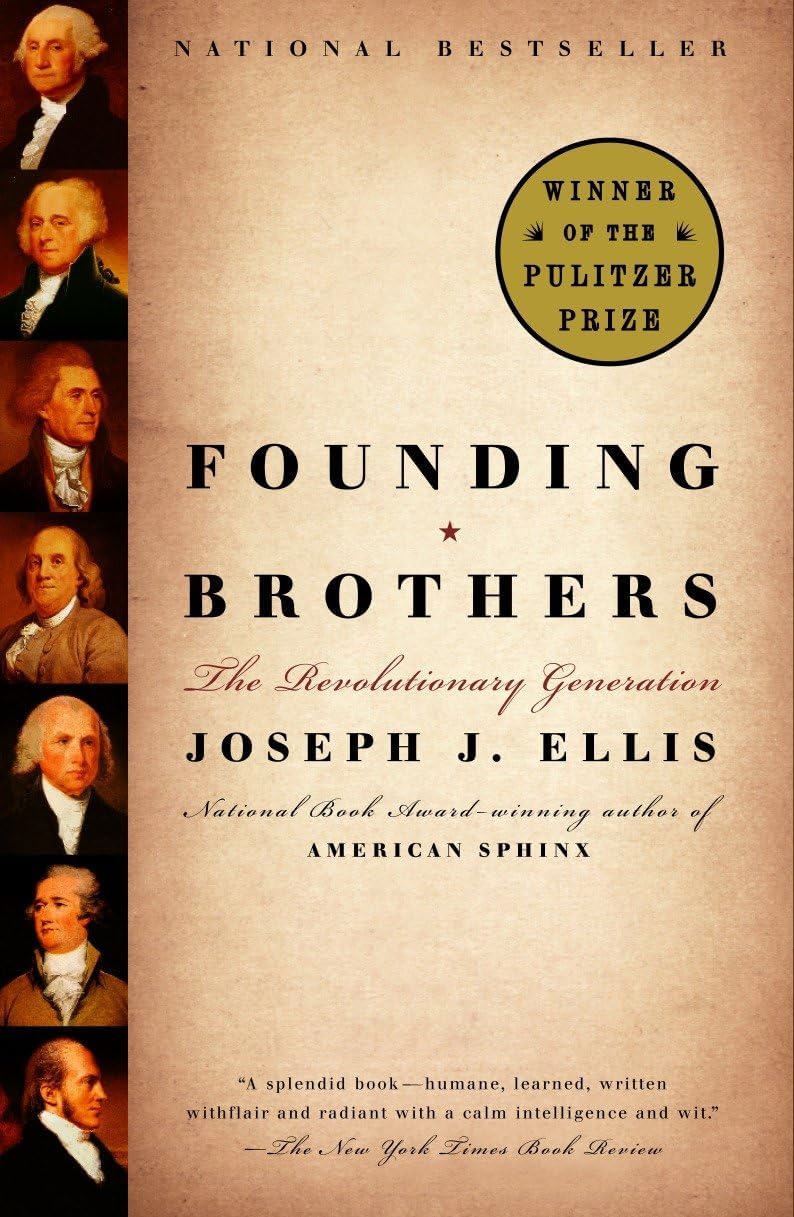
PULITZER PRIZE WINNER • NATIONAL BESTSELLER • A landmark work of history explores how a group of greatly gifted but deeply flawed individuals—Hamilton, Burr, Jefferson, Franklin, Washington, Adams, and Madison—confronted the overwhelming challenges before them to set the course for our nation. “A splendid book—humane, learned, written with flair and radiant with a calm intelligence and wit.” — The New York Times Book Review The United States was more a fragile hope than a reality in 1790. During the decade that followed, the Founding Fathers—re-examined here as Founding Brothers—combined the ideals of the Declaration of Independence with the content of the Constitution to create the practical workings of our government. Through an analysis of six fascinating episodes—Hamilton and Burr’s deadly duel, Washington’s precedent-setting Farewell Address, Adams’ administration and political partnership with his wife, the debate about where to place the capital, Franklin’s attempt to force Congress to confront the issue of slavery and Madison’s attempts to block him, and Jefferson and Adams’ famous correspondence— Founding Brothers brings to life the vital issues and personalities from the most important decade in our nation’s history. Review: A masterful look behind the founding myths. - Just finished Joseph Ellis's "Founding Brothers." Rather than offering another lengthy biography of a single Founding Father, Ellis uncovers the nuances, relationships, rivalries, and compromises that shaped the earliest years of the American experiment. If you enjoyed "Hamilton" the musical, but aren't eager to tackle an 800-page biography, "Founding Brothers" offers an outstanding alternative. Ellis brings the personalities and conflicts to life while providing historical context and perspective without overwhelming the reader. As America approaches and celebrates its 250th anniversary, "Founding Brothers" feels especially timely and why my fraternity book club selected it for our Summer read. It reminds us that the nation's founders weren't flawless. They were neither heroes nor villains, but complex individuals grappling with difficult situations, circumstances and questions whose decisions continue to shape our country today. A masterful look behind the founding myths. Check it out! Review: Political Leadership Exemplified! - Below are key excerpts from the book that I found particularly insightful: 1- "In the long run, the evolution of an independent American nation, gradually developing its political and economic strength over the nineteenth century within the protective constraints of the British Empire, was probably inevitable. This was Paine's point. But that was not the way history happened. The creation of a separate American nation occurred suddenly rather than gradually, in revolutionary rather than evolutionary fashion, the decisive events that shaped the political ideas and institutions of the emerging state all taking place with dynamic intensity during the quarter of the eighteenth century. No one present at the start knew how it would turn out in the end. What in retrospect has the look of a foreordained unfolding of God's will was in reality an improvisational affair in which sheer chance, pure luck both good and bad—and specific decisions made in the crucible of specific military and political crises determined the outcome. At the dawn of a new century, indeed a new millennium, the United States is now the oldest enduring republic in world history, with a set of political institutions and traditions that have stood the test of time. The basic framework for all these institutions and traditions was built in a sudden spasm of enforced inspiration and makeshift construction during the final decades of the eighteenth century." 2- " My own answers to these questions are contained in the stories that follow, which attempt to recover the sense of urgency and improvisation, what it looked and felt like, for the eight most prominent political leaders in the early republic. They are, in alphabetical order. Abigail and John Adams, Aaron Burr, Benjamin Franklin, Alexander Hamilton, Thomas Jefferson, James Madison, and George Washington. While each episode is a self-contained narrative designed to illuminate one propitious moment with as much storytelling skill as I can muster, taken together they feature several common themes. First, the achievement of the revolutionary generation was a collective enterprise that succeeded because of the diversity of personalities and ideologies present in the mix...Second, they all knew one another personally, meaning that they broke bread together, sat together at countless meetings, corresponded with one another about private as well as public matters...Third, they managed to take the most threatening; and divisive issue off the political agenda...Fourth, the faces that look down upon us with such classical dignity in those portraits by John Trumbull, Gilbert Stuart, and Charles Willson Peale, the voices that speak to us across the ages in such lyrical cadences, seem so mythically heroic, at least in part, because they knew we would be looking and listening. All the vanguard members of the revolutionary generation developed a keen sense of their historical significance even while they were still making the history on which their reputations would rest." 3- "In the wake of other national movements—the French, Russian, and Chinese revolutions, as well as the multiple movements for national independence in Africa, Asia, and Latin America—the leadership class of the successful revolution proceeded to decimate itself in bloody reprisals that frequently assumed genocidal proportions. But the conflict within the American revolutionary generation remained a passionate yet bloodless affair in which the energies released by national independence did not devour its own children. Th Burr-Hamilton duel represented the singular exception to this rule." 4- "By selecting the Potomac location, the Congress had implicitly decided to separate the political and financial capitals of the United "States. All the major European capitals—Berlin, London, Paris, Rome, Vienna—were metropolitan centers that gathered together the political, economic, and cultural energies of their respective populations in one place. The United States was almost inadvertently deciding to segregate them. The exciting synergy of institutional life in an all-ll-purpose national metropolis was deemed less important than the dangerous corruptions likely to afflict a nexus of politicians and financier." 5- "For the next seventy years, until the outbreak of the Civil War in 1986, the essence of political wisdom in the emergent American republic was to insist that such choices did not have to be made. But the recognition that these were the competing options, the contested versions, if you will, of what the core legacy of the American Revolution truly meant, first became visible in the summer of 1790. Thee Constitution did not resolve these questions; it only provided an orderly framework within which the arguments could continue. Nor would it be historically correct to regard the issues at stake as exclusively or even primarily constitutional. Legalistic debates over federal versus state sovereignty were just the most accessible handles to grab, t the safest and most politically suitable ways to talk about alternative national visions. The Compromise of 1790 is most famous for averting a political crisis that many statesmen of the time considered a threat to the survival of the infant republic. But it also exposed the incompatible expectations concerning Americas future that animated these same st statesmen. In a sense, it is a very old story which has been rendered even more familiar by the violent dissolution of revolutionary regimes i; in modern day emergent nations: Bound together in solidarity against t the imperialistic enemy, the leadership fragments when the common enemy disappears and the different agenda for the new nation must confront its differences. Securing a revolution has proven to be a much more daunting assignment than winning one. The accommodation that culminated in the agreement reached over Jefferson's dinner table provides a momentary exposure of the sharp differences dividing the leadership of the revolutionary generation: sectional versus national allegiance; agrarian versus commercial economic priorities; diffusion versus consolidation as social ideals; an impotent versus a potent federal government. The compromise reached did not resolve these conflicts so much as prevent them from exploding when the newly created government was so vulnerable; it bought time during which the debate could continue." 6- "The main themes of the Farewell Address are just as easy to state succinctly as they are difficult to appreciate fully. After declaring his irreversible intention to retire, Washington devoted several paragraphs to the need for national unity. He denounced excessive partisanship, most especially when it took the form of political parties pursuing a vested ideological agenda or sectional interest groups oblivious to the advantages of cooperation. The rest of the Farewell Address was then devoted to foreign policy, calling for strict American neutrality and diplomatic independence from the tangled affairs of Europe..."Washington was not claiming to offer novel prescriptions based on his original reading of philosophical treatises or books; quite the opposite, he was reminding his countrymen of the venerable principles he had acquired from personal experience, principles so obvious and elemental that they were at risk of being overlooked by his contemporaries; and so thoroughly grounded in the American Revolution that they are virtually invisible to a more distant posterity." 7- "Finally, Adams apprised Jefferson: "Your distinction between natural and artificial Aristocracy does not appear to me well founded." One might be able to separate wealth from talent in theory, but in practice, and in all societies, they were inextricably connected: "The five Pillars of Aristocracy," he argued, "are Beauty, Wealth, Birth, Genius and Virtues. Any one of the three first, can at any time, over bear any one or both of the two last." But it would never come to that anyway, because the qualities Jefferson regarded as artificial and those he regarded as natural were all mixed together inside human nature, then mixed together again within society, in blended patterns that defied Jefferson's neat dissections." 8- "They both (Adams and Jefferson) did anticipate, albeit from decidedly different perspectives,;, the looming sectional crisis between North and South that their partnership stretched across. "I fear there will be greater difficulties to preserve our Union," Adams warned, "than You and I, our Fathers Brothers Disciples and Sons have had to form it." Jefferson concurred, though the subject touched the most explosive issue of all—namely, the unmentionable fact of slavery. Even the ever-candid Adams recognized that this was the forbidden topic, the one piece of ground declared off-limits by mutual consent. With one notable exception, the dialogue between Adams and Jefferson, so revealing in its engagement of the conflicting ideas and impulses that shaped the American Revolution, also symbolized the unofficial policy of silence within the revolutionary generation on the most glaring disagreement of all." 9- "One would like to believe, and there is some basis for the belief, that each man (Adams and Jefferson) came to recognize in the other the intellectual and temperamental qualities lacking in himself; that they, in effect, completed each other; that only when joined could the pieces of the story of the American Revolution come together to make a whole. But the more mundane truth is that they never faced and therefore never fully resolved all their political differences; they simply outlived them." 10- "He conceded (Adams) that the era of the American Revolution had been "a memorable epoch in the annals of the human race," but the jury was still out on its significance. He doubted whether the republican principles planted by the founding generation would grow in foreign soil. Neither Europe nor Latin America were ready for them. Even within the United States, the fate of those principles was still problematic. He warned that America was "destined in future history to form the brightest or blackest page, according to the use or the abuse of those political institutions by which they shall in time to come be shaped by the human mind!" Asked to pose for posterity, he chose to go out hurling it a challenge."


| Best Sellers Rank | #8,001 in Books ( See Top 100 in Books ) #6 in American Revolution Biographies (Books) #19 in History & Theory of Politics #19 in U.S. Revolution & Founding History |
| Customer Reviews | 4.5 out of 5 stars 2,804 Reviews |
R**E
A masterful look behind the founding myths.
Just finished Joseph Ellis's "Founding Brothers." Rather than offering another lengthy biography of a single Founding Father, Ellis uncovers the nuances, relationships, rivalries, and compromises that shaped the earliest years of the American experiment. If you enjoyed "Hamilton" the musical, but aren't eager to tackle an 800-page biography, "Founding Brothers" offers an outstanding alternative. Ellis brings the personalities and conflicts to life while providing historical context and perspective without overwhelming the reader. As America approaches and celebrates its 250th anniversary, "Founding Brothers" feels especially timely and why my fraternity book club selected it for our Summer read. It reminds us that the nation's founders weren't flawless. They were neither heroes nor villains, but complex individuals grappling with difficult situations, circumstances and questions whose decisions continue to shape our country today. A masterful look behind the founding myths. Check it out!
O**H
Political Leadership Exemplified!
Below are key excerpts from the book that I found particularly insightful: 1- "In the long run, the evolution of an independent American nation, gradually developing its political and economic strength over the nineteenth century within the protective constraints of the British Empire, was probably inevitable. This was Paine's point. But that was not the way history happened. The creation of a separate American nation occurred suddenly rather than gradually, in revolutionary rather than evolutionary fashion, the decisive events that shaped the political ideas and institutions of the emerging state all taking place with dynamic intensity during the quarter of the eighteenth century. No one present at the start knew how it would turn out in the end. What in retrospect has the look of a foreordained unfolding of God's will was in reality an improvisational affair in which sheer chance, pure luck both good and bad—and specific decisions made in the crucible of specific military and political crises determined the outcome. At the dawn of a new century, indeed a new millennium, the United States is now the oldest enduring republic in world history, with a set of political institutions and traditions that have stood the test of time. The basic framework for all these institutions and traditions was built in a sudden spasm of enforced inspiration and makeshift construction during the final decades of the eighteenth century." 2- " My own answers to these questions are contained in the stories that follow, which attempt to recover the sense of urgency and improvisation, what it looked and felt like, for the eight most prominent political leaders in the early republic. They are, in alphabetical order. Abigail and John Adams, Aaron Burr, Benjamin Franklin, Alexander Hamilton, Thomas Jefferson, James Madison, and George Washington. While each episode is a self-contained narrative designed to illuminate one propitious moment with as much storytelling skill as I can muster, taken together they feature several common themes. First, the achievement of the revolutionary generation was a collective enterprise that succeeded because of the diversity of personalities and ideologies present in the mix...Second, they all knew one another personally, meaning that they broke bread together, sat together at countless meetings, corresponded with one another about private as well as public matters...Third, they managed to take the most threatening; and divisive issue off the political agenda...Fourth, the faces that look down upon us with such classical dignity in those portraits by John Trumbull, Gilbert Stuart, and Charles Willson Peale, the voices that speak to us across the ages in such lyrical cadences, seem so mythically heroic, at least in part, because they knew we would be looking and listening. All the vanguard members of the revolutionary generation developed a keen sense of their historical significance even while they were still making the history on which their reputations would rest." 3- "In the wake of other national movements—the French, Russian, and Chinese revolutions, as well as the multiple movements for national independence in Africa, Asia, and Latin America—the leadership class of the successful revolution proceeded to decimate itself in bloody reprisals that frequently assumed genocidal proportions. But the conflict within the American revolutionary generation remained a passionate yet bloodless affair in which the energies released by national independence did not devour its own children. Th Burr-Hamilton duel represented the singular exception to this rule." 4- "By selecting the Potomac location, the Congress had implicitly decided to separate the political and financial capitals of the United "States. All the major European capitals—Berlin, London, Paris, Rome, Vienna—were metropolitan centers that gathered together the political, economic, and cultural energies of their respective populations in one place. The United States was almost inadvertently deciding to segregate them. The exciting synergy of institutional life in an all-ll-purpose national metropolis was deemed less important than the dangerous corruptions likely to afflict a nexus of politicians and financier." 5- "For the next seventy years, until the outbreak of the Civil War in 1986, the essence of political wisdom in the emergent American republic was to insist that such choices did not have to be made. But the recognition that these were the competing options, the contested versions, if you will, of what the core legacy of the American Revolution truly meant, first became visible in the summer of 1790. Thee Constitution did not resolve these questions; it only provided an orderly framework within which the arguments could continue. Nor would it be historically correct to regard the issues at stake as exclusively or even primarily constitutional. Legalistic debates over federal versus state sovereignty were just the most accessible handles to grab, t the safest and most politically suitable ways to talk about alternative national visions. The Compromise of 1790 is most famous for averting a political crisis that many statesmen of the time considered a threat to the survival of the infant republic. But it also exposed the incompatible expectations concerning Americas future that animated these same st statesmen. In a sense, it is a very old story which has been rendered even more familiar by the violent dissolution of revolutionary regimes i; in modern day emergent nations: Bound together in solidarity against t the imperialistic enemy, the leadership fragments when the common enemy disappears and the different agenda for the new nation must confront its differences. Securing a revolution has proven to be a much more daunting assignment than winning one. The accommodation that culminated in the agreement reached over Jefferson's dinner table provides a momentary exposure of the sharp differences dividing the leadership of the revolutionary generation: sectional versus national allegiance; agrarian versus commercial economic priorities; diffusion versus consolidation as social ideals; an impotent versus a potent federal government. The compromise reached did not resolve these conflicts so much as prevent them from exploding when the newly created government was so vulnerable; it bought time during which the debate could continue." 6- "The main themes of the Farewell Address are just as easy to state succinctly as they are difficult to appreciate fully. After declaring his irreversible intention to retire, Washington devoted several paragraphs to the need for national unity. He denounced excessive partisanship, most especially when it took the form of political parties pursuing a vested ideological agenda or sectional interest groups oblivious to the advantages of cooperation. The rest of the Farewell Address was then devoted to foreign policy, calling for strict American neutrality and diplomatic independence from the tangled affairs of Europe..."Washington was not claiming to offer novel prescriptions based on his original reading of philosophical treatises or books; quite the opposite, he was reminding his countrymen of the venerable principles he had acquired from personal experience, principles so obvious and elemental that they were at risk of being overlooked by his contemporaries; and so thoroughly grounded in the American Revolution that they are virtually invisible to a more distant posterity." 7- "Finally, Adams apprised Jefferson: "Your distinction between natural and artificial Aristocracy does not appear to me well founded." One might be able to separate wealth from talent in theory, but in practice, and in all societies, they were inextricably connected: "The five Pillars of Aristocracy," he argued, "are Beauty, Wealth, Birth, Genius and Virtues. Any one of the three first, can at any time, over bear any one or both of the two last." But it would never come to that anyway, because the qualities Jefferson regarded as artificial and those he regarded as natural were all mixed together inside human nature, then mixed together again within society, in blended patterns that defied Jefferson's neat dissections." 8- "They both (Adams and Jefferson) did anticipate, albeit from decidedly different perspectives,;, the looming sectional crisis between North and South that their partnership stretched across. "I fear there will be greater difficulties to preserve our Union," Adams warned, "than You and I, our Fathers Brothers Disciples and Sons have had to form it." Jefferson concurred, though the subject touched the most explosive issue of all—namely, the unmentionable fact of slavery. Even the ever-candid Adams recognized that this was the forbidden topic, the one piece of ground declared off-limits by mutual consent. With one notable exception, the dialogue between Adams and Jefferson, so revealing in its engagement of the conflicting ideas and impulses that shaped the American Revolution, also symbolized the unofficial policy of silence within the revolutionary generation on the most glaring disagreement of all." 9- "One would like to believe, and there is some basis for the belief, that each man (Adams and Jefferson) came to recognize in the other the intellectual and temperamental qualities lacking in himself; that they, in effect, completed each other; that only when joined could the pieces of the story of the American Revolution come together to make a whole. But the more mundane truth is that they never faced and therefore never fully resolved all their political differences; they simply outlived them." 10- "He conceded (Adams) that the era of the American Revolution had been "a memorable epoch in the annals of the human race," but the jury was still out on its significance. He doubted whether the republican principles planted by the founding generation would grow in foreign soil. Neither Europe nor Latin America were ready for them. Even within the United States, the fate of those principles was still problematic. He warned that America was "destined in future history to form the brightest or blackest page, according to the use or the abuse of those political institutions by which they shall in time to come be shaped by the human mind!" Asked to pose for posterity, he chose to go out hurling it a challenge."
J**R
A Fraternity of Genius
Historians can be forgiven for deifying the men who made the American Revolution. Looking back from our cynical century, it's easy to regard their greatness as something above the human experience. In "Founding Brothers", Joseph Ellis retains all the immense respect due to Washington, Jefferson, Madison, Adams, Monroe, Hamilton and Burr. But by examining their relationships through a fraternal prism, he renders them three dimensional and accessible to those who long to understand more about exactly what happened during the revolution, and why. These icons of American independence are wholly human in "Founding Brothers." Like brothers in any family, they fight battles of ideas, egos, and principles. But when threatened from without, they come together in a fierce synthesis strong enough to spawn a nation. Ellis spins his story in a series of vignettes, focusing on very specific moments which changed the nature of the events swirling around them. He creates an intimacy with his subjects, exploring their psychology, their thought processes, plumbing the origins of their motivations. In the first chapter, for instance, he describes all the various possibilities of what went on during the duel between Alexander Hamilton and Aaron Burr on the banks of the Hudson in 1804. By carefully turning over all the possibilities--did Hamilton's gun go off or not, did he intend to strike Burr, did Burr indeed mean to strike Hamilton--he opens the door to an understanding about what each man thought as his boat crossed from Manhattan to New Jersey for the fateful meeting. The book abounds with intimate anecdotes like this, covering all the well worn subjects of revolutionary history and re-invigorating them with keen insights and intelligent conjecture. It covers Jefferson's dinner party, the tortured issue of slavery, Washington's farewell address, and the remarkable fifty year asssociation of Adams and Jefferson with affection and elegant style.
B**H
New Fave for a History Buff
Joseph Ellis manages to take the interactions of seven (or eight, is you include Abigail Adams) founders and illustrate the truly amazing issues that faced the framers of the new country. In the preface, Ellis states he believes that politics, rather than the War itself, was the revolution of America. The Revolutionary War was, as we all know, instituted to free the colonists from the economic and social yoke of the British. To do that, they inspired themselves and their countrymen with the idea of individual freedom. But how does one reconcile individual freedom with the notion of government -- any government. Of the fathers(George Washington, John Adams, Thomas Jefferson, James Madison, Alexander Hamilton, Aaron Burr and Benjamin Franklin), Washington, Adams and Jefferson are most deeply drawn. They represent the issues, icons and ideologies that perhaps any successful revolution must have. The issues threatened to tear apart the brand new nation nearly at birth. The political battles between Federalists and Repupblicans were vicious and prolonged, and featured lies, personal attacks, misunderstandings, and featured some amazingly strong and intellectually profound personalities. The 'band of brothers' were not overwhelmed with brotherly love. They fought literally and figuratively with one another, even when they were on the same side. The 'Brothers' were far more than the two dimensional figures on our classroom walls, and their weaknesses, failures and blind spots are made clear. But the wrestling resulted in a Constitution that manages to somehow preserve the idea of individual rights with the demands of a coordinated and unified governance. Ellis is a gifted writer but even better, he is gifted in choosing the incidents and relationships that illustrate the conflicts that had to be raised, faced and compromised to allow the new country to continue. The Burr Hamilton duel. The love affair between Adams and his wife. The disrespect Jefferson felt, but hid from even his friends. The invisible elephant in middle of the room that was slavery. The impact of one personality -- George Washington -- had in keeping the country together. There are bits of humor, lots of examples, some fine imagining and nice underlying juxtaposition of issues with their examples. The author can see a theme underlying the disputes. While he calls the eight chapters "stories", I suspect he chose the word to avoid calling them 'essays' and thus scaring off most of us who don't want to read boring, windy expositions of historical views. On the other hand, I was originally attracted to history precisely because it is all stories, and I read history in part to see if I can understand the meaning, if there is any, behind the stories. Ellis, I suspect, sees it my way (or more properly, I see it his). He tells the story and manages to tell you why the story matters. While he never says as much, The Founding Brothers is about the second American Revolution--the one that took place in the Congress, the plantations of Viginia, the small towns of Massachusetts, the bluffs of New Jersey. With one exception, the second Revolution is bloodless, but wounding; barely civilized at times, but world shaking. It was the overturning of all that had come before in the notion of nations, the idea of governing, and the attempt to make practical the very romantic idea of individual liberty. I was around in the sixties, which self conciously billed itself as a revolution and at the time, the people behind the bullhorns were exhorting their fellow citizens to shake off the shackles of a lying government and take over the government for the people. I remember thinking at the time, Great, but let's say it works, and the government falls. What do we do then? All of the romantic ideas could be put into practice, but how? And who gets to decide? The Founding Brothers describes with charm, insight, clarity and sympathy the 'how' after the Revolutionary War is done, and the only weapons were wit, ideals, ideas and politics. A failure of politics would be the end of America then. Just as it might be now.
A**R
one of the best, readable history books about the founding of america
an excellent book
D**H
Mind of a scholar, pen of a poet
Joseph Ellis captures the heart and soul of the revolutionary generation with his aptly titled “Founding Brothers,” a book that chronicles the approximately twenty year period that followed the ratification of the US constitution, a period so dramatic that no novelist could have written it. The book covers six key conflicts among the founders of this nation, conflicts which typify their struggle to reconcile their disparate ideas on public policy. It takes an in-depth look at the psychology of these first statesmen, their ideologies, and the choices they make in the interest of national unity. Some of the highlights include the Hamilton-Burr duel, the ever-contentious debate about slavery, the celebrity status of George Washington (and the point-of-view of his detractors), the star-crossed presidency of John Adams and his eventual correspondence with political rival Thomas Jefferson. Like a great novelist, Ellis develops the character profile of each of the founding fathers with great care, spelling out their personal political views (or lack thereof) and fleshing out all their idiosyncrasies with such wry wit that one can’t help but wonder if he knew them personally. His prose is fluid, elegant and often poetic; his historical acumen is unparalleled. The book is firmly rooted in reality and rarely ever indulges in idle speculation or in tendentious commentary. I don’t know if this is common, but I find it incredibly annoying when a historian takes it upon himself to editorialize history. Leave Howard Zinn and Paul Johnson to write “A Pundit’s History of the United States” and leave others to read it. I will take Joseph Ellis’ version, “A Scholar’s History of the United States,” as this book should be subtitled. It is a true testament to the idea that one can write about the past without inserting one’s own opinion of it. There is so much we can learn from history if we allow ourselves to learn it objectively and draw our own conclusions as we study it. Post-2000 readers should be warned about Chapter 3, which treats of the first congressional debate about slavery, the darkest chapter in US history. Ellis does the best he can to be diplomatic on this subject, even as many of the founding fathers were either apathetic, silent or in favor of this horrible institution. Nevertheless, the task of the historian is to depict all sides of the story, including the detestable. Some passages which he cites in this chapter (out of necessity) will likely outrage contemporary readers. Readers who choose to skip this chapter for this reason will not lose much, as each chapter is self-contained and could be read on its own. In any case, Ellis’ book is a masterpiece, and the reader eager to learn about the history of this fun-filled period will not be disappointed!
B**U
THE VOICES PERSONIFING 1776 AMERICA.
"... [A]ll the heroic portraits of the great men were romanticized distortions" (p. 217). Brings to life the iconic patriot founders: George Washington, Benjamin Franklin, Thomas Jefferson, James Madison, Alexander Hamilton, John Adams. An accomplished eloquent portrayal of the competing rivalries, friendships, and, betrayals, affecting the developing policies of a nation destined for global prowess. As the Constitutional Convention wrestled in defining its agenda: "The political dialogue within the highest echelon of the revolutionary generation was a decade-long shouting match" (p. 16). Further, President Washington emphatically cautioned against foreign entanglements in his epic Presidential retirement Farewell Address (1797): "The Great role of conduct for us, in regard to foreign nations is in extending our commercial relations to have them as little political connections as possible.... Europe has a set of primary interests ... she must be engaged in frequent controversies, the causes of which are essentially foreign to our concerns..." (p. 152). A blueprint in understanding the intentions of great fallible American leaders whose ideals continue to echo today.
L**S
A Brilliant, Insightful Account of the Founders and Their Achievement
Most history books and biographies of historical figures tend to be long, running into the many hundreds of pages, sometimes even a thousand pages or more; that tendency is certainly prevalent when it comes to books on American history and those who were instrumental in the American founding. And there is good reason for the doorstop quality of this genre of books: if the book aspires to tell the story, there is a lot to tell. With that truism in mind, the first remarkable thing about Joseph Ellis's Founding Brothers, even before the cover is opened and the first page is read, is its brevity. The paperback version I read comes in short of two hundred and fifty pages for a book that purports to tell its readers a story about America's founding and those who were in the thick of the melee; that in itself is a noteworthy achievement. Ellis's concision is a feature of his account; he states in the acknowledgments, "I wanted to write a modest-sized account of a massive historical subject…hoped to render human and accessible that generation of political leaders customarily deified and capitalized as Founding Fathers." But how to do this with what he calls the "great ocean of material" ? He found his answer reading Lytton Strachey's famous biography Eminent Victorians, where Strachey uses "stealth and selectivity" with the idea that less could be more. Ellis's version of "less could be more" consists of six defining episodes that occurred in roughly the decade after the ratification of the Constitution (1790 - 1800). Ellis chose this decade because it was "the most crucial and consequential in American history…It set the precedents, established in palpable fact what the Constitution had only outlined in purposely ambiguous theory, thereby opening up and closing off options for all the history that followed." Another remarkable quality of Founding Brothers is Ellis's ability to combine limpid prose and novel-quality storytelling with the erudition of a first-rate historian. Yes, a historical account that is educational and a joy to read. Who would have thunk it? And, yes, in case you are wondering, Ellis succeeds marvelously in achieving his goal of "rendering human and accessible" those great men (and Abigail Adams) who audaciously succeeded against all odds of bringing the American nation to birth. In our current historical moment when the greatness of what has been called the "American experiment" is being questioned, and the founders of that "experiment" are being judged by anachronistic moral and ethical standards, and their names and likenesses are being removed from schools and government buildings; we are sorely in need of books like Founding Brothers to remind us what a remarkable achievement in the history of the world the United States of America is. Highly recommended.
M**I
Awesome book.
Awesome book. Must read ! If you are looking for a history book, full of details, written with passion and enthusiasm, this is it. Top notch service !
R**A
Gosto desse tipo de história.
Já li diversos livros sobre o tema e gostei mais de outros mas vale a leitura desse livro, conhecer e entender a história é sempre bom.
J**N
Review
Makes one somewhat depressed that current politicians don't come close to the curiosity, intellect and openness of these men and women described in the fascinating book. Only quibble is that the sentences are very long
A**O
Excellent book
Excellent book!!!
O**R
Correcto
Un poco pequeño, y la letra muy pequeña. Tal vez deberían haberlo hecho más grande.
Trustpilot
3 weeks ago
1 month ago