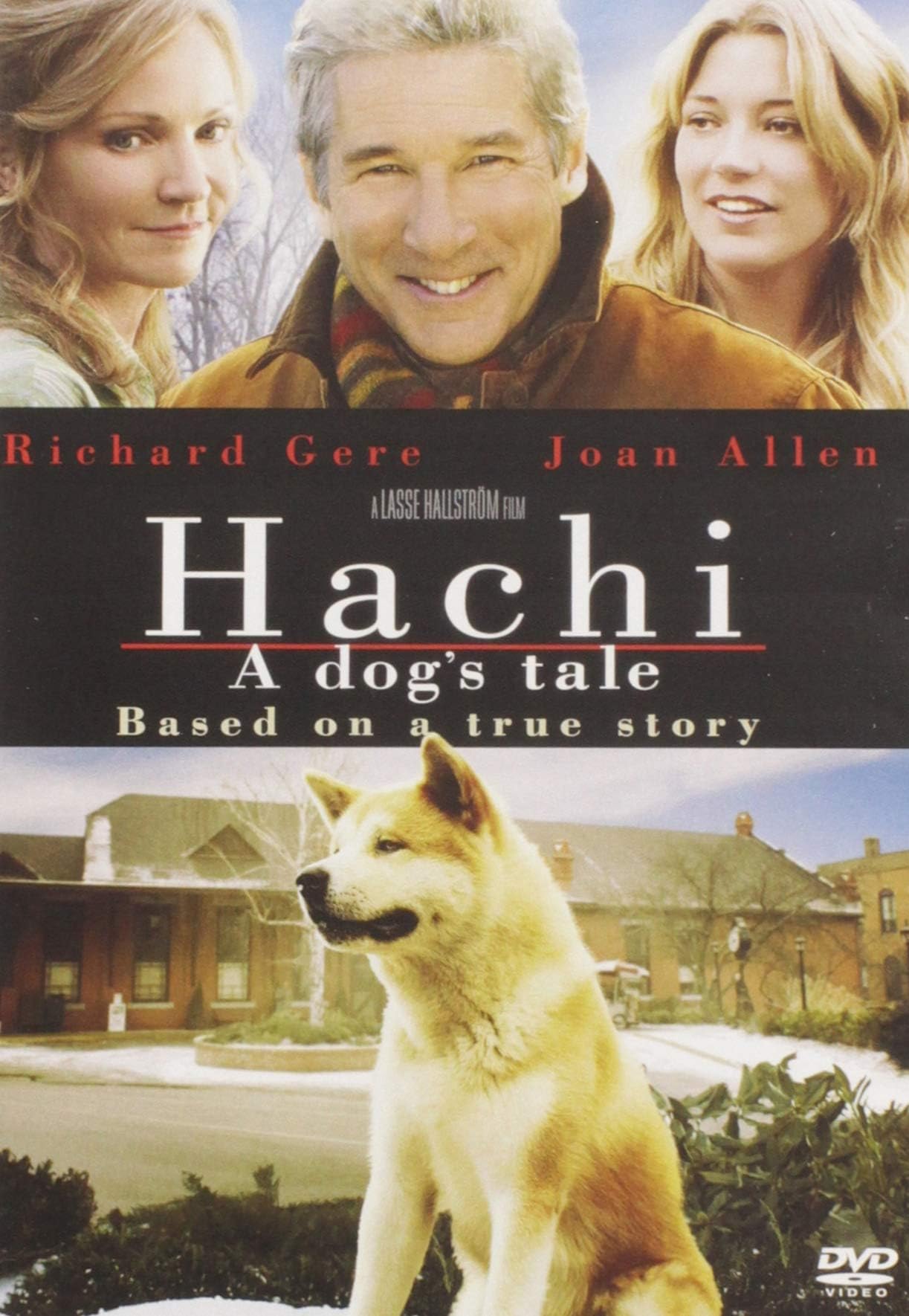


Hachi: A Dog's Tale
Product ID: 1320588
Details
- FormatDVD
- GenreDrama Family
- Initial release date2010-01-01
- LanguageEnglish
Desertcart purchases this item on your behalf and handles shipping, customs, and support to South Africa.
Based on a true story from Japan, Hachi: A Dog's Tale is a moving film about loyalty and the rare, invincible bonds that occasionally form almost instantaneously in the most unlikely places. College professor Parker Wilson (Richard Gere) finds a young Akita puppy that's been abandoned at the local train station, and he's instantly captivated by the dog. Assuming the dog's owner will return to the train station to claim him in the morning, Parker takes the puppy home overnight. But when no one comes to get the dog, Parker convinces his wife, Cate (Joan Allen), to welcome him as part of the family. He dubs the puppy Hachiko--Hachi, for short--because of the Japanese symbol for good luck that's hanging from his collar. Hachi is a somewhat peculiar dog that refuses to learn to fetch or master other people-pleasing tricks, but he is a faithful companion and friend to Parker, alerting him of potential dangers and accompanying him to the train station each morning and meeting him there after his return trip each evening. An unforeseen event will continually test Hachi's devotion. This film is neither overwrought nor sappy; it is heartfelt and immensely powerful despite its tendency to drag in a few places. Prepare to be moved to tears by this beautiful, seemingly simple film--it's about so much more than just the relationship between a man and his dog. --Tami Horiuchi From Academy Award�-nominated director Lasse Hallstr�m (2000, The Cider House Rules) comes HACHI: A DOG?S TALE, a film based on one of the most treasured and heartwarming true stories ever told. Golden Globe winner Richard Gere (2002, Best Actor in a Musical or Comedy, Chicago) and Academy Award� nominee Joan Allen (2000, Best Actress, The Contender) star in this inspiring true story. Review: heartwarming and delivers a great message of about patience - The Richard Gere-Hollywood Hachi movie is very emotional, heartwarming and delivers a great message of about patience, loyalty and that you should never forget the ones you loved. It’s a quiet story with a lot of texture in its simplicity and it tells the essential story of Hachi returning to the train station for 10 years to wait for the professor. As good as the Gere movie is, it’s a shadow of the true Hachi tale. The real life of Hachi is significantly more improbable, dramatic and truly incredible. One example of the difference is in the opening scene of the American version of the film. It shows Hachi as a puppy being placed in a crate by a Shinto priest and shipped via truck, plane and train and eventually delivered to the fictitious Benbridge train depot. The real story of Hachi’s journey from his birthplace to the Shibuya train station was recounted by the Endo, Teru the sculptor of the famous Hachi statue. Endo remarked, “In 1934, Hachiko's first statue was placed at Shibuya Station. The photo of a relaxed Hachi (above) was taken around that time by the late Isamu Yamamoto, a former bank employee who lived in the Shibuya Ward, Tokyo. Yamamoto's family found the photo and presented it to Ando who sculpted the Hachiko statue we see today. “I have never looked at such a photo that caught the atmosphere of Hachiko’s everyday life at that time so well,” Ando said. “On Hachi's birthday, I think back to the first months of his life. I can imagine a plump squirming puppy playing with his four male siblings in a barn. Hachi was born on a farm in snow country- Odate, Akita prefecture- to a wealthy landlord farmer. At two months old, he was gifted to professor Ueno Hidesaburo from a former student. On January 14, 1924, Hachi was placed in a small tightly-knit straw crate for his journey. Straw crates were heat retaining and also used to carry rice. Three people walked 12.5 miles to Ōdate Station, carrying Hachi in the midst of a snow storm. Hachi departed Ōdate Station at 3: 20 PM and scheduled to arrive at Ueno Station in Tokyo at 8: 50 AM the next day. In that blizzard, Hachi left his birthplace never to return. The Ōdate-Ueno route ran through a series of mountain ranges, and included one of the steepest approaches to a pass for trains in Japan. The train climbed up and down mountain peaks and passed through numerous tunnels. The train oscillated wildly and the locomotives gave off thick soot. It must have been a terrifying experience for the two-month old puppy. He was separated from his mother and siblings, carried outside in a blizzard, and sat in a crate on a bumpy train for 20 hours. On the day of Hachi's arrival, the newspapers reported that Tokyo was hit by a strong earthquake, by a windstorm, and a sandstorm was blowing over the capital city. People thought Hachi was dead when he arrived.” Queisse, I’ve thought a lot about the story over the past year. One day it dawned on me that Hachi is much more than a sentimental story. It’s actually a metaphor for the human predicament. Hachi spent most of his life mourning the death of his beloved master, Professor Uneo , a renowned agricultural engineer. (In the Richared Gere movie it was Parker Wilson a music professor). If Hachi did not comprehend Ueno’s death, Hachi lived most of his life missing him. Hachi lived with with Uneo for only a year and four months. These were Hachi’s happy times. After Uneo’s death, people saw Hachi walking with his head down as if he were sad and depressed. He did not wag his tale. This unfortunate life of Hachi paradoxically created the legend of the loyal dog Hachiko and Hachi became a permanent fixture of Japanese popular culture and the amazing story spread throughout the world. Review: All the more special because it is based on true story - This film is wonderfully shot, includes subtle symbolism in the scenes (hint: look at the train station decorations and time on the clock near the very end of the movie) and is probably the most pure, simple and emotional movie I have ever seen. I don't understand why this great film was not promoted more and/or did not get a good solid American release. I would not even have known about it unless I saw it on the New Releases for Blockbuster. It was filmed in early 2008, released in Japan in August 2009 ..... then simply placed on the "Direct to DVD" market here in the USA. I never heard anything about this movie even being made until stumbling across it by chance luck. A great and well done movie like this deserved better promotion and press treatment. It is a shame because many people may miss out on this film. I can only guess that budget over runs and limited financing left no money in the budget for advertising after the filming was done ? Anybody know ? Or are American audience now only fascinated with fancy CGI visual effects "eye candy" and no story ? In either case ... This movie deserved and still deserves more attention ! So on to the movie itself ... A tough guy like me does not usually get choked up over movies, but here is one I can recommend to you that will probably touch you. It is based on a true story from Japan ... although this version with Richard Gere has been shifted to USA. Basically this is the story if you don't already know it. WARNING SPOILER BELOW ........ ......... ............ .......... A college professor had a dog that was loyal to him. Each day it would follow him to the train station where he left for work. The dog would run around and do whatever all day long. But at 5:00 in the evening the dog was always back at the train station to meet his owner. This went on for years, One day the dog was waiting at the train station, but the professor never showed up. The professor had died of a heart attack at the school campus that day. For the next 9 years, the dog kept waiting and looking for it's owner at the train station everyday. Other people would try to take the dog home, but every time the dog would run away and return to the train station trying to wait for the professor. He became a local legend and the other people at the train station each day would bring the dog food and water to take care of him since the dog refused to leave his post. Eventually 9 years later the dog died, still sitting at the train station watching the people get off every train, looking for his owner. Today in Japan where this really happened they have a bronze statue of the dog sitting in the train station as a tribute to that kind of loyalty. ......... .......... ......... ......... END OF SPOILER I suppose the reason I found this particular story touching enough to even put a lump in my throat was two reasons .. 1) I have always thought there is something innocent and pure about an animals loyalty and affections that is rare in humans. 2) When I was young and walking to elementary school, my friend had a dog named Pal. He would follow us when we walked the 2 miles to school. He would wait for us all day long. I can remember sitting in classes and looking out the window and seeing that dog under a tree looking at the school building and waiting for us to get out. When we got out of class in the afternoon he would be all excited and come running to meet us and follow us home again. This went on for around 2 years as I recall. But one day when we got out of school, the dog was all excited to see us and came running across the parking lot. We started yelling "NO PAL. STOP" But it did not help. Pal ran in front of a school bus in the parking lot. Now being older and wiser, I look back at this story from childhood and think .......... Yes, it is a cute story about boys and their dogs growing up together. But the real world is not the 1800 or early 1900s of farmhouses, dirt roads and horse & buggies anymore. The world is an urban , mechanized jungle that is dangerous for loosely roaming animals. If people really care about their animals they should not let them run around loose all day long to get hit by cars or other dangers. This is one of those rare movies you see in life that will leave an impression. Well done to everybody who worked on this project !

| Contributor | Bates Wilder, Bill Johnson, Blake Friedman, Cary-Hiroyuki Tagawa, Daniel Kirby, Davenia McFadden, Denece Ryland, Donna Sorbello, Erick Avari, Frank Aronson, Gloria Crist, Ian Sherman, Jason Alexander, Joan Allen, Kevin DeCoste, Lasse Hallstrom, Lasse Hallstr�m, Rich Tretheway, Richard Gere, Robbie Sublett, Robert Degnan, Sarah Roemer, Timothy Crowe, Tom Tynell, Tora Hallstr�m, Troy Doherty, Vicki Shigekuni Wong Contributor Bates Wilder, Bill Johnson, Blake Friedman, Cary-Hiroyuki Tagawa, Daniel Kirby, Davenia McFadden, Denece Ryland, Donna Sorbello, Erick Avari, Frank Aronson, Gloria Crist, Ian Sherman, Jason Alexander, Joan Allen, Kevin DeCoste, Lasse Hallstrom, Lasse Hallstr�m, Rich Tretheway, Richard Gere, Robbie Sublett, Robert Degnan, Sarah Roemer, Timothy Crowe, Tom Tynell, Tora Hallstr�m, Troy Doherty, Vicki Shigekuni Wong See more |
| Customer Reviews | 4.8 out of 5 stars 20,209 Reviews |
| Format | DVD |
| Genre | Drama, Family |
| Language | English |
| Runtime | 1 hour and 33 minutes |
P**S
heartwarming and delivers a great message of about patience
The Richard Gere-Hollywood Hachi movie is very emotional, heartwarming and delivers a great message of about patience, loyalty and that you should never forget the ones you loved. It’s a quiet story with a lot of texture in its simplicity and it tells the essential story of Hachi returning to the train station for 10 years to wait for the professor. As good as the Gere movie is, it’s a shadow of the true Hachi tale. The real life of Hachi is significantly more improbable, dramatic and truly incredible. One example of the difference is in the opening scene of the American version of the film. It shows Hachi as a puppy being placed in a crate by a Shinto priest and shipped via truck, plane and train and eventually delivered to the fictitious Benbridge train depot. The real story of Hachi’s journey from his birthplace to the Shibuya train station was recounted by the Endo, Teru the sculptor of the famous Hachi statue. Endo remarked, “In 1934, Hachiko's first statue was placed at Shibuya Station. The photo of a relaxed Hachi (above) was taken around that time by the late Isamu Yamamoto, a former bank employee who lived in the Shibuya Ward, Tokyo. Yamamoto's family found the photo and presented it to Ando who sculpted the Hachiko statue we see today. “I have never looked at such a photo that caught the atmosphere of Hachiko’s everyday life at that time so well,” Ando said. “On Hachi's birthday, I think back to the first months of his life. I can imagine a plump squirming puppy playing with his four male siblings in a barn. Hachi was born on a farm in snow country- Odate, Akita prefecture- to a wealthy landlord farmer. At two months old, he was gifted to professor Ueno Hidesaburo from a former student. On January 14, 1924, Hachi was placed in a small tightly-knit straw crate for his journey. Straw crates were heat retaining and also used to carry rice. Three people walked 12.5 miles to Ōdate Station, carrying Hachi in the midst of a snow storm. Hachi departed Ōdate Station at 3: 20 PM and scheduled to arrive at Ueno Station in Tokyo at 8: 50 AM the next day. In that blizzard, Hachi left his birthplace never to return. The Ōdate-Ueno route ran through a series of mountain ranges, and included one of the steepest approaches to a pass for trains in Japan. The train climbed up and down mountain peaks and passed through numerous tunnels. The train oscillated wildly and the locomotives gave off thick soot. It must have been a terrifying experience for the two-month old puppy. He was separated from his mother and siblings, carried outside in a blizzard, and sat in a crate on a bumpy train for 20 hours. On the day of Hachi's arrival, the newspapers reported that Tokyo was hit by a strong earthquake, by a windstorm, and a sandstorm was blowing over the capital city. People thought Hachi was dead when he arrived.” Queisse, I’ve thought a lot about the story over the past year. One day it dawned on me that Hachi is much more than a sentimental story. It’s actually a metaphor for the human predicament. Hachi spent most of his life mourning the death of his beloved master, Professor Uneo , a renowned agricultural engineer. (In the Richared Gere movie it was Parker Wilson a music professor). If Hachi did not comprehend Ueno’s death, Hachi lived most of his life missing him. Hachi lived with with Uneo for only a year and four months. These were Hachi’s happy times. After Uneo’s death, people saw Hachi walking with his head down as if he were sad and depressed. He did not wag his tale. This unfortunate life of Hachi paradoxically created the legend of the loyal dog Hachiko and Hachi became a permanent fixture of Japanese popular culture and the amazing story spread throughout the world.
M**R
All the more special because it is based on true story
This film is wonderfully shot, includes subtle symbolism in the scenes (hint: look at the train station decorations and time on the clock near the very end of the movie) and is probably the most pure, simple and emotional movie I have ever seen. I don't understand why this great film was not promoted more and/or did not get a good solid American release. I would not even have known about it unless I saw it on the New Releases for Blockbuster. It was filmed in early 2008, released in Japan in August 2009 ..... then simply placed on the "Direct to DVD" market here in the USA. I never heard anything about this movie even being made until stumbling across it by chance luck. A great and well done movie like this deserved better promotion and press treatment. It is a shame because many people may miss out on this film. I can only guess that budget over runs and limited financing left no money in the budget for advertising after the filming was done ? Anybody know ? Or are American audience now only fascinated with fancy CGI visual effects "eye candy" and no story ? In either case ... This movie deserved and still deserves more attention ! So on to the movie itself ... A tough guy like me does not usually get choked up over movies, but here is one I can recommend to you that will probably touch you. It is based on a true story from Japan ... although this version with Richard Gere has been shifted to USA. Basically this is the story if you don't already know it. WARNING SPOILER BELOW ........ ......... ............ .......... A college professor had a dog that was loyal to him. Each day it would follow him to the train station where he left for work. The dog would run around and do whatever all day long. But at 5:00 in the evening the dog was always back at the train station to meet his owner. This went on for years, One day the dog was waiting at the train station, but the professor never showed up. The professor had died of a heart attack at the school campus that day. For the next 9 years, the dog kept waiting and looking for it's owner at the train station everyday. Other people would try to take the dog home, but every time the dog would run away and return to the train station trying to wait for the professor. He became a local legend and the other people at the train station each day would bring the dog food and water to take care of him since the dog refused to leave his post. Eventually 9 years later the dog died, still sitting at the train station watching the people get off every train, looking for his owner. Today in Japan where this really happened they have a bronze statue of the dog sitting in the train station as a tribute to that kind of loyalty. ......... .......... ......... ......... END OF SPOILER I suppose the reason I found this particular story touching enough to even put a lump in my throat was two reasons .. 1) I have always thought there is something innocent and pure about an animals loyalty and affections that is rare in humans. 2) When I was young and walking to elementary school, my friend had a dog named Pal. He would follow us when we walked the 2 miles to school. He would wait for us all day long. I can remember sitting in classes and looking out the window and seeing that dog under a tree looking at the school building and waiting for us to get out. When we got out of class in the afternoon he would be all excited and come running to meet us and follow us home again. This went on for around 2 years as I recall. But one day when we got out of school, the dog was all excited to see us and came running across the parking lot. We started yelling "NO PAL. STOP" But it did not help. Pal ran in front of a school bus in the parking lot. Now being older and wiser, I look back at this story from childhood and think .......... Yes, it is a cute story about boys and their dogs growing up together. But the real world is not the 1800 or early 1900s of farmhouses, dirt roads and horse & buggies anymore. The world is an urban , mechanized jungle that is dangerous for loosely roaming animals. If people really care about their animals they should not let them run around loose all day long to get hit by cars or other dangers. This is one of those rare movies you see in life that will leave an impression. Well done to everybody who worked on this project !
J**S
An unforgettable tale of animal love and loyalty
Hachi: A Dog’s Tale (2009) is a true dog story. No, no — not a bad movie, it’s a great movie, a truly great movie. Truly, and true to the real-life story of a Japanese Hachi-Ko who lived in an earlier century. Truly a dog story, because it is all about a dog, not just about the people who lived with the dog, as most “dog stories” are. If you love dogs, the images of Hachi are irresistible. And a truly great movie, for many reasons. The imagery is simply gorgeous. The acting superb, all around. The musical score hauntingly unforgettable. The screenplay well paced, avoiding over-sentimentality in a story that has to bring tears to the eyes of any red-blooded person. It is a movie that works on many levels. For its purely sentimental plot about a dog who never gave up loving his master, it conveys the story effectively such that any child can enjoy. (And the plot is framed by the telling of the young boy who has grown up hearing the story, and now is telling it to his classmates at school.) This is where its charm as a true dog story is unparalleled. On another level, it is a re-make of the Japanese film (1987) entitled Hachiko Monogatari, which is based more literally upon the life of the original Hachi-Ko. The Japanese film interprets his life story as a morality tale, in sombre tones of reproach for all the failures of human actors who fail Hachi in some way. The American re-make inverts the dark tone, translating it into a kinder, gentler tale. Love abounds in the life of this dog. Half of the film depicts the joyous companionship of the music professor and his dog. The professor and his wife enjoy a happy, loving marriage, and secondary characters are also portrayed in warm tones. An interesting technique is to visualize Hachi’s perspective towards humans in nearly colorless images, whereas the human perspective contrasts in full color. We see Hachi lying in his back yard while the professor’s wife tends to her garden. Hachi watches her. He rolls over onto his side, seeing her image with gravity on one side. Then rolls onto his back, seeing her completely upside down. Is this just to drive home the issue of contrasting viewpoints as it relates to the morality of this tale? Or is it also to reveal how an uncritical mind accepts reality, as Hachi sees it, and not just as a human mind expects to see it? There is a critical scene at the center of the movie, where a Japanese guru-figure reads briefly at the graveside, speaking of a philosophy of unconditional love and unconditional acceptance. I cannot help but see the morality of this film in the context of this scene, which is probably too fleeting (my only criticism of the film). Hachi accepts unconditionally what his master can give to him, limited as it has to be; he sees life just as it is. But Hachi loves totally and gives himself without limitation. The professor too accepts Hachi’s unwillingness to play fetch, no matter how much he wishes for his dog to make him happy in this token way — until the final day, when Hachi seems to have forewarning of his master’s death, and he begs him to stay home and cavorts with him, fetching ball for the first and only time. When the professor falls in an apparent heart attack, he drops that ball he has been holding. At this deeper level, in my understanding of the story, there is again the failing of secondary human characters to fully engage Hachi, in the unconditional terms portrayed in the relationship of Hachi and his master. After her father’s death, the professor’s daughter sincerely offers Hachi a home, but she cannot fulfill her commitment completely. Her family has to come first. At least she has the understanding to give Hachi her permission to leave, to live on the streets, free to live out his own imperative. And so do others, allowing Hachi to do what he has to do. The shift of seasons through the years, the flow of life, passes gently. Only the hotdog stand owner comes close to standing by his promise to look after the dog as Hachi pursues his lonely life, waiting. So Hachi waits, for 10 years, and only in his final moments of transcendental imagination experiences his reunion with the man whom he has always loved and will always love. It is easy for me to transpose Hachi’s morality tale to my own life. I have never lived with a dog, but with many cats. The meaning is the same. Animals are capable of an unconditional love which humans find difficult to emulate. We can only go so far in devoting our lives to them, as they devote themselves to us. It is with that knowledge, and that ultimate regret, that I will leave the rest unspoken.
M**Y
Good movie
Great family movie I love the story and it is based on a true story
J**J
Very good
This is based on a true story and is a tear-jerker.
J**C
AN INSPIRING TRUE STORY ABOUT THE LOYAL AND LOVING BOND BETWEEN DOG AND HUMAN
The film HACHI will forever be in my heart with bittersweet memories of a poignant goodbye to a beloved companion. I will explain later, but first I will give well-deserved praise to a beautiful film that is based on a true story that is a legend in Japan. I bought HACHI months ago but had hesitated to watch it knowing it would be a tearjerker. Finally, I was up to watch an uplifting and inspirational story of love, loyalty and friendship. I know the true story of Hachi and I wondered how a Hollywood movie would translate the Japanese iconic story into an American film. Hachi was the beloved companion to a professor in Japan. Each day, Hachi would go to the train station and patiently wait for his human to return home from work. I won’t give away any details but will say fate intervenes in the lives of Hachi and his human. A story of amazing loyalty and love is born. In the American telling of the HACHI story, Richard Gere is the professor. Some mystical destiny brings the professor and Hachi together. It was meant to be. Here is a delightful and sweet story of a man and dog whose love and respect for each other never ends. It’s refreshing to have a true story about a dog that does not involve any mistreatment or bad people trying to do harm. Every second of this film is about love and kindness. Richard Gere absolutely shines with joy and happiness in every scene with Hachi. It's clear there is chemistry between Gere and the dogs playing Hachi. Unfortunately, the rest of the cast including Joan Allen and Jason Alexander are actually distractions to the film. Allen and Alexander are fine actors but both seem rather limp in this film. It’s the professor and Hachi that wins our hearts. Any scene of Hachi, whether as a puppy or as an adult dog, is precious. And any scene of Gere and Hachi interacting with love and exuberant joy will warm any heart. A beautiful story unfolds of an unbreakable bond between a human and a dog. As I mentioned, I waited months to watch this film. I finally decided it was time to experience HACHI. My elderly loyal German Shepherd named True was at my side as always. Tears filled my eyes when I saw Hachi in old age. I looked at my girl True knowing our time together was slowly coming to a close. Little did I know that end came the very next day due to undiagnosed advanced cancer. After I watched HACHI, I felt the need to give True some extra love, hugs and attention. Fate guided me to watch HACHI that night. I will be forever grateful for the loving last evening with True.
Z**S
For dog lovers!
Great movie all around! Based on a true story. The acting is fantastic...as far as the dogs are concerned. I cannot imagine what took to have the dogs play the role of Hachi and go through all the emotions. Some of the work is explained in the extras. Make sure you watch the extras AFTER you watch the movie. Richard Gere is OK but because of his previous roles and his usual mediocre acting (when was the last time that Richard Gere got an award for his acting?) it is hard to imagine him in this role of a dog lover/owner who suddenly carries a ball in his mouth to teach the dog how to fetch. And of course he is a music teacher, not a stock broker from New Jersey or an agricultural scientist like the real owner of Hachi. That is the reason for the four stars. Bruce Willis, Bobby DeNiro or Chuck Norris would be a more credible choice for this type of movie. Especially since it doesn't require much acting since the principal character of the movie is Hachi (the dog). The real Hachi died in 1935 in Japan and his owner, who died from a hemorrhagic stroke in 1925 while lecturing, was an agricultural scientist (not a ...music teacher) at the Imperial University in Tokyo. But of course for a Swedish liberal director/producer who directed all promotional films for the group ABBA, a music teacher is better, more classy(?), and doesn't have dirt on his hands. And of course he is playing the piano! That is exactly why Richard Gere was a poor choice. Don't you hate when liberal directors (mostly from Hollywood) take the freedom to change a true story? This is NOT fiction people, it should be left as is! Simple story, very complicated emotions. A professor adopts a puppy in spite of the complaining of his wife (I think his wife is not represented well by Joan Allen who is quite cold and emotionless throughout the movie). It happens to be a very smart dog that has a huge bonding with his owner and waits for him every day at the train station. When the owner dies suddenly, it keeps coming back at the train station every day for nine years to wait for him. The last third part of the movie (the better part of the movie less people more Hachi) follows the dog's life after the owner dies. Very well done and you will definitely get emotional because of the behavior of Hachi. As a dog lover/owner myself I can tell you that a dog is by far worth any human friend you can have. If you like Richard Gere you will give it five stars if not, don't worry the dogs are making up for the bad choice of the supporting cast.
L**N
Excellent
❤️❤️ this
G**L
Muy buena película
Excelente película si te gusta el género y buen servicio de entrega.
K**K
HACHIのけなげさ!
とてもよかったです、繰り返し見てます
C**N
Pas commentaire
C'est un très bon film mais je ne peux pas le regarder sur mon lecteur DVD vu qu'il viens d'Europe et je n'ai pas de code
D**E
Hachi will break your heart
This is a beautiful family film that is based on a true story and will have you in tears by the end of the film. Loved this film.
M**.
Awesome
Awesome movie have a box of tissues you will cry in the end.
Trustpilot
5 days ago
1 week ago