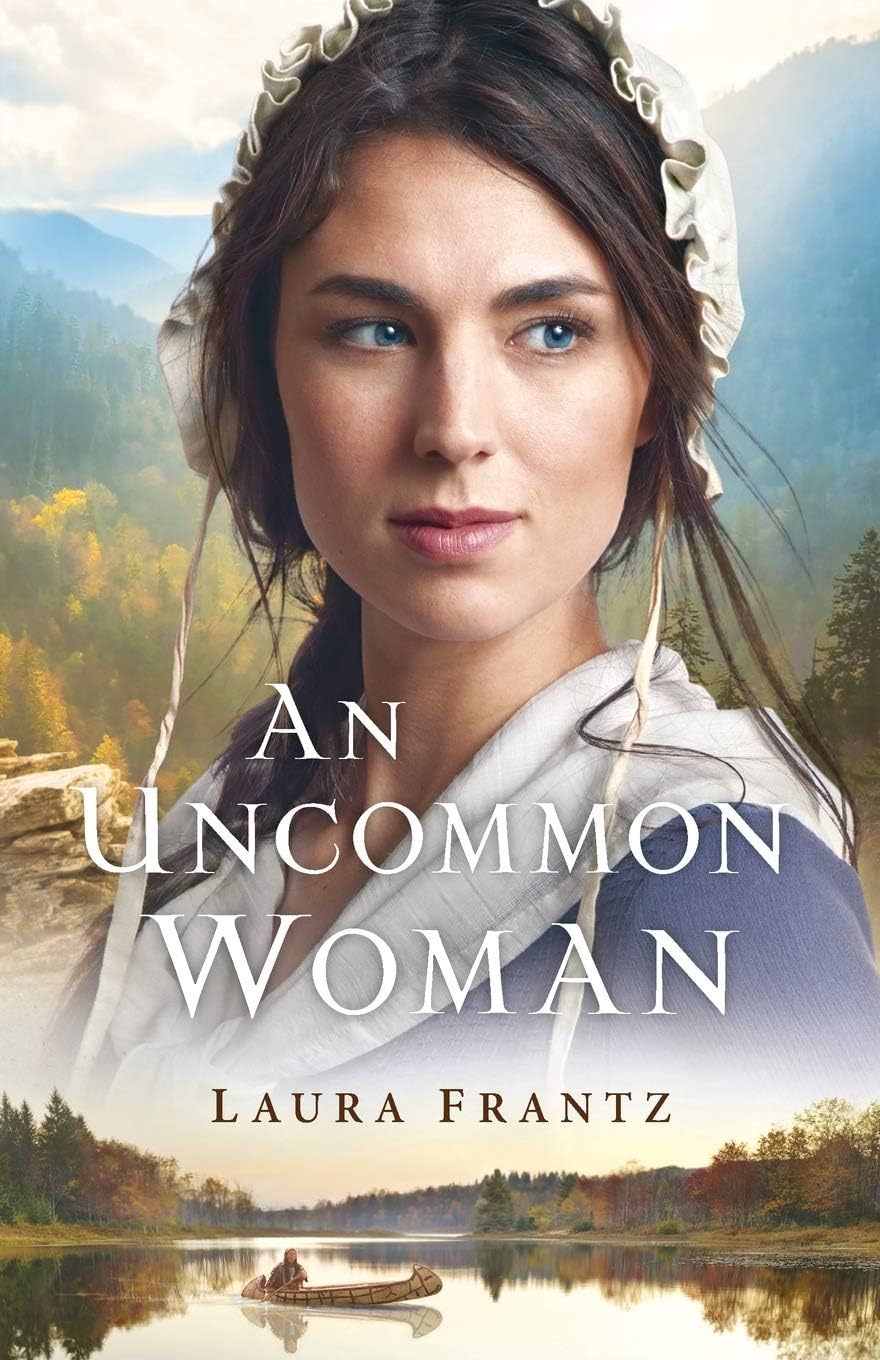
An Uncommon Woman
Product ID: 131607753
Desertcart purchases this item on your behalf and handles shipping, customs, and support to South Africa.
In the borderlands of 1770 West Virginia there is no place for finer feelings. Charged with keeping the peace with local tribes, a hero of the French and Indian War is determined to stay free of romantic entanglement--until he meets a frontier maiden who just might be able to change his mind. Unflinching and plainspoken, Tessa Swan is not your typical eighteenth-century woman. Born and bred on the western Virginia frontier along with her five brothers, she is a force to be reckoned with. Quiet and courageous, Clay Tygart is not your typical eighteenth-century man. Raised by Lenape Indians, he returns a hero from the Seven Years' War to the fort that bears his name, bringing with him Tessa's long-lost friend, Keturah, who disappeared from the settlement years earlier. Determined to avoid any romantic entanglements as fort commander, Clay remains aloof whenever he encounters the lovely Tessa. But when circumstances force Clay's hand--and heart--the stage is set for one very private and one very public reckoning. Review: One of Laura's best & I love them all! - Reading a Laura Frantz novel pretty much guarantees the discovery of a new kindred spirit friend. In Tessa Swan readers will encounter a determined, fiercely protective, devout, and genuine-hearted frontier lady. Tessa embraces contentment and chooses joy regardless of the dangers her family faces by living beyond the nearby fort’s protective walls. While she loves tiny feminine touches like a lace-edged petticoat or delicate hand fan, readers shouldn’t expect a frail hothouse flower in this darling and daring heroine. Tessa proves to be as sturdy and dependable as a meadow wildflower, delighting everyone with her honest, humble charm. Resourceful even when her life is threatened, Tessa’s pioneer spirit provides a glimpse into an untamed but exhilarating time in our country’s history. Of course you can also count on a sigh-worthy hero in Laura’s stories. Dashingly different than the overdone Hollywood handsome, Clay Taggart is a man of substance and strength but also a one who dares to feel even though he believes love is a luxury he cannot afford. Torn between two worlds but determined to follow the Lord to the best of his ability, Clay’s authenticity and audacious bravery absolutely won my heart. Those counted on features that make Laura’s stories so fabulous were, of course, also present. Her reliable research and writing style weave such vivid details into the story that you linger rather than rushing because you want the adventure to last as long as possible. A cast of loveable and genuine characters, each possessing their own flaws and struggles, add delicious ambiance. Then there’s that beautiful redemption thread Laura never fails to include. Before finding Laura Frantz, author extraordinaire, I rarely re-read any book. I will be forever grateful for the opportunity to revisit such beloved characters while anxiously awaiting my next excursion with Laura. Don't miss the free epilogue available on Laura's website! Review: "There is a friend that sticketh closer than a brother." - In my opinion, three things set Laura Frantz’ writing apart from and above that of all others currently writing for the historical Christian market. Firstly, her meticulous and exhaustive research of the period and place. Writing primarily (but not exclusively) in the late 1700’s (and again, not exclusively) in areas of Virginia and Kentucky, she thoroughly employs the entire ethos of her characters’ language, mannerisms, food, farming, and moral and religious values; many of them inherited from European sources, most notably Scotland. Add to that a well-researched grasp of the geo-political climate of the period and you have the makings of a wonderful story. Thirdly, Laura Frantz’ mellifluous narration of the storyline is eloquent and patient. Many a love story is ruined by an author’s awkward rushing of the love angle in an otherwise good story. Ms. Frantz richly deserves the Christy award she won for her 2018 novel, “The Lacemaker,” and this novel may well be a contender for the Christy and other honors as well. Each of the principle characters – Tessa, Clay, and Keturah - is uniquely interesting. Tessa - guileless, unpretentious, yet plucky - demonstrates extraordinary courage – some might suggest foolhardiness - in the face of danger and hardship. Keturah, taken captive at an early age and held for years by Lenapes, has suffered much with repeated dislocation, much in her life having gone awry, though none of her own doing. He entire existence might have devolved into a swirl of life’s most basic questions; “Who am I?” “Where do I belong?” “Who are my people – both the natives and settlers, though they war against each other?” In spite of all she endured she is eminently Christlike and selfless. A proverb says, “there is a friend that sticketh closer than a brother.” Such a friend was Keturah. Clay too had been taken by Indians at an early age. He knew the Indians’ ways well, having lived them in his formative years. His character, thoughts, and values bring into sharp relief the moral paradox of the settlers and the Indians. Clay has had more time than Keturah to adjust to the jarring effects of returning to what remained of his former life. But still he harbored powerful mental and emotional ties to both heritages. Tamanen is not a principal character, and we have less exposure to his thoughts, personality, and actions; but his part is critical to the understanding of the tension between himself and Clay, which in turn is a microcosm of the overall conflict faced by the natives and the settlers. Did the aboriginal peoples, by virtue of their nativity, have exclusive claim to the land with an accompanying right to expel others who sought a place to live in peace and freedom? Did any rights at all accrue to the settlers who fled oppression and strictures on their practice of religion seeking freedom and opportunity? Indians had a different perception about the land – based more on communal rights to use the land on which they lived for residency, hunting and burial grounds - rights that must be protected against encroachers. The settlers held the European concept of exclusive ownership and a person’s or family’s total control of land so owned, along with the perception that any land unclaimed under those terms was for the taking. Clay clearly understood both sets of beliefs, setting up conflict not only between himself and Tamanen, but within Clay's own mind and heart. Probably only a person who had lived in both worlds could grasp the ramifications of the inevitable clash, as Clay and Keturah surely did. So the stories of Clay and Keturah and the Swans – and to an extent Tamanen – transport those nettlesome questions from the abstract to a personal framework. Several passages in “An Uncommon Woman” are relatable to people living today…the excruciating melancholy of parting with a loved one, possibly never to meet again…the vicissitudes of a developing relationship as it ripens from infatuation to deep love…the nocuous effect of alienation from a loved one on health and well-being. “An Uncommon Woman” is a thoroughly interesting and entertaining story. More formal accolades will likely be coming Laura Frantz’ way.


| Best Sellers Rank | #161,123 in Books ( See Top 100 in Books ) #290 in Christian Historical Fiction (Books) #842 in Christian Historical Romance #1,418 in American Historical Romance (Books) |
| Customer Reviews | 4.6 out of 5 stars 2,286 Reviews |
D**F
One of Laura's best & I love them all!
Reading a Laura Frantz novel pretty much guarantees the discovery of a new kindred spirit friend. In Tessa Swan readers will encounter a determined, fiercely protective, devout, and genuine-hearted frontier lady. Tessa embraces contentment and chooses joy regardless of the dangers her family faces by living beyond the nearby fort’s protective walls. While she loves tiny feminine touches like a lace-edged petticoat or delicate hand fan, readers shouldn’t expect a frail hothouse flower in this darling and daring heroine. Tessa proves to be as sturdy and dependable as a meadow wildflower, delighting everyone with her honest, humble charm. Resourceful even when her life is threatened, Tessa’s pioneer spirit provides a glimpse into an untamed but exhilarating time in our country’s history. Of course you can also count on a sigh-worthy hero in Laura’s stories. Dashingly different than the overdone Hollywood handsome, Clay Taggart is a man of substance and strength but also a one who dares to feel even though he believes love is a luxury he cannot afford. Torn between two worlds but determined to follow the Lord to the best of his ability, Clay’s authenticity and audacious bravery absolutely won my heart. Those counted on features that make Laura’s stories so fabulous were, of course, also present. Her reliable research and writing style weave such vivid details into the story that you linger rather than rushing because you want the adventure to last as long as possible. A cast of loveable and genuine characters, each possessing their own flaws and struggles, add delicious ambiance. Then there’s that beautiful redemption thread Laura never fails to include. Before finding Laura Frantz, author extraordinaire, I rarely re-read any book. I will be forever grateful for the opportunity to revisit such beloved characters while anxiously awaiting my next excursion with Laura. Don't miss the free epilogue available on Laura's website!
S**K
"There is a friend that sticketh closer than a brother."
In my opinion, three things set Laura Frantz’ writing apart from and above that of all others currently writing for the historical Christian market. Firstly, her meticulous and exhaustive research of the period and place. Writing primarily (but not exclusively) in the late 1700’s (and again, not exclusively) in areas of Virginia and Kentucky, she thoroughly employs the entire ethos of her characters’ language, mannerisms, food, farming, and moral and religious values; many of them inherited from European sources, most notably Scotland. Add to that a well-researched grasp of the geo-political climate of the period and you have the makings of a wonderful story. Thirdly, Laura Frantz’ mellifluous narration of the storyline is eloquent and patient. Many a love story is ruined by an author’s awkward rushing of the love angle in an otherwise good story. Ms. Frantz richly deserves the Christy award she won for her 2018 novel, “The Lacemaker,” and this novel may well be a contender for the Christy and other honors as well. Each of the principle characters – Tessa, Clay, and Keturah - is uniquely interesting. Tessa - guileless, unpretentious, yet plucky - demonstrates extraordinary courage – some might suggest foolhardiness - in the face of danger and hardship. Keturah, taken captive at an early age and held for years by Lenapes, has suffered much with repeated dislocation, much in her life having gone awry, though none of her own doing. He entire existence might have devolved into a swirl of life’s most basic questions; “Who am I?” “Where do I belong?” “Who are my people – both the natives and settlers, though they war against each other?” In spite of all she endured she is eminently Christlike and selfless. A proverb says, “there is a friend that sticketh closer than a brother.” Such a friend was Keturah. Clay too had been taken by Indians at an early age. He knew the Indians’ ways well, having lived them in his formative years. His character, thoughts, and values bring into sharp relief the moral paradox of the settlers and the Indians. Clay has had more time than Keturah to adjust to the jarring effects of returning to what remained of his former life. But still he harbored powerful mental and emotional ties to both heritages. Tamanen is not a principal character, and we have less exposure to his thoughts, personality, and actions; but his part is critical to the understanding of the tension between himself and Clay, which in turn is a microcosm of the overall conflict faced by the natives and the settlers. Did the aboriginal peoples, by virtue of their nativity, have exclusive claim to the land with an accompanying right to expel others who sought a place to live in peace and freedom? Did any rights at all accrue to the settlers who fled oppression and strictures on their practice of religion seeking freedom and opportunity? Indians had a different perception about the land – based more on communal rights to use the land on which they lived for residency, hunting and burial grounds - rights that must be protected against encroachers. The settlers held the European concept of exclusive ownership and a person’s or family’s total control of land so owned, along with the perception that any land unclaimed under those terms was for the taking. Clay clearly understood both sets of beliefs, setting up conflict not only between himself and Tamanen, but within Clay's own mind and heart. Probably only a person who had lived in both worlds could grasp the ramifications of the inevitable clash, as Clay and Keturah surely did. So the stories of Clay and Keturah and the Swans – and to an extent Tamanen – transport those nettlesome questions from the abstract to a personal framework. Several passages in “An Uncommon Woman” are relatable to people living today…the excruciating melancholy of parting with a loved one, possibly never to meet again…the vicissitudes of a developing relationship as it ripens from infatuation to deep love…the nocuous effect of alienation from a loved one on health and well-being. “An Uncommon Woman” is a thoroughly interesting and entertaining story. More formal accolades will likely be coming Laura Frantz’ way.
S**L
An Uncommon Woman is Definitely an Uncommonly Good Book
Laura Frantz is fast becoming one of those writers I look forward to every year, and perhaps one whose books I would read no matter what they were about. This time, she tackles a piece of history often forgotten, the relationships between white colonial Americans and Native Americans on the frontier. However, this is not Laura Ingalls Wilder's frontier, but the Ohio/Virginia/West Virginia border country. Throw in a three-dimensional cast of characters and you have a refreshing, intriguing book. Speaking of intriguing, Tessa Swan embodies the trait. Laura does a great job of mixing character traits with her. One moment, she's an intrepid frontier woman who can shoot, ride, and handle the wilderness as well as or better than any of her five brothers. The next she's a feminine lady who rightfully craves luxuries like poetry, petticoats, and authentic English tea without being prissy or spoiled about it. She's whip-smart, great in a crisis, but tenderhearted enough to want true love, not a hot and cold relationship. All this makes her a pleasure to spend almost 400 pages with. As for Clay Tygart, he has his fair share of intrigue, too. Raised as a Lenape captive for over a decade, he straddles two worlds with more aplomb than I've seen similar characters do in his type of situation. I did want to see more of his Lenape experiences paying off and influencing the story, but what exists works great. I also loved the twist regarding Clay, Tamenen, and Keturah. It incited some deep, relatable conflict and raised the stakes well for our characters. The secondary characters were pleasures as well, although some are necessarily less developed than others. Some, I wanted to see more of, to learn how they might grow and change, or how they might influence the story. Jasper and Keturah are the two that come to mind. With that said, they work well together, especially in the Fort Tygart setting, which almost functions as a character in itself. I love settings that function in such a way. The plot is an almost perfect mix of action and romance, internal and external stakes. From the muster day kiss to Tessa's ingenious way of dealing with Native American interlopers, from Clay and Tessa's first dance to their final one at Semple's, each scene is crafted with a deft and loving hand. You never feel as though one half of the story is pulling you away from the other, which isn't an easy feat. I also appreciate that Laura didn't fall back on some old, almost cliched conflicts like having Tessa's frontier upbringing pose an obstacle to marriage. The overall story can feel too packed at times, or as if certain conflicts or characters don't have quite enough space. For instance, Laura explains in her author's note why Keturah is not the heroine, and I'm on board with her decision. But Keturah seems like such an important character and catalyst, yet she's barely there. The same is true for Tamenen. Perhaps if Clay's captive years had been better explored, or Tessa had been the captive, this would've worked better. Overall though, An Uncommon Woman nets a solid 4.5-4.75 and a solid recommendation.
M**Y
A GEM of a story; it has everything!
AN UNCOMMON WOMAN by Laura Frantz is a treasure of a story. It has everything ~ engaging storyline, plot twists aplenty, characters that move into your home! All this presented in Frantz’s lovely prose with the sensitivity and insight into people and cultures that is rare and a pleasure to read. Once again Frantz has captured the tenor of the setting, and so skillfully planted her characters in that setting that it’s impossible to imagine them hailing from elsewhere. Tessa Swan, born and bred on the western Virginia frontier with five brothers is tough and resilient as a willow branch, competent and caring, and weary of having to live always looking over her shoulder and yearning for a pretty petticoat. Keenly aware of possible consequences meted out by the clash of cultures of settlers and Indians, she just sets to work daily whether on their farm or at the family’s ferry across the Buckhannon River. She doesn’t waste time dwelling on possibilities or losses, but uses wisdom gained through experience to make cautious choices. Frantz draws Tessa ~ and indeed, all characters in this story ~ so intimately connected to their land and experiences, we feel we’re peering into the viewer of a time machine to meet these frontier folk and watch living history. The cast of characters is realistic and flawed, and so deftly drawn that even five brothers have clear, distinct personalities. For example, “Ross always dwelt on the light side,” while “Jasper was all pounds, and pence and position.” When Colonel Tygart from the nearby fort meets the Swan family, we watch as interest and attraction spark and grow between him and Tessa. Readers will enjoy walking with them as the tension grows and we wonder ~ Will these two souls, fractured by loss, be able to see each other as anything other than a threat? Will their environment and culture give them opportunity to develop any sort of relationship? Life is hard out there. Crops, animals, gardens, friendships, dreams—many things die on the frontier. Frantz builds her story world so well that readers feel the tentativeness of life on the edge of the wilderness. Everything but God must be held loosely. And when we hear a snap, we spin around to see who’s creeping up on us…though it be just a bit of wood in our own fireplace. And Frantz’s delightful way with words gives everything in this story a fresh and new view—setting, people, dilemmas, decisions. I collected quite a list of favorites to send her. I’d like to share them with you, but that would rob you of the joy of seeing them light up the pages as you read. Frantz has once again given us a book that rings with truth, delights the sense, surprises with plot twists, and takes the reader on a journey that just might make you stay up reading later than you intended. Enjoy the journey.
K**E
unpredictable
I found this book to be engaging and how it was unpredictable at every turn. It was well written, and I could easily see myself traveling with Tessa.
P**S
A stellar novel to start the new year
It’s always a pleasure to read a novel by Christy award-winning author Laura Frantz, who never disappoints this finicky reader. So it is with her latest release, An Uncommon Woman, the story of what-you-see-is-what-you-get Tessa Swan and the I-am-what-I-am Clay Tygart. Ah, but these 18th century Virginians are so much more than what they see in themselves and what they think others see in them thanks to the skill of Frantz, who has yet to disappoint me since her first novel, The Frontiersman’s Daughter, debuted in 2009. Frantz ranks among my top four must-read authors because of her consistent expertise in crafting words that keep me turning pages. Known for her impeccable research, she leaves me with a better knowledge of the culture and customs of the people and the time they live. The dialogue is authentic and never stilted or out of place. The characters are well-developed so that the reader isn’t left wondering or confused about their motivations or actions. I love that young Tessa is strong and determined, but malleable; independent yet loyal and committed. Clay Tygart is a man of integrity and decency, sure of himself in many ways but wrestling, like Tessa, with inner turmoil and doubts. Frantz skillfully brings these two together in a perfectly paced and lyrical fashion, intertwined with tense and intense encounters with family and foes, bittersweet reunions and partings, a little bit of humor and some mighty fine and perfectly placed swoony scenes. My only complaint is that there’s too much time between her novels, but that lends itself to more time to re-read her other books. I was privileged to read a rough first draft of An Uncommon Woman, and I received an advanced copy of the book from the publisher. I also pre-ordered AUW because I just can’t get enough of Laura Frantz. My review was not solicited and all opinions are my own.
T**S
A Proper Romance Set in Dangerous Circumstances
This is the first Laura Franz book I've read and I thoroughly enjoyed it. It is set in the 1770's near my home. I chose the.book because of it's setting, South of Morgantown, West Virginia. Colonel Tygart and Fort Tygart appear to.be fictional, however named after the Tygart River and Tygart Lake in the area. I grew up in Wheeling, WV, along the Ohio River and am familiar with the history of that area which was known for many Indian skirmishes and fights during the same time this novel is set. I am less familiar with the history of the Buckhannon and and Tygart Rivers but the story and setting were believable. I hadn't intended to buy a love story, which this is. However, it was tame and as proper as the protagonist, a strong young woman with several brothers and her widowed mother. Her Dutch childhood friend had been taken by Lenape Indians several years earlier, and handsome Colonel Tygart returned to the Fort, bringing long lost Ketura, whose family has left after the heartbreak of losing.their daughter. The story has drama amid the sweet telling of hard life on the then western frontier. I enjoyed it very much.
N**H
Thoroughly Swept Away
What praise can I give Laura Frantz’s An Uncommon Woman that hasn’t been given? She has written with beauty and precision the kind of story that absolutely grips me in this frontier tale. I was thoroughly swept away into a world of danger, humanity, and romance. Frantz’s characters, especially that of Tessa, the story’s heroine, shine through with the sort of vivid personality all writers want to capture, but not all do. When I met Tessa, it wasn’t long before I realized that the cover artist had rendered her perfectly. See that expression on her face? Know that when you read this book, you'll envision her just like that. You'll clearly imagine other characters like Tessa’s aunt, “a fearsome wrinkle of a woman”, her brave and sometimes impetuous brothers, her long-lost and unusual childhood friend, and of course the hero Clay, called “Ghost Eyes” by the natives, because “his blue eye, it sees heaven. His brown eye, earth.” I was also pleased with the creative yet accurate way that Ms. Frantz rendered some actual historical characters in the story, especially the volatile Simon Girty, someone with whom most modern readers are probably not very familiar. His presence immediately set me on edge. (If you know much of Simon Girty, it'll do the same to you.) The peril of the times and the situations settlers faced in that over-mountain wilderness enthralls me. I can’t imagine their level of endurance. Ms. Frantz portrays such with beauty and truth, and she doesn’t shy away from harsh realities. An Uncommon Woman was an uncommon book, provoking in turns happiness, sadness, and content. This may have become my favorite of Laura's books, hearkening back to the likes of The Frontiersman’s Daughter and A Moonbow Night.
R**L
So we think things are difficult now?
After reading Laura Frantz's The Frontier's Daughter, I had to read An Uncommon Woman. It came up to all my expectations of being taken to another time and place with so many hardships, yet triumphs. A good book to read in today's challenges. I loved it.
G**S
fascinating historical fiction
This is another captivating story by Laura Frantz. The American western Virginia frontier in the eighteenth century comes to life as she unfolds the story of a young woman, Tessa Swan who was born and bred on the frontier and a man named Clay Tygart, a white man who was raised by Lenape Indians. As always in a story by Frantz, I learned so much about that time and place in history in general and about the pioneers in particular. I became immersed in their daily lives, and by the time I finished the book, I felt I knew all the people in the story personally. Frantz is a great writer, drawing in the reader with exceptional gifting in descriptive writing and in-depth character development. Reading one of her stories is like sitting down to a feast.
K**L
Laura does it again!
Laura Frantz continues to be my favourite author, and has been since I first picked up The Colonel’s Lady years ago. I cannot wait for each new novel. As I read this newest contribution, I kept dreading that I was nearing the end the further I read, but I didn’t want to put it down. Her characters feel genuine, the detail and history worked into the story are captivating and refreshing, and I yet again was sad that the story came to an end. I count this among my favourite novels of hers, along with The Colonel’s Lady and the Frontiersman’s Daughter, but honestly, I find it difficult to choose favourites.
A**E
Ripped my very heart out!
This one ripped my heart out of my chest and did a little victory dance over top as I lay sobbing (heartless) in a corner. Okay, so maybe that's putting it a bit dramatically, but whoa. This book was intense. INTENSE frontier life, yo. However, it was beautifully written. Frantz did a great job with vivid wording, creating an immersive landscape and setting--as I said, it was intense. The pace was pretty slow, but I didn't find myself minding, until the 50-75% mark when I was expecting certain big plot things to happen, and then they didn't, until like three chapters until the end, and then I kind of felt like certain things were sprung, not explained properly (considering how methodic the plot pacing was until that point) & just rushed through. Yes, I read the epilogue on Frantz's website, but...I've never been a huge epilogue fan. So, I wished that the pacing could've changed about halfway through to accommodate some of the big plot changes/arcs that took place at the end--when I felt they should've taken place half-ish way through so we had longer for the people to sort out the fallout of these major events. Some key moments definitely felt rushed to me. However, those matters aside--I really enjoyed Clay & Tessa as characters. They went so well together. Both such sweet, genuine people--and I love to see a good couple like them come together! They were a slow burn couple, and boy was it hard to not see them come together sooner--but as far as slow-burn romances go--theirs was pretty fantastic, I'll admit.
G**L
Another page turner that needs a part 2!
I thoroughly enjoyed this book. An engaging history lesson on frontier life that I didn’t want to end. I was not ready to say goodbye to Clay and Tessa when I finished the book. I wish there was a part 2! Thank you Laura for another deeply satisfying read.
Trustpilot
1 day ago
2 months ago