Desertcart purchases this item on your behalf and handles shipping, customs, and support to South Africa.
๐ Elevate your focus, own every detail.
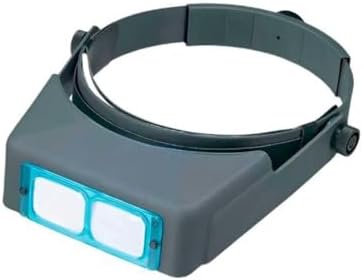
The Donegan DA-5 OptiVisor is a premium binocular headband magnifier featuring 2.5x magnification with high-quality optical glass lenses and an 8-inch focal length. Its adjustable, padded headband offers all-day comfort, while compatibility with third-party LED light kits ensures optimal illumination. Ideal for professionals and hobbyists demanding precision in jewelry-making, electronics, miniature painting, and more, it fits comfortably over prescription or safety glasses, delivering distortion-free, hands-free magnification that outperforms cheaper alternatives.
| ASIN | B0015IN8J6 |
| Best Sellers Rank | #48,376 in Health & Household ( See Top 100 in Health & Household ) #102 in Magnifiers |
| Brand | Donegan Optical |
| Brand Name | Donegan Optical |
| Color | Black |
| Customer Reviews | 4.6 out of 5 stars 940 Reviews |
| Global Trade Identification Number | 00633096000502 |
| Handle Material | Plastic |
| Included Components | DA-5 OptiVisor Headband Magnifier |
| Item Dimensions L x W | 11.5"L x 8"W |
| Item Type Name | OptiVisor |
| Item Weight | 0.27 g |
| Lens Material | Glass |
| Magnification Strength | 2.5 x |
| Manufacturer | Donegan Optical |
| Manufacturer Part Number | DA-5 |
| Manufacturer Warranty Description | No warranty. |
| Model Number | 6.33096E+11 |
| Product Dimensions | 11.5"L x 8"W |
| UPC | 654207152002 798804883287 791836772017 633096000502 885115188580 885233185157 |
| Unit Count | 1 Count |
N**O
Excellent binocular vision and a definite cut above the low priced units
I had to sort through a lot of reviews for similar products that were cheaper in price, and questionable in quality, before settling on this Optivisor unit. I knew from the start that I wanted to have a setup that has a light, but definitely did not want a silly USB rechargeable light that has a fixed battery that is not replaceable. I wanted something with an aimable light kit that takes standard double a or triple a batteries. This one has a very adjustable and secure headband, that has a pad in the forehead area, and a very good tension adjustment nut with excellent click detents for holding its setting. I have a similar antique item that belonged to my grandfather, that is all metal with a sliding adjustable hoop that goes around your head and a flip up lens assembly. The Optivisor appears to be the closest modern equivalent and I have been delighted with it. The visor assembly does pivot up and down and stays in place nicely, but more importantly, you can get a third party LED light kit made by Quasar, which is a truly excellent addition. Because the light kit places LEDs around the periphery of both lenses, it stays permanently aimed at whatever you are looking at. I highly recommend a complete kit that includes this Optivisor, the Quasar LED light kit, and the accessory pivoting loupe lens. There is a minor difficulty you have to watch out for when you install the accessory lens along with the Quasar LED light kit. Do not fully install the light kit with the one-way push pins until you attach the lens. You also want to know which eye is your dominant eye, and be sure to install the lens on that side. See my review for the lens kit about how to know which is your dominant eye. The screw shaft that comes on the lens is not long enough to pass through and accommodate the thickness of the LED bezel. The Quasar light kit comes with a longer screw and you have to disassemble the lens assembly, with its spring and tension nut, in order to install the longer screw. The screw on the lens replaces one of the four plastic push pins and be sure to adjust the spring tension nut first for proper pivoting friction, before you install and tighten the nut on the inside of the visor. If you've got it right, the lens easily pivots in or out of your line of vision and stays in place without being jammed up. There is a pivoting monocular lens assembly that is available as an option for this visor. One of the things that I wanted was the opportunity for more magnification that some of the cheaper units seemed to offer. Well this is a solution as an accessory that addresses all my needs. You have to accept the fact that when you use the accessory lens, you temporarily give up the binocular vision and just concentrate on what you see with your dominant eye. It works quite well. The illuminated binocular / stereo magnified vision that this visor and light kit provide are excellent for doing fine work with small tools, surface mount electronics work, pulling splinters, plucking reversed eyelashes etc etc. The total kit with accessories costs much more than the cheap stuff but really delivers. Sometimes life is too short for cheap junk. I really appreciate the quality and utility of this kit, and I expect it will last a long time.
K**R
Awesome, worth the cost
I picked this up for miniature painting. I was previously using a magnified swivel lamp and also ordered the Yoctosun glasses that a lot rave about. Let me tell you the Donegan's are by far the best of the 3. I honestly shied away from the Donegans as they looked cheap and like they would not work well. Comparisons: With my swivel lamp the Donegan's are much better. The swivel lamp had a 2.5x magnifier made of glass. The problem was that it was 5 inches in diameter and you had to look through that. Due to the curvature of such a big lens if you were not centered exactly in the middle then whatever you were looking at would be distorted and/or out of focus. The viewing distance was such that your paintbrush would always be hitting the lens. You also could not change out the lights if you wanted something brighter. Yoctosun: These were really not bad at all. Firstly the lenses are plastic, and the Donegan's are glass and there is a significant difference in clarity and function. The Yoctosuns are also open so you don't really get that tunnel vision that I think is actually better for seeing small stuff. The Yoctosuns were also really uncomforable after 15 or so minutes, the nosepiece pinches and is only lightly padded and the entire unit is front heavy due to the light. Donegan: Perfect mix of all. The glass lenses are much clearer with zero distortion. The closed design lends itself to ultra sharp focus on what you are painting. The headstrap system is quite comfortable for hours at a time and you can very easily swivel the entire lens/headset up. While the headset is on you can also easily see underneath for things you need regular vision for such as putting your brush in paint. I got the 2.5x which is perfect for painting minis, you get about 8" of focal distance which is perfect for not having the brush hit the headset and also for having a comfortable stance for your shoulders and neck. But you can always buy different lens strengths. Best of all I can choose which light to purchase. I didn't choose one that attaches to the headset as I wanted something brighter. Rather I was able to get a 5000 lumens led bulb that I put onto a swivel light, so it can be moved around independent of where I am.
J**M
Wish I had bought these sooner!!
I bought the optivisor DA-5 and they are perfect for my jewelry projects! Right now Iโm working on a wax carving with some fine details and that will also hold 4mm stones, so not very tiny, but enough that I felt that I was straining to see what I was doing. Also, Iโm new to working with stones and want to teach myself some setting techniques, so I caved in and bought them. I regret not getting them sooner! With the strength of magnification I bought I definetly feel they are adequate for the stone size Iโm currently working with. As I get more experience working with stones and go smaller I might look into get a higher magnification or one of the attachable loupes that donegan also sells for the Optivisors. Theyโre comfortable and they fit my small head really well and are easily adjustable. I didnโt experience any eye strain and never had difficulty focusing on my project. They feel sturdy and the lenses are great , super clear and not an imperfection on them. Iโll definitely be putting these on every time Iโm at my bench. Well worth the money.
T**H
Good but not impressive
Bout X2 zoom which is DIA5 and the result is there but what strikes me is: why cant NO ONE make headband with X5 that does not require you to look at the subject 1" away and allow 1 foot away instead ? Why is it so hard to make optics like that ?
J**.
It helps old eyes see much better
I have used this magnifier for working 38 count (38 threads per inch) cross stitch projects several months now and like it. The 2.5 magnification is perfect. Two changes that I would like to see is the rim around the glass magnifiers should be clear. The blue frame was distracting for a while until I got use to it. Also there could be a bit more padding in the head frame. If it were possible to have a bit of padding on the visor part that would be good also. I find the sharp edge of plastic a bit uncomfortable at times. I would recommend these to any one who does fine, detailed work (miniatures, jewelry, scale modeling, etc) .
K**R
Prescription Glasses, DA vs. XL/AL models, Lens Plates, OptiLoupe, Quasar LED Light, and Diopters vs. Magnification ...
Donegan vs. MagnifyLabs vs. Bausch & Lomb: The main decent quality choices seemed to be: Donegan Optivisor DA ($36 - glass lens - this review) or LX ($26 - acrylic lens), MagnifyLabs Headband Magnifier ($26 - glass lens) and less-known knock-offs, and Bausch & Lomb Magna Visor ($36 - acrylic lens). The Bausch & Lomb had too many bad reviews. The MagnifyLabs apparently has glass lenses like the Donegan DA and is cheaper and well-reviewed. But for only $10 more I preferred to go with the proven original - the Donegan DA. The headband has a huge adjustment range to accommodate a-n-y head size and is remarkably comfortable due to the padded forehead. The plastic adjusting size and flip-up tension knobs are hokey but they work. DA vs. LX / AL Regardless of misinformation by others, the Optivisor "DA" models have the two-piece glass-lens-in-blue-tinted-plastic-frame lens plates, while the cheaper Optivisor LX (= AL lens) models have the single-piece-all-clear-molded-in-acrylic-lens-plate. No idea why Donegan chose to confuse things by using Optivisor "LX" for the headband but "AL" for the lenses. My box said "DA-5" and I scratch-tested the lens - it's glass. Prescription Glasses: You can wear your glasses with this - plenty of room - or no, as the lens acts like near-sight glasses anyway. I prefer to wear my normal prescription glasses with these since they correct both my eyes for crystal clear starting vision, with two interesting side effects: 1) the overall magnification is noticeably greater due to the magnification added by my glasses (great!); and 2) the focused working distance is reduced - for me for the 2.5x lens from the nominal 8" to 5-6". So if you wear glasses, consider this in your lens power choice, as your glasses will add more magnification themselves, plus reduce your working distance further than the nominal number claimed. Lens choice: For me, the 2.5x magnification lens (5 diopter) is perfect for general usage inspecting things like splinters, coins, golf club grooves, electronics, bugs, super-glueing very small stuff, etc., because it shows everything of possible interest while still allowing a comfortable 6-8" distance from the work and a reasonably broad and deep field of view. This is as opposed to, say, the highest 3x magnification (10 diopter) which makes you work excruciatingly close at 4" (or 3" with glasses) and also with a narrower field and depth of view. With a 3x lens at 4" you can't even get your fingers in there to do anything - only for specific professional use. So I think most would find opting for a comfortable working distance more important than trading that off for any extra magnification. A modern car key is about 4" long so try it - put a newspaper down and bend down until your glasses meet the car key and try to do anything in front of the lens. Plus you can just add a $10 OptiLoupe (see below) to a medium magnification lens for the rare times you want to scrunch down to 2" to check out something further at 4-5x. OptiLoupe LP-1 ($10): I added the separate 2.5x OptiLoupe for the occasional super-close-up. The loupe mounts on either side you prefer - just pull the original lens mounting screw or pin out on that side and shove the OptiLoupe on with its longer screw in its place. The loupe lens was maybe glass at one time but it definitely is acrylic now (I scratch-tested it), but that seems irrelevant given the perfect clarity. You have to close the other eye when using the loupe, but that works fine. (You can't use one for each eye because your eyes won't focus properly through both together.) Assuming you'll rarely need/use a super-close-up, this is a much better solution than having to switch a separate high power lens plate in and out of the headband. With my glasses on and this flipped down, the working distance is reduced to 2" but the clarity is great. Quasar LS (Lighting System) model 6010 ($25) - not Donegan You can see things with normal room lighting, but for serious views, actual detailed work, or long use, the more magnification, the more light required. The Quasar is very convenient - very bright lighting comes with you and I haven't felt the need to add external light. To add it on, you pull the two original lens mounting plate screws out, slap the Quasar LED frame on the front of the lens plate, and stick both back on with the longer plastic pins supplied. Then you just place the battery pack on the side of the headband and strap it on with the supplied velcro strap. Simple on-off switch on the side of the battery pack. Unnoticeable when mounted. Takes 2 AA batteries that come with it (nice surprise - Energizer alkalines!). Batteries claim 100+ hours of life, which given LEDs, seems likely. Fyi, works with the MagnifyLabs headband also. Donegan offers the VisorLIGHT, a single non-LED bulb alternative but it seems pretty lame in comparison given 5 hour battery life, $10 replacement Xenon bulbs, and review quality issues. Additional/Replacement Lens Plates: This is extremely confusing because of the supplier misinformation as of June 2016. So I talked with the manufacturer Donegan. They confirmed they do offer both glass and acrylic additional/replacement lens plates through their dealers (although, oddly, you can't find these on their manufacturer website). They confirmed their glass lenses are two-piece, with the lenses glued into a blue-tinted surrounding acrylic frame and designated LP-2/3/4/5 with "LP" standing for Lens Plate. Their acrylic lenses are a single-piece of clear acrylic, with the lenses molded directly into and as p[art of the overall acrylic frame and designated AL-2/3/4/5 with "AL" standing for Acrylic Lens. So glass lenses have a blue-tinted frame and acrylic lenses have a clear frame. Confusingly, all the "LP" lens plates currently listed on Amazon indicate in their details that they are acrylic, not glass, which conflicts with the "LP" designation. Counter-confusingly, the pictures show blue-tinted frames which would indicate glass lenses. So either they are glass and the "acrylic" in the detail description is wrong, or they are acrylic and the LP and picture are wrong. So check what you get accordingly - maybe they'll correct this corrected after our talk. Optical Power (Diopter) vs. Magnification Power: I did a little research to figure out what the Optical Power ("Diopter") vs. Magnification Power thing is all about. Turns out Optical Power ("Diopter") is the fundamental measurement optical professionals use because it integrates naturally with the compound optical equations typically required in their profession. Technically, the Optical Power (Diopter) of a lens equals the reciprocal of its Focal Length measured in meters. So, for example, a lens with a 20 centimeter focal length (1/5th of a meter) has a Diopter of 1 / [1/5] = 5, and a lens with a 10 cm focal length (1/10th of a meter) has a Diopter of 1 / [1/10] = 10. "Magnification Power" = the increased size of the image viewed, not the Focal Length, so it is not a one-to-one linear relationship, but is generally related to Diopter as follows: Magnification = [Diopter / 4] + 1. So, for example, a 5 Diopter lens has a Magnification Power of: [5/4] + 1 = 2.25x while a 10 Diopter lens = [10/4] + 1 = 3.5x magnification. Usefully, you can add Optical Powers (Diopters) to understand the Magnification result, but not Magnification Powers. So adding a 5 Diopter OptiLoupe (2.5x) to my 5 Diopter headband (2.5x) = 10 Diopters => which converting = [10/4] + 1 = 3.5x overall magnification ... similar to the maximum 10 diopter 3.5x lens plate option.
A**.
Good quality
Amazing, as I expected.
D**L
Good optics, comfortable, light weight
Surprisingly comfortable, lightweight, can have these on my head for extended periods of time. The 2.5x does get one quite close to whatever you want magnified, and I might buy the 2.0x lenses in the future for a little more distance. These are not the least expensive headband magnifiers, but I have a feeling that the less expensive ones are probably pretty cheap (!). The Donegan magnifiers have ground glass lenses, it looks like the no-name clones have multiple plastic lenses (and lots of other gadgets as well). Judging by the overall appearance it looks like most of the effort and expense went into the ground glass lenses. My DA-5 model fits my XL - XXL head, the headband becomes more oval as it is expanded (using the rear knob). Don't over-tighten the side knobs that raise and lower the magnifier, if you do, the act of raising or lowering will cause the entire headband to move up or down, maybe even off your head.
Trustpilot
2 months ago
3 days ago