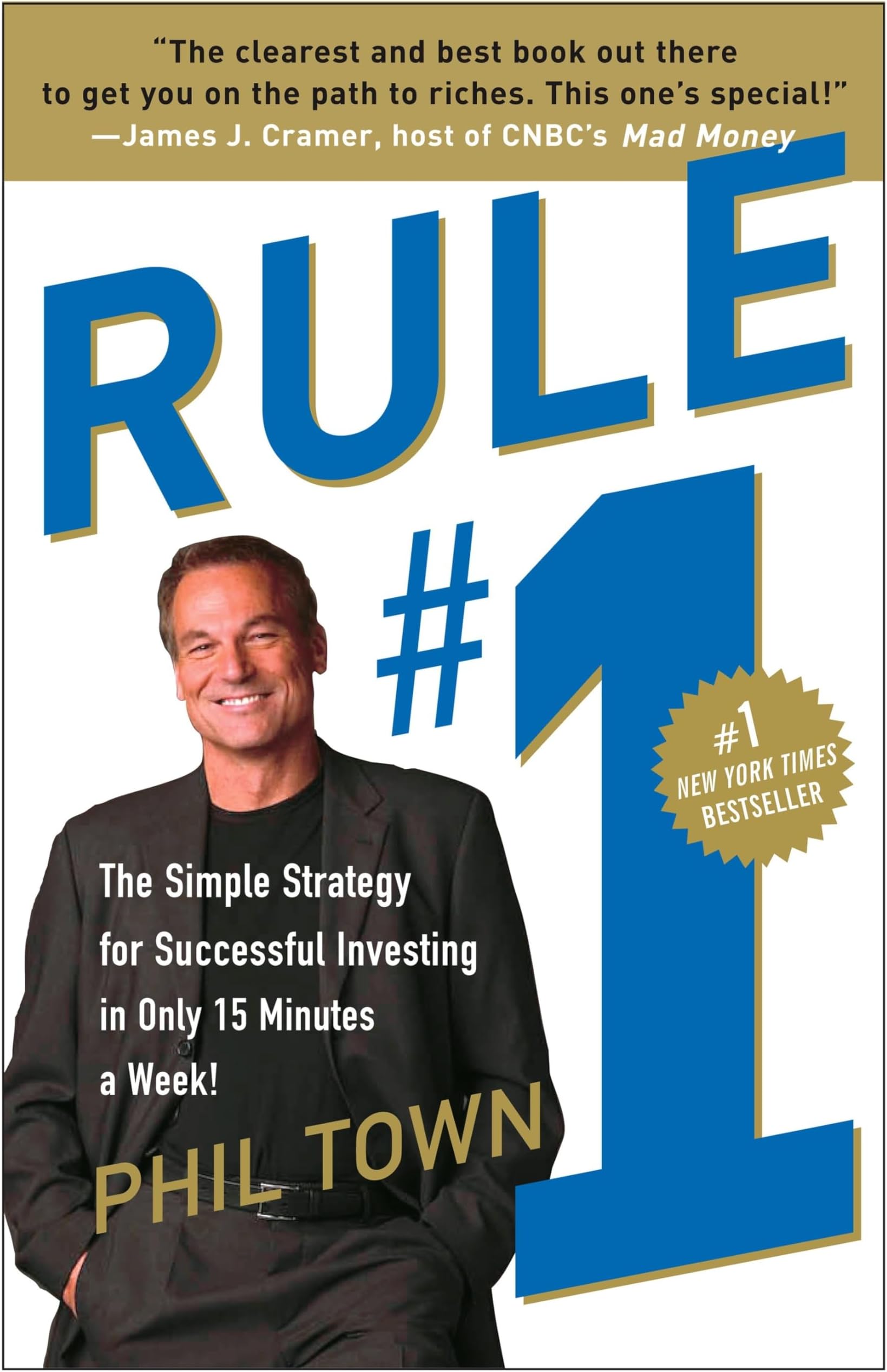
Rule #1: The Simple Strategy for Successful Investing in Only 15 Minutes a Week!
Product ID: 11648430
Desertcart purchases this item on your behalf and handles shipping, customs, and support to South Africa.
#1 NEW YORK TIMES BESTSELLER • “The clearest and best book out there to get you on the path to riches. This one’s special!”—Jim Cramer, host of CNBC’s Mad Money “Great tools for anyone wanting to dabble in the stock market.”— USA Today Phil Town is a very wealthy man, but he wasn’t always. In fact, he was living on a salary of $4,000 a year when some well-timed advice launched him down a highway of investing self-education that revealed what the true “rules” are and how to make them work in one’s favor. Chief among them, of course, is Rule #1: “Don’t lose money.” In this updated edition to the #1 national bestseller, you’ll learn more of Phil’s fresh, think-outside-the-box rules, including: • Don’t diversify • Only buy a stock when it’s on sale • Think long term—but act short term to maximize your return • And most of all, beat the big investors at their own game by using the tools designed for them ! As Phil demonstrates in these pages, giant mutual funds can’t help but regress to the mean—and as we’ve all learned in recent years, that mean could be very disappointing indeed. Fortunately, Rule #1 takes readers step-by-step through a do-it-yourself process, equipping even the biggest investing-phobes with the tools they need to make quantum leaps toward financial security—regardless of where the market is headed.
| Asin | 0307336840 |
| Dimensions | 6.13 x 0.83 x 9.25 inches |
| Isbn 10 | 9780307336842 |
| Isbn 13 | 978-0307336842 |
| Item Weight | 1 pounds |
| Language | English |
| Print Length | 336 pages |
| Publication Date | August 28, 2007 |
| Publisher | Crown Currency |
User
Helpful
I ordered this book sight unseen from Amazon because of the advanced reviews. If I had seen it first, I *might* not have bought it. But I'm still glad I have it anway.What I really like about this book is that it explains key financial figures for calculating the future worth of a company and for deciding what a good price would be to pay for the company today (in terms of the paid stock price.) This aspect of the book is invaluable and is easily worth the cost of the book.What I don't like about the book is the presumption that you can just sit down, at any given time, and with a little research, quickly find a company that's on fire sale and that will safely reap 15% a year or more, for many years out. It takes special circumstances to find companies in such positions. One of the author's inspirations, Warren Buffet, has not found many such opportunities for years now, which is why he is sitting on 46Billion in cash. He can't find anything to buy that's cheap enough and that would meet the author's criteria!So the author is disingenuous in suggesting that you, after reading the book, and putting in a few minutes a week looking at web sites, can discover a gem that the greats like Buffet haven't been able to find. Bargains like this don't come along everyday. But they do come along over time.And that's why I ended up really liking this book. The author's instructions on how to find such gems thrown into the trash by the market, when such situations occur, is the clearest, best, and simplest description I've come across (and I have no less that 3 sagging shelves of investment books.) I'm going to use the information the author gave so that, when the market tanks, say, I can pick up some of the great companies he describes and KNOW, because of his formulas, that I'm buying a jewel at a bargain basement price. I'd been looking for that information for some time, thus, in the final analysis, I really do value this book.
User
Learn the System, Research Each Company for 1 Hour
Do you want to be a long-term investor?If so, this is the book to read. I feel like I get it, but it takes ongoing effort to find stock picks that will work. And by "work" I mean giving 15% annual returns for the next 10 years (or doubling twice).Forget the 15 minutes per week. It takes more effort than that.The biggest obstacle is understanding the system and then finding the numbers. The author explains it well. But you will have to figure out how to get the information you need. I found it, but only after lots of looking. Your web research skills will pay off here. And you will likely use his website calculator to do the math on the Margin of Safety, but he offers it for free.Here is what it takes.I spent several days learning the system of finding great companies. This took me 50-100 hours of finding the right websites and getting it down to a simple research system that worked for me, mostly based on the book.Now I research individual companies for about an hour and put their stats on a notecard. This INCLUDES the actual price I want to pay for the stock.But you will have to research 100 companies to find 10-15 great companies.The prices will be way too high, except for one or two companies. Invest in those. You only need one or two or three investments like this per year.Repeat the research process until you find more great companies.Besides teaching the system itself, the book's strength is in showing you what to look for right away before wasting a lot of time researching a company. So if it doesn't fit this initial criterion, I move on immediately. So I don't have to waste an hour on research for that company.It takes time, especially in your learning phase, but it is time well spent.
User
Overstated promise, but mostly sound advise
I read this book last summer for the first time. Now I read it again. It is good that I did; last summer I would have given it only two stars because of the hype, including the cheesy name "Rule #1 Investing". On second reading, and with some experience gained in the meantime, I found the book a lot more insightful.Town's book's best feature is that he does not focus on the price of a stock as the first and foremost information about a company. That sets his book apart from most information sources about stocks (especially the media coverage). What I like about the book is that it is about INVESTMENT, as opposed to speculation. He describes an approach of figuring out the fair value of a stock. Whereas the principle is sound, the formula is somewhat flawed, especially the approximation that the PE of the stock would be twice its EPS growth rate (expressed as %). Town correctly identifies the ROIC as the most important numeric parameter of the company's moat, and the equity growth rate as the best predictor of its long term earnings growth rate. Another important positive of the book is its emphasis on assessing the qualities of the company's management. There are many excellent businesses that disregard the interests of the owners (the shareholders), and the top managers self their own interests. John Bogle's books explain the rampant abuse in "managers' capitalism" better, but Town appropriately addresses the issue from a practical point of view.The use of the "tools" (technical trading) in conjunction with the stock valuation is an interesting notion. However, it works only when your investment is relatively large, and "nimbly dancing in and out" of holding equity would not eat up the profits due to trading expenses (commission). Apart from the fact that Town's description may lead the reader to overtrading, it is important to recognize that even with limited selling and repurchasing, the approach is ONLY viable in IRA accounts. Otherwise the compounded gains will be destroyed by compounded tax expenses. (Realized gains are taxed in the same tax year when the gains occurred.) Town points out that legislation should allow investors to roll over their gains into different stocks without taxation, similar to real estate. However, until that happens, Town's approach is not going to deliver the promised 15% annual return. In fact, there is no guarantee for such return even if one uses a tax-deferred IRA account. That is a negative of the book - it just promises too much. It is clearly a hype.There are various investment strategies, and the one described in this book can be combined with some others. For example, Greenblatt's "The little book that beat the market" and his stock-screening website would complement Town's approach, and aid identifying underpriced, solid companies. However, some other investment strategies may not be compatible. It is questionable that Town's approach is superior, but it is clear that it is a good approach.Take seriously the margin of safety he mentions. It is important to note that the future fair value estimates are not precise, and without the margin of safety, the investment may be too risky. If one insists on the margin of safety, the stock may - on occasion - yield far more than 15% return.The folksy style of the book may find approval from some readers, but personally I did not like it. It could have been conversational without using double negatives, colloquialisms, and - simply put - poor, unrefined English. Do we need to shoot for the lowest common denominator?I am not sure how Town made his fortune. What he describes, cannot be explained with 15% annualized return, and was probably NOT "Rule #1" investing. I am also uncertain, whether Town makes more money from investing, or from his book and investment seminars (like Kiyosaki). It would make the book a lot more credible if we knew whether that investing by the "Rule" is Town's primary source of income, and whether he personally is still making 15% or more on his stock investments.
User
Biggest Flaw In The Book
There is one big flaw in the book and I did not wait to even finish it before writing this!The man gives a terrific introduction to valuation and stock analysis. No doubt! In fact he enlightened and unstuck me from 10% return mindset. He also gave wonderful new angles on business valuation like ROIC and Equity growth rates.But when arriving at present valuation - "the sticker price" of the stock, he takes projected future EPS at Year 10 and multiplies it by a conservative P/E. That will be his starting point which he un-compounds at 15% rate of return for 10 years to arrive at present stock price!Boom and there lies the big flaw!If the market does not value the stock at year 10 at his conservative P/E, if the fortunes of the sector diminishes or if his arrived P/E projections for Year 10 still turns out to be too steep (He talks of projected P/E in 40s and 20s) then there is a great chance that the present sticker price arrived at willSTILL BE TOO STEEP.I think the book would have been a lot smarter if he had just discounted the projected earnings and arrived at Net-present-value for the stock. Because in that case earnings yield on the price paid (for the stock) would have grown the book value for the investor, whether or not the market prices the stock optimistically in years to come in the future.The book is still a must read!As close as the book comes to teaching true value investing, it suddenly fails in the critical aspect of liberating investor from market pricing and market fluctuations.
User
A great supplement to Value Investing
I have been reading quite a bit on value investing and one of the issues I've had from the beginning is figuring out how to calculate things like margin of safety and growth rates. It just seemed that many of the books I had read kind of got into it but the explanations did not seem concrete enough to repeat outside the examples.I read through Rule #1 and what seemed like such an arduous task became simpler. It was not on the first reading, but by going back and reading through the one chapter showing the step by step process Doug and Susan use to evaluate The Cheesecake Factory and referencing prior chapters helped me gain a much better understanding.What helps even more is to actually put numbers to work using Excel. To make this even easier to do I am using an Excel add-in called 'SMF Tools' that is free which I found in Yahoo! groups. Using SMF Tools you are able to grab stock and financial data directly from websites such as MSN Money and Yahoo! finance. I was able to put together a worksheet that pulls the necessary info from these sites to do the Rule #1 calculations. Automation is a very nice thing :-DWhile its great to know how well the Rule #1 calculations are for a company, it is also worth noting that Phil Town also highly recommends that due diligence is done on a company to help create a solid fact based decision before taking a dive into investing your hard earned dollars in a stock.Another aspect that I am still working on is a better understanding on using "The Three Tools" used to help know when it might be best to finally invest (or divest) in a stock.This is an excellent read and I highly recommend it along with several other books on Value Investing like How Buffett Does It, Value Investing from Graham to Buffett and Beyond and The Warren Buffett Way among others. I think those in combination with this book lay the groundwork to you becoming a much better, educated investor. Lastly, don't forget about reading those annual reports either!
User
A Good Book For Starters
I ordered the book after watching Phil Town on CNBC "The Millionaire Inside". It is a good source for knowledge if you are a beginner, as I was. Although far from being an expert, I have spent the last year doing further reading on the methods of value investing. Yes, Phil's book is good, but there is so much more a person needs to look at when researching a company. Some examples: Ben Graham (Warren Buffett's Professor-mentor) strived for a P/E of around 10. Phil doesn't seem to care how high the P/E ratio is. He also never mentions price/sales, current or quick ratios, net profit margin. And he takes pride in his statement "I will not own this business for 10 minutes unless I will own it for 10 years", yet he tells us in another chapter to dart in and out of the investments using technical analysis indicators.Again, I will reiterate the fact that this book is very good as a starting point. It's easy to understand without leaving you buried under an avalanche of calculations. After that one needs to read "buffettology" or other books based on Warren Buffett and Benjamin Graham. Then I would suggest "paper trading" (fake trading) by setting up a watch list as MSN finance. Do this for 6 months before even thinking about investing a nickel.I recently purchased this book as a gift for my sister and brother-inlaw. They only invest through their 401k mutual (moron) fund. Phil Town has a way of explaining the stock market and avoidance of mutual funds like no other. He makes it fun. My sister would never attempt to learn the valuation methods involved in researching an investment if not for a book like this. For this I give this book 5 stars.
User
Excellent and sound investment advice, but be aware...
Phil Town has put together a clear, friendly and concise book here that lays out a very sound approach to buying and selling stocks. Boiled down into one sentence, his philosophy is to buy great companies at really low prices and then sell them when the market wakes up and realizes what they're really worth.That's a great idea, and furthermore, Town explains quite clearly how you can go about doing it. As someone who's been in the investment business for 15 years, I still found this to be a helpful structure for thinking about investments. Beyond that, I'm going to do what Phil Town will tell you I won't and say that you can do this on your own.Before you start, though, be warned. I don't think you can do this in 15 minutes a week. At least not at the start. While finding great companies that are wildly undervalued by the market is totally feasible, it is - no surprise here - not very easy to do. It may take some serious digging to find any companies that fir the Rule #1 criteria. You may look at a whole bunch of companies and only find candidates to put on your watch list and wait for their prices to come down. I wouldn't let that discourage you, but it could take some real work and some serious patience.In the end, this investment program can be effective, but like any effective fitness program, it's going to take some real work. The outcome will certainly make the work worthwhile. Highly recommended.
User
Rule #1 Rules
I really appreciate Phil Town because his admonition to take charge of our own investments has had a great positive impact on my financial life and that of thousands of people (possibly millions). Rule #1 lays out his personal story and solid approaching to stock trading in common sense and understandable prose. For everyone who is frustrated and crushed after watching so-called professional money managers lose half their money while charging fat fees, Mr. Town's insights are a series of liberating "Aha!" moments that will inspire you to take personal responsibility for your financial future.Mr. Town believes that if he can be a successful investor, anyone can. While it's never as easy as it sounds, I have found that his methods can work for the average investor who still has a day job and other responsibilities and who cannot be glued to a ticker tape all day long. In fact, since he wrote the book, on-line information sites have made following Rule #1 far easier and faster - almost ridiculously easy - even for those who are quantitatively challenged! The book's clear instructions and logical methods demystify stock investing and invite readers to take the first steps of their journey to financial freedom.Today more than ever it is essential to achieve consistent, solid returns on your nest egg while not endangering the egg. It can be the difference between a comfortable life during the last several decades of life and a never-ending struggle to make ends meet in an inflationary economy. I strongly recommend reading more than one book on investing and also taking on-line classes, but Rule #1 provides an excellent foundation.
User
Fundamental+Technical analysis!
This is book is one of the best I've read on investing. Firstly, it deals with Technical analysis of a company, earnings growth, ROC, and others to determine the health, growth, management effectiveness and future prospects of the company. The fundamental analysis also helps in determining the intrinsic value of the company and buying them at the right price.What peaked my interest was when he unexpectedly chartered me into Technical analysis of a stock, which I completely disregard before. He took us through 3 tools which helped us determine whether the big guys (institutional investors) were pulling money out or flooding money in the stock, as majority of the U.S money is with those guys.However, for the Indian stock market that's not the case. U.S stock market has 80% institutional money whereas Indian stock market has around 30%-60% depending on the specific stock. You can calculate the ratio for specific stocks. But, the tools should still work, so don't worry. What the tools will help you with is get out of a stock when it signals it's gonna go down, even a stock which is at 50% MOS from it's intrinsic value can still go down further. The combination of Fundamental and Technical analysis assures safety from short term loss and guaranteed long term gains. The gain from the stock market can act as a sort of income now, as you can pull of your money when you know there's gonna be a decline and buy back again when there's about to be money coming in the stock.Whatever you learnt, should work for the Indian stock market as well, so go for it, and apply something you learnt here for your investments because "Knowledge is not power, it's potential power. Application of knowledge in your life is power".
User
Pretty good starting point
Phil Town explains key concepts to value investing in a simple and straight forward manner. Phil Town's valuation method has a solid foundation and I love how he explain complex topics in laymans terms. But if you're still skeptical than I suggest you listen to his podcast called InvestED. The only thing I can fault is he uses MSN Money multiple times for 10-year financial data, and to my current knowledge, MSN Money doesn't do that anymore.This is also just my opinion but I believe this valuation method is best suited to American Stock Exchanges as Australias Stock Market has several key differences and operates differently to US exchanges. A couple of other setbacks you will encounter is that financial information is not always freely available in Australia and therefore you need to get accustomed to reading annual reports or pay a subscription-based service, the other setback is America's taxation is different from Australia's. We got a tax imputations credit system, as well as CGT based on how long the security is held, both these will impede the Phil Towns method. Please keep in mind this has nothing to do with the book and more on the Australian investing climate, just know he's an American investor, and as such most of his method of reducing or eliminating tax will no apply to Australia.Happy Hunting.
User
Bestes Buch zur Umsetzung für Value Investoren
Eines der besten Bücher aus dem Bereich des Value Investing nach Warren Buffett und Benjamin Graham mit ganz konkreten Schritten zur Umsetzung.Es ist kein reines „Philosophisches Werk“ wie z. B. das Buch von Benjamin Graham, das auch sehr lesenswert ist, aber leider ohne konkrete anwendbare Methoden.
User
timely delivery! well packaged
a brand new book what can you ask for
User
Great read for people at any level of Investing knowledge -- Rule #1 works!
I saw Phil Town live at a Tony Robbins event earlier this year and was impressed by his presentation skills, his concept on investing and the simplicity in which he explains the process.His book, Rule #1, demonstrates the same simplicity and straightforwardness and is truly an easy read even for someone who has never invested in the stock market before. I finished this book within a weekend and feel like I have learned so much about choosing the right investment and not feeling like I need to pour my life savings into something risky.Phil Town goes into detail on exactly how to select the right company to invest in, how to analyze the figures and statistics and when to buy and sell to take full advantage of any type of market, whether Bull or Bear. Along with his web site and the tools available there to help you analyze your potential investments, I feel like I am now prepared to invest using Rule #1 to make higher returns and secure a more comfortable retirement for my wife and I.I urge anyone looking to start investing in the stock market to read this book and refer back to it often, as it contains a common sense approach and honest statements about those wishing to invest your money on your behalf.
Trustpilot
2 days ago
2 months ago