📷 Zoom, Shoot, Share — Elevate Your Visual Storytelling Instantly!
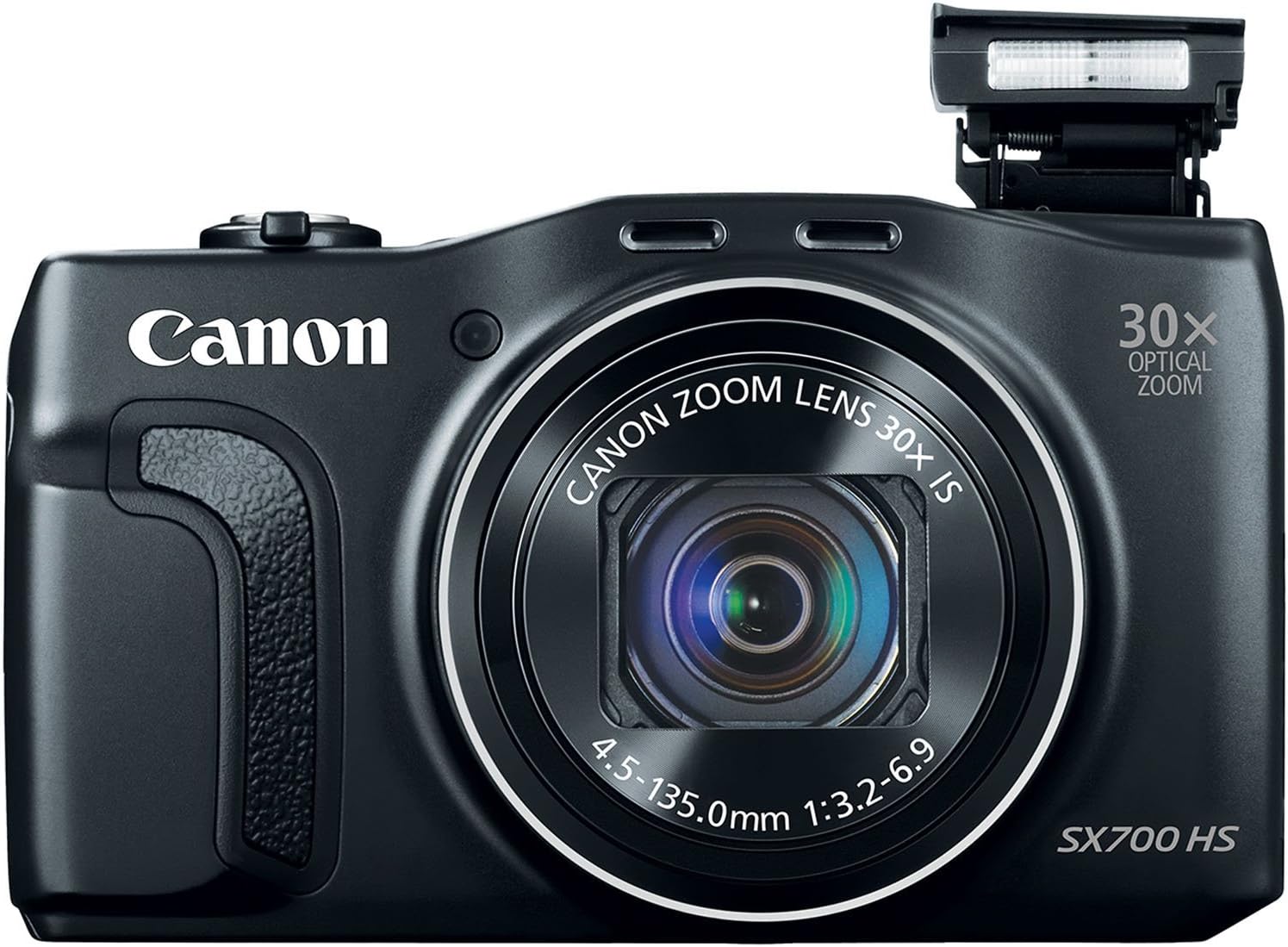
The Canon PowerShot SX700 HS is a compact powerhouse featuring a 16.1MP BSI CMOS sensor paired with DIGIC 6 processing for exceptional image quality and low-light performance. Its 30x optical zoom lens (25-750mm equivalent) offers versatile framing from wide-angle to super-telephoto. Built-in Wi-Fi and NFC enable effortless wireless sharing and remote control via mobile devices. Capture stunning 1080p/60fps Full HD video with a dedicated button, while Creative Shot mode adds artistic filters automatically. Intelligent IS ensures sharp, steady shots, making this camera ideal for professionals and enthusiasts seeking a portable yet feature-rich imaging solution.
| ASIN | B00I58M26Y |
| Age Range Description | Adult |
| Aperture modes | Shutter Priority, Aperture Priority, Manual |
| Are Batteries Included | Yes |
| Aspect Ratio | 4:3 |
| Auto Focus Technology | Center, Continuous, Contrast Detection, Face Detection, Live View, Multi-area, Single |
| Autofocus | Yes |
| Autofocus Points | 9 |
| Best Sellers Rank | #42,997 in Electronics ( See Top 100 in Electronics ) #397 in Digital Point & Shoot Cameras |
| Bit Depth | 8 Bit |
| Brand | Canon |
| Built-In Media | Battery |
| Camera Flash | Built-In |
| Camera Lens | A versatile 25-750mm equivalent lens with optical and digital zoom capabilities |
| Color | Black |
| Compatible Devices | Canon |
| Compatible Flash Memory Type | SD, SDHC, SDXC |
| Compatible Mountings | Canon |
| Connectivity Technology | HDMI, NFC, USB |
| Continuous Shooting | 8.5 |
| Customer Reviews | 4.2 out of 5 stars 520 Reviews |
| Digital Scene Transition | True |
| Digital Zoom | 4 |
| Digital-Still | Yes |
| Display Fixture Type | Fixed |
| Display Maximum Resolution | 1080 x 852 |
| Display Resolution Maximum | 922000 |
| Display Type | LCD |
| Dots Per Screen | 922000 |
| Effective Still Resolution | 16.1 |
| Expanded ISO Minimum | 100 |
| Exposure Control | Aperture Priority, Automatic, Manual, Program, Shutter Priority |
| File Format | JPEG (Exif 2.3) |
| Flash Memory Bus Interface Type | SDIO or SD |
| Flash Memory Type | SD/SDHC/SDXC |
| Flash Modes | Automatic |
| Flash Sync Speed | 15 seconds |
| Focal Length Description | 750 millimeters |
| Focus Features | Contrast detection |
| Focus Mode | Automatic AF (AF-A) |
| Focus Type | Auto Focus |
| Form Factor | Compact |
| Generation | 7 |
| Global Trade Identification Number | 00013803239416 |
| HDMI Type | Type D Micro HDMI |
| Hardware Interface | USB |
| Has Color Screen | Yes |
| Image Capture Type | Stills & Video |
| Image Stabilization | Optical |
| Image stabilization | Optical |
| Item Weight | 0.59 Pounds |
| JPEG Quality Level | Fine |
| Lens Type | Zoom |
| Manufacturer | CANU9 |
| Manufacturer Part Number | 9338B001 |
| Maximum Aperture | 3.2 f |
| Maximum Focal Length | 750 Millimeters |
| Maximum Image Size | 16.1 MP |
| Maximum Shutter Speed | 1/3200 Seconds |
| Metering Methods | Multi, Center-weighted, Spot |
| Minimum Focal Length | 25 Millimeters |
| Minimum Shutter Speed | 15 seconds |
| Model Name | Canon PowerShot SX700 HS |
| Model Number | 9338B001AA |
| Model Series | SX |
| Movie Mode | Yes |
| Night vision | No |
| Number of Diaphragm Blades | 6 |
| Optical Zoom | 30 x |
| Photo Sensor Resolution | 16.1 MP |
| Photo Sensor Size | 1/2.3-inch |
| Photo Sensor Technology | BSI CMOS |
| Real Angle Of View | 1.4 Degrees |
| Recording Capacity | 10 Minutes |
| Remote Included | No |
| Screen Size | 3 Inches |
| Self Timer | 10 Seconds |
| Sensor Type | BSI CMOS |
| Series Number | 700 |
| Shooting Modes | Automatic |
| Skill Level | Professional |
| Special Feature | Image Stabilization |
| Specific Uses For Product | Photography |
| Supported File Format | JPEG (Exif 2.3) |
| Supported Image Format | JPEG |
| Total Still Resolution | 16.1 MP |
| Total USB 2.0 Ports | 1 |
| Total USB Ports | 1 |
| UPC | 013803239416 804892185438 |
| Unit Count | 1.0 Count |
| Video Capture Format | AVC |
| Video Resolution | FHD 1080p |
| Viewfinder | Electronic |
| Warranty Description | 1 year limited |
| White Balance Settings | Auto |
| Wireless Technology | NFC, Wi-Fi |
| Write Speed | 8.5 fps |
| Zoom | Digital Zoom, Optical Zoom |
P**M
Great Travel Zoom
For the recent few years Canon has made great efforts to improve their travel-zoom compact cameras, and the new SX700 is their next remarkable achievement on that way. It's a little bit bigger than its predecessor (SX280) but it is very well built and has an attractive look and feel (I like the black one). It also got a new front grip which makes one-hand shooting more convenient, even when shooting video, since the Video button was moved from the back to the top and you can now use your thumb solely for holding the camera. Here is a brief list of the new camera pros & cons: PROS: * A very good design and build quality with the attractive finish. * A new powerful 30x optical zoom lens in just a pocket-size body. * Incredible range from 25mm wide to 750mm telephoto for stills and video. * Zoom Framing Assist - very useful new feature to compose your pictures at long telephoto. * Very effective optical Intelligent Image Stabilization for stills. * 5-axis Dynamic Image Stabilization and continuous AF for movies. * New 16MP high-resolution, high-speed CMOS Sensor. * The recent DIGIC6 processor with a new advanced Noise Reduction algorithm. * Intelligent Contrast system to retain shadow detail in high contrast scenes. * Full HD 1920 x 1080, 60 fps progressinve movie recording in a popular MP4 format. * Good-quality stereo microphones facing the subject being recorded. * A dedicated Movie-button for instant recording, now on the top of the camera. * A new high-resolution 922K, 3" display. * WiFi and NFC (Near Field Communication) features for transferring files to your smartphone or tablet. * Short startup time (just about 1 sec) and no any noticeable shutter Lag. * Almost the same battery (NB-6LH) as for SX280 (NB-6L) - old one works fine . CONS: * Slightly bigger and heavier than its predecessor SX280. * A new Noise Reduction algorithm is more aggressive on low-contrast areas. I'm basically a photo-amateur, but sometimes I do big prints and so my first priority is the image quality, and in particular its clarity at the pixel level. That's why my recent travel-zoom cameras consequently were SX230, SX260, and SX280, since Canon is doing all their best to preserve the fine details of the picture even at higher ISO's. With my recent SX280 I took many good pictures - sharp and clean, with nice colors, however while doing some research regarding the new SX700 camera features and characteristics I got a number of reasons for upgrade which I would like to share with you. Actually there are 3 main reasons: 30x Zoom Lens, 16-Megapixel CMOS sensor, and the advanced DIGIC 6 processor with the new Noise Reduction Algorithm. LENS: A new powerful 30x optical zoom lens with an Optical Image Stabilization, which spans an incredible 25-750mm equivalent range in a pocket-sized body, is a significant improvement over the SX280's 20x range. The real achievement is that the aperture of the new lens at its maximum 30x telephoto end drops to almost the same (F/6.9) value as of its predecessor at only 20x (F/6.8), what means the additional zoom will not cost you the increased ISO and therefore will not bring more noise to your pictures. On the other hand, when wide-open, the new lens provides slightly better aperture - F/3.2 than the older one - F/3.5, what gives you some advantage for shooting in low light conditions. The new SX700 also introduces an interesting feature - Zoom Framing Assist, which should help with composing shots of far distant subjects. I have to play with it for a while to find out how it actually works. SENSOR: The newly designed 1/2.3" CMOS sensor can produce 16 Megapixel images while having actually 17 MP - it seems extra pixels are needed to provide additional digital image stabilization along with the existing optical one, what would be very helpful for shooting with such a long zoom. From the prospective of the image resolution, it is nice to step up from the prior 12 MP to the new 16 MP especially for landscape photos, what allows to present more fine details and to make your pictures to look more natural than before. Of course, packing more megapixels into the same sensor size causes less light to be collected by each pixel, but on the other hand, Canon stated this new one is a "High-Sensitivity CMOS sensor" and also a new noise-reduction algorithm works more effectively, so such a resolution leap should not cause any noticeable deterioration in IQ. I'm really thankful to Canon especially for the two design decisions: for years they were not following that crazy mega-pixels race; and they were not afraid to generate large (up to 10MB) jpeg files in "Large" mode to preserve as much fine details as possible. Having got such detailed jpeg files you can have much less regret of not having the RAW output, than if your camera always packed your pictures into just 2-3 MB with a lot of smearing and smudging in low contrast areas. On the other hand if you don't need so detailed pictures you can always select either "Medium" or "Small" file size. NOISE REDUCTION: The Canon SX700 uses the recent Canon's DIGIC 6 processor, which was first introduced in the SX280 model and provided the improved noise reduction technique especially at higher ISO's. It's a kind of luxury for such a small camera to have such an advanced processor, and at the moment of writing this review only a few enthusiast's Canon cameras like G1X II, G16, S120 was equipped with that powerful picture processing engine. Although both cameras SX280 and SX700 use the same processor, the latest model has more advanced Noise Reduction Algorithm which provides more smooth rendering of the low-contrast areas with significantly less visible noise. People say one picture is worth a thousand words, but the Amazon rules do not allow to include external links to pictures in the text of the review itself, however they do not mind them in the comments. So I put those links with the respective explanations into my own comments and so you can treat them as a part of this review. Actually you will find there the links to the two 100%-crop fragments of green leaves taken by the old and new camera respectively. While the most bright areas on both fragments look pretty much the same, the areas with less light on the older camera's shots show the noticeable noise, while the SX700's counterparts look almost clear, however a bit softer. LOW_LIGHT: Both cameras have pretty similar and one of best on the market High Sensitivity (HS) system for taking pictures in low-light conditions with minimal noise. In many cases if you shoot even at the highest ISO and then browse those pictures on you monitor without additional cropping, you hardly can see any noise at all (since even Full HD monitors have resolution just about 2MP, and the most advanced - not more than 3-4MP). So from that prospective the difference between two cameras is not that big: the new SX700 provides slightly less visible noise (if any at all) but at the price of somewhat softer images, however all those imperfections of both cameras for most of the ISO range from 100 to about 800 in reality are visible only on the really big prints, and only above ISO-800 the smearing of the fine details becomes visible. So both cameras can be considered as good players in the low-light league. I took the 2 series of shots at high ISO with both cameras, and for the viewers convenience I put them as the 2nd part into my most first comment for this review. SHARPNESS: The sharpness of the output jpeg pictures pretty much depends on the "Compression" settings: to get the maximum details you have to select the "Super Fine" mode, which will produce the jpeg files with the size up to 10MB. If you don't need big prints you can choose "Fine" compression which will result in jpeg files about 5MB or less for the full 16MP resolution. Be aware that with the "Fine" setting the pictures at 100%-crop will look significantly softer at any ISO, however if you browse them on your monitor in the full-screen mode they will look almost the same. Also if you're only going to upload them on Internet or make small prints, you can even choose instead of "Large" resolution the "Medium" one (actually there two of them - "M1" with 8MP and "M2" with 3MP) what will produce even smaller files and will give you more room on your flash memory card and hard disk. So I took some comparative test shots with my both cameras SX280 and SX700 at the ISO-100, max resolution, and the Super-Fine compression in the range of the equivalent focal lengths from 25mm to 500mm. Since the both cameras have a pretty good noise reduction mechanisms, the noise is not visible on all those shots, and the only difference is in the effective sharpness, which can vary in the zoom range. I put the links to those shots into my comment on 04/10/14 with the respective explanations. SAMPLE_PICTURES: I've uploaded some real-world pictures and you can get links to them in my comment with the respective title posted on 04/13/2014. VIDEO: As the same as its predecessor, this camera can capture stunning 1080p 60p/30p Full HD video using a dedicated movie button which now resides on the top of the camera. And to provide sharp results the new SX700 is equipped with an Intelligent Image Stabilization system plus 5-axis Dynamic IS for steady movies. VIDEO_SAMPLES: I've uploaded some video clips and you can get links to them in my comment with the respective title posted on 04/11/2014. So this new Canon camera is a very good compact device for taking nice still pictures and advanced video recording.
K**R
Love this camera
If I could give this camera higher than 5 stars, I would. I had already owned two Canon cameras. Two Rebel DSLRs. the XS and the Xsi so I already knew how great Canon cameras were. I was out elk viewing and saw this man with a small camera that had a better zoom on it than my telephoto lens on my Canon. I continued to watch him and had my husband watch. I always carried both of my cameras with me. I had the normal lens on the one and my telephoto lens on the other. It was 75-300 mm I believe. I am 63 years old and it was getting hard to carry both cameras at the same time but I did it so I would not miss any great shots. Well, after this man was done taking his picture I asked him what kind of camera he had. He showed me and I saw it was a PowerShot SX200. My husband wrote down what it was. This man was so impressed with it. He also had a Canon Rebel and said this little camera was even better and so much easier to carry around. When i got home I started researching and I actually found the PowerShot SX700 HD for around the same price. I read most of the reviews and decided to get one. I received it two days before we left on vacation to Colorado. It was so close to being the same as my Rebel it did not take me long to figure it out! I took my rebel cameras on vacation, too, just in case! But I never had to use them. This little camera did all that my larger cameras did and more. The quality is awesome. The shake feature is amazing. Even when I zoomed in the whole 30X it got great shots. I loved that you can zoom in and it shows you what you are seeing and you can see if it is focused in correctly. You can take great shots in the Auto mode or the P mode. I usually keep it in the P mode so i can made changes if I need to but mostly I don't. I can even zoom up to 120X and get decent shots. I love the video feature. It takes really nice video. My Rebels did not have this feature. It nice to just hit the record button and not have to stop and get my video camera out. :) I would suggest to all those who tend to take hundreds of pictures at a time to have a couple spare batteries on hand! :) The battery lasts pretty good but if you take a lot like I do, then you need extra batteries. I took over 10,000 pictures the two weeks we were on vacation and only had to delete a small amount because of them being blurry. I have my settings set for continues shooting so I know I will get some good shots. Even though with this camera I only need to take two in order to get the great shot. I would actually recommend this camera to everyone. If you leave it in either auto or P mode you should be fine. I was concerned that I would not like the fact that it does not have the view finder. But I never miss it!! So far I cannot think of anything I don't like about the camera.
K**E
Upgrade From Canon SX280; Very Effective Image Stabilization; Good Video
Update 24 August 2014. I have two camcorders: a Canon Vixia HF R400 and a Sony PJ340. I have been testing both of them to see which I should take on an upcoming cruise to the Caribbean and Panama Canal. But I have pretty much decided not to take either because the video shot with the SX700 is sharper, clearer and has better color. ---------- This is not my first camera; I have several, including a Canon 60D with several lenses which I no longer use very much despite it being much more expensive. The SX700, like the SX280 previously, is my walk-around and travel camera. Although I was quite pleased with the SX280, for both photos and video, I upgraded for 2 reasons: (a) the ability to shoot video by the press of a button rather than having to turn a dial is a huge plus for me. I shoot both video and photos and have lost a number that I would very much have liked to have because of the time it took to turn the dial and then setup and refocus. With the SX700, I can switch between photos and video in a fraction of a second. (b) the longer zoom. The 20X zoom on the SX280 was good, the 30X on the SX700 is even better and gives me better photos of distant objects. To give some perspective, here is a comparison of the maximum focal length with my 60D using a 70-300mm lens, the SX280 I had previously and the SX700. Testing the 3 cameras shooting a distant object, the focal length with the 70-300 lens was 70 mm, the SX280 with the lens zoomed out was 90 mm, and the focal length with the SX700 zoomed out was 135 mm, almost double the best I could do with the far more expensive 60D and 70-300 mm lens. Suppose for illustration I am shooting a landscape scene where I not interested in a particular object, but in the scene. I would do well with the 60D, but I can also do well with SX700 by not zooming out the full distance. But suppose there is a distant bear in the landscape that I want to get a photo of. With the 60D and 70-300 lens, the bear is going to be very small in relation to the surround landscape. However, with the lens of the SX700 zoomed out, the bear will be at least twice a big. Less landscape, but much more bear; and it was the bear that I wanted the photo of, not all the landscape. That distant bear will also be noticeably larger if shot with the SX700 rather than the SX280. So I have an expensive dslr with lenses that now I almost never use. With the SX700, I am getting very good photos and video, it is always ready to shoot both close ups and distant object, no lens change necessary, and it is light weight and easy to carry. The best camera, of course, is the one you have with you. Given the quality of the photos and video I am shooting with the SX700, the effectiveness of the image stabilization, and the camera's portability, I don't hesitate to take the SX700 when going out for the day or traveling. Whenever I leave the house, it is in is case on my belt, ready for use. PS: I would like to say a little more about the image stabilization. I used to think that it was necessary to have a view finder in order to get sharp shots because with the view finder the camera is better supported. You can use both hands and press the camera against your forehead to hold it steady. I almost never used the screen to focus if the camera had a view finder. However, with the SX700 there is no choice, you must use the screen. So I hold the camera in both hands, raise my hands and bend my elbows and look at the screen to line up my shot. I can see the screen fine, but I can also see that the camera is not being held rock steady. However, when I look at the resulting shot, even those taken with the lens fully zoomed out, I see no evidence of the camera shake that I know existed. Really amazing, my expensive 60D doesn't do any better even though I am using the viewfinder and holding the camera steady against my head.
A**R
Great camera and a good buy
Wonderful camera! I fell and badly scratched my older powershot camera that had a 20x zoom. This one has a 30x zoom and it is terrific! this one also has wifi and I can transfer the pictures either to my PC where the repository is located, or to my Google drive. Getting the wifi setup to transfer to the Google drive was rather easy, but it was more complicated to get it setup to transfer to my PC. The PC transfer uses another interface or application that must be installed and must pop up when you ask the camera to access your PC. Figuring that interface out and what was needed required me to read the instructions carefully to understand them. I thought I had installed the application but it didn't work, so I had to uninstall it and re-install and it finally worked. Picture quality of the camera is great. Small footprint so I can put it in my pocket. I like the fact that the flash must be manually deployed. I found on my last powershot camera that when I wanted the flash, I always had my finger over the flash stopping it from popping up. This one, I must flick and button and consequently my finger is out of the way when the flash pops up. The recovery time for the flash is very very quick. I took 3 or 4 flash pictures one right after the other with no delay. I ordered this camera for the battery and battery charger were the same as my older powershot, thus I didn't have to buy another battery as a spare. Now I have 3 batteries! The LCD is quite bright so that when taking a picture in the sunlight you can still see the LCD. Great camera and a good buy!
J**R
Big Camera Features in A Little Package
This is a great camera with big camera features in a little package. I didn't want to lug my big camera around on a recent trip to Europe and wanted to replace my compact camera for motorcycling. I was looking at the SX710 HS when I saw that this was also available. The biggest difference is the lack of GPS and this was quite a bit cheaper. In looking at a fellow traveler's SX710 I find I like the menus on this better. To delete unwanted shots you have to go to a sub-menu rather than just pressing a wastebasket button as you have on most other Canons. If you like to cull shots on the fly this is a big drawback. They've compacted the number of scenes available in that mode. I found that the standard auto setting produced better results than the low light scene for city streets at night. Auto also works great for the 'magic hour' at sunrise and sunset. The long zoom allows me great flexibility in framing. The new processor gives great picture details and processes quickly. The grip on the camera is rather shallow but you get used to it. It has a anti-shake mode but it doesn't seem to work well when you have the telephoto all the way out when you get there you really need to brace the camera, put it on a solid surface,have a monopod or tripod to get the best shots. The auto focus seems easily confused if you swing the camera around as you might at a sporting event or other fast action. Battery life with the standard settings isn't very good so you need to adjust them. Get at least one more Canon battery as a backup because you'll need it during a long day of shooting foliage or travel pix. The included manual doesn't tell you much except how to get the camera unpacked, put in the battery and memory card. To really find out how to use the various settings and controls go to the Canon site and download the guide. The quickest way there is to Google it. I also put the hand leash from my old camera on this one. Canon used to have a little adjustment piece that made it feel more secure on your hand. The included one feels way too lose and didn't give me much confidence. I also used the one button WIFI connect to get my shots from the camera to my iPad and then to Google Photos. This meant I could back up my shots as I traveled and could view them on a bigger screen to make decisions on which ones to delete. Once you get the app it worked pretty smoothly, although it worked better with the iPad than it did with my Android phone.
P**T
Pretty darn good
I use this backpacking so I wanted something relatively lightweight. I think this takes pretty great photos given how light it is. I often will print the photos into 8x10 prints for framing and they look superb. It isn't as good at macro shots as my similar Sony that has kicked the bucket. And now it is a couple years old and I have noticed occasionally the lens doesn't open quite all the way and I have to poke it to get it to open up. Otherwise it works well. Oh, the wifi connectivity isn't fabulous, but neither was it on my other camera. I don't bother with it if I can avoid it. I can never seem to get it to work with my desktop so I just transfer with the cord. I have been successful using the camera's wifi with my ipad though. The battery charges pretty quickly and lasts a long time. It doesn't last very long if it's really cold outside but I think that's universal for batteries. I just bought a 2nd to bring along. It's pretty easy to accidentally flip the dial to be on a different setting. Also pretty universal and you just deal with that. One thing that does drive me crazy is that it will turn on if you tough the arrow button that's on the back on the camera. Sometimes I would take it out of the case and it would have somehow turned on and I was finding the battery was short lived. I am now careful to keep my fingers away from that arrow button and I set it to turn off the LCD display after a few seconds on inactivity. That has helped things. All in all a really good camera.
H**A
Good camera, some button placement could be better, 30x zoom works nice.
Purchased as a present to myself to replace my current Canon SX230 that has dust inside the lens. Photos seem to be great, HD video is also nice but sometimes if you don't get the focus just right immediately, the entire video will be out of focus. The position of the On/Off button is not in a good place as it is very easy to accidently push this as it is on the top where you want to hold the camera by in your right hand, The Video button also is on the top on the other side of the shutter button, this really limits how to hold this with the right hand. The flash does not auto-pup up as it does on my Canon SX230, you have to open manually. So if you are taking flash photos, can't hold the camera in your left hand and the on/off / video buttons are in the way for your right. It would have been better if these were moved to the back as on the SX230. Video can also really drain the battery. Make sure you have at least 1 extra battery for a day trip & more for a longer period.
C**P
The versatility and just plain fun of this camera make it worth the price.
My first reaction to this camera was one of disappointment. I was not (and still not really) happy with the low light picture taking capabilities. My smartphone has less video capability and seems to do much better in low light than this dedicated device. So that is a short coming in my opinion. I stuck the camera in my pack and did not pull it out much to put it to good use. Our family had a trip to Glacier National Park coming up and I was torn between bringing just this camera or my DSLR. My daughter opted to bring her DSLR and I wanted to avoid the extra carry weight, so I just brought this small camera. It was on this trip that I discovered the versatility and is truly the awesomeness of this camera. It is small enough for me to put in a pocket and thus was carried with me where ever I went. I shot in large format and high resolution and the 1GB SD card I used had room for hundreds of photos. On one early morning hike we came across a buck and several does. I was able to get some great close up shots of the buck even though he was bedded down deep in some trees, the light was enough to render some good pictures. We attended a wedding at the park and several people were taking pictures, but no one took video. I thought that capturing the ceremony would be nice for video and thought it a shame that no video camera was in sight. Then I remembered that my camera could take video, so I recorded the ceremony and the couple have that as a memory to keep now. Considering the small nature of the device and the microphone, the sound was surprisingly good. Later I was able to zoom in sufficiently enough to capture a grizzly bear from a safe distance and even got some video of her and her cub as well. I took several hundred photos, capture some great video (including a fun feature I stumbled across that recorded video while I had the shutter pressed halfway down as I composed the shot and then the resulting shot. A fun way to share the experience. This camera even lets me view and transfer pictures as well as control the shutter from my smart phone. I now consider buying this camera a good investment. Not as a perfect pocket picture taker, but for the amazing versatility and fun that is available. This little device put the fun back into picture taking for me in a way that I did not expect. I did take a star off because of the low light issue.
J**O
Bon achat
L'appareil a été livré rapidement et tel que décrit. Il est arrivé avec l'étui de transport, batterie, chargeur de batterie et le tout en excellente état.
R**O
Good quality
received as expected
T**E
Great pictures from this camera
Great pictures from this camera. The only problem was the camera user guide that came with it, the writing and pictures were to small . I downloaded this user guide from the internet and the writing and pictures are very easy to see and understand.
C**Y
Five Stars
Bon service, très belle caméra facile à utiliser
C**I
tres satisfaite
fonctionne bien et compact
Trustpilot
2 weeks ago
2 months ago