🔆 Harness the sun smarter — power your future with precision and efficiency!
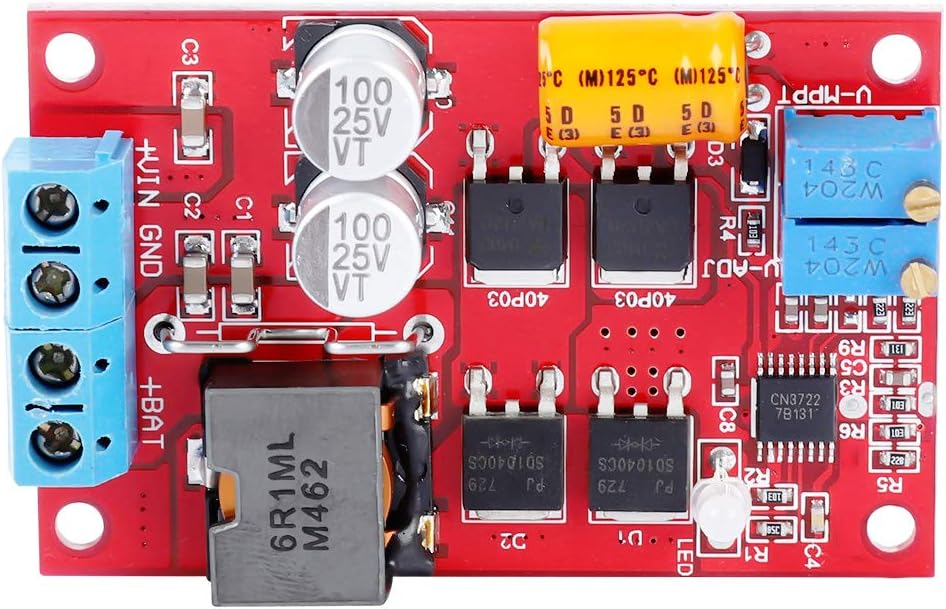
The Universe 5A MPPT Solar Charge Controller is a compact, high-efficiency module designed for 9V to 24V solar panels and multiple battery types including lithium and lead acid. Featuring true maximum power point tracking technology, it delivers up to 5A charging current with up to 93% conversion efficiency. Its stepless adjustable output voltage and intelligent three-stage charging ensure optimal battery health and performance. Industrial-grade components provide reliable operation across extreme temperatures, while dual LED indicators offer clear charging status. Ideal for DIY solar setups, this controller requires careful calibration but rewards users with enhanced solar energy utilization and battery longevity.
| ASIN | B07PT7HBRF |
| Best Sellers Rank | #330,518 in Patio, Lawn & Garden ( See Top 100 in Patio, Lawn & Garden ) #364 in Renewable Energy Controllers |
| Brand Name | Ciglow |
| Color | Red |
| Customer Reviews | 2.9 2.9 out of 5 stars (32) |
| Display Type | indicator light |
| Manufacturer | Ciglow |
| Material Type | Phosphate |
| Operating Temperature | 85 Degrees Celsius |
| UPC | 736342429819 |
| Voltage | 28 Volts (DC) |
A**N
They deleted my review
Review date: 6-5-2024, Revision: B... They deleted my original review. This is another try... This is a DIY solar controller. It requires that you google, an alignment procedure that's, might be a bit too much for some to follow (you need to have, and know how to use, a volt and current meter - Your volt and current meter, needs to go up to at least, to your solar panels spec'd output). See below, "Required reading," for how to align the controller. I used mine on an OLD Sunsie SE-1800 (18W) solar panel, with new leads. This was without the in-line diode that were made by Sunsue, that I already had. My panel has an OP of 21v approx., and short circuit test op current of 0.44A (440mA), sitting outside, under full sun. Other spec's are, 1.2A at 15V (18W). Using this MPPT controller, I got 0.52A output, from inside my car (sitting on my dashboard, under full sun, through the cars windshield.). I use this set up to keep my cars battery charged, because the car sits a lot. And, I have HAM radio's pulling parasitic current, and I can't just disconnect the radios. My battery is an AGM. Its a Odyssey ODX-AGM34R (this is oversized for my car, because, HAM Radio). Bottom line after, misreading one sentence, I had to re do the set up, as described below (google, the above key words, or read below, "Required reading"), and now the controller seems to be working correctly. I'll keep checking on it.. Required reading: Google : “robotzero.one 5a-mppt-charger-instructions” Below is the just of what the instructions say (it a copy).... Instructions for setting up the MPPT-V08A Lithium Solar Charge Controller with CN3722 The information in the listings for these modules is virtually incomprehensible so after a bit of trial and error I’ve worked out how to set the maximum output current for your solar panel and the cut off voltage for your batteries. The instructions below are using the following items. Step 1 First turn the voltage pot fully anti-clockwise and turn the MPPT pot fully clockwise. You will be able to hear them click when they are fully turned. Step 2 Connect the solar panel but don’t connect the batteries. Connect a voltmeter across the battery terminals. Turn the MPPT pot anticlockwise until a voltage reading appears and the LED flashes blue Step 3 Connect batteries that aren’t fully charged via an ammeter. Turn the voltage pot clockwise until a reading appears and the LED turns red. Step 4 Adjust the MPPT pot to reach the highest value on the ammeter. This is the maximum charging current your solar panel can provide. Step 5 Charge the batteries in a quality charger until they are full. Connect the charged batteries. Slowly turn the voltage pot anti-clockwise until the current shown on the ammeter is 0. This is the cut off for charging when the batteries are full IE the maximum charging voltage. Advice Note that the above is just a tutorial for setting up these devices. Your finished system must include battery balancing so your batteries are evenly charged. Without a balancing system your maximum charging voltage could be unevenly distributed. For example if your maximum is set at 16.8 for 4 batteries you might expect them all to be topped up to 4.2v but without the BMS they are could have any value that adds up to 16.8v. Some of them could be overcharging.
J**T
Not so great
The LED comes on when the color panel is connected, but nothing else worked. The potentiometers are both broken from what I could tell. Neither of them have a stoping point or click when turning either clockwise or anti-clockwise.
J**G
Works but takes time to set up
The guide in the description is easy to follow but the potentiometers don't click, so you have to spin them a lot and do some guess and checking. But I was able to get it to charge my 18v power tool battery with an old 100w solar panel. I made a video of this on Youtube @hackertwins idk if I can post links in a review
A**R
totally five stars
I used this for charging a sla battery that keeps my Raspberry Pi weather station up and running. it really helps to have an electronics background and be familiar with how the chip that runs this thing works. If not, this may not be for you. The datasheet for the chip is available online. what I did was swap out the current sense resistor to 0.1 ohm which limited the current to 2A. Then I used a discharged battery to adjust the MPPT point to 18v which was the value for my solar panel. Then I used a fully charged battery to set the voltage to 14v which is kind of a midpoint voltage for an SLA battery that works for me. I also changed out the heat sink for a smaller one, then connected the top of the heatsink to a larger metal plate. The problem with the supplied heat sink is that protrusions from thru hole components are at risk of a short. In my mind this is a significant risk factor and one that has come up in other reviews. Because this ended up working out as well as it did it gets five stars from me !
M**G
Nice little charge controller.
You have to adjust the right voltage for the type of battery. Beside that it work ok.
D**.
Don't buy these....
-5 stars... Neither work, one arrived broken. Really getting sick of being sent garbage.
A**E
Just made a lot of heat
Picked this up for a small 50 watt solar project. It was used to charge a bank of 18650 batteries. I monitored the current/voltage coming from the panel and the current/voltage going into the batteries. Often I could see much more power coming from the solar panels than going into the batteries--several watts more. Seems this device was simply turning that additional power into heat rather than doing any useful work. Power-point tracking is pretty useless if you just turn the additional energy into heat. Overall I got less power from this device than just a plain buck-converter, probably because of the losses from the output diodes. Reverted back to my buck converter which didn't suffer such problems.
M**V
Worked well
Blue is charging indicator, Red is charged indicator. Blue and red blinking - battery disconnected.
Trustpilot
2 days ago
1 day ago