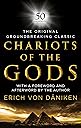
Chariots of the Gods: 50th Anniversary Edition
Product ID: 105431722
📚50 years of groundbreaking theories
🚀Ancient astronaut hypothesis explored
🧠Accessible, thought-provoking writing
Desertcart purchases this item on your behalf and handles shipping, customs, and support to South Africa.
🚀 Unlock the secrets of the cosmos and history — don’t miss the conversation that’s reshaping our past!
Chariots of the Gods: 50th Anniversary Edition by Erich von Däniken revisits the pioneering ancient astronaut theory that has fascinated millions for half a century. This edition offers accessible, engaging prose that challenges conventional history and invites readers to explore the possibility of extraterrestrial influence on early civilizations. A must-read for curious minds eager to question mainstream narratives and join a global dialogue on humanity’s cosmic origins.

| Best Sellers Rank | #57,287 in Books ( See Top 100 in Books ) #6 in Ancient & Controversial Knowledge #6 in Unexplained Mysteries (Books) #7 in UFOs (Books) |
| Customer Reviews | 4.6 out of 5 stars 11,506 Reviews |
A**.
Excellent perspective, great theories, relatable writing
I am only on chapter 4, but I already absolutely love it. I originally, like most of you, heard of Erich's work through the tv show Ancient Aliens that more or less features his research and theories. This being the most popular of his books, I bought it to sink my teeth into some more details and get deeper into the theories, because I think they are fascinating. When my book arrived, I was so excited, and after just the first two chapters, any doubt in this theory had left my mind. The first two chapters are all about putting the universe into perspective, then he describes a hypothetical scenario followed by a "Why couldn't this have happened to our ancestors?" It's very compelling and very convincing and in my opinion, makes way more sense than what mainstream scientists try to shove down our throats. It infuriates me that in school and in the news we are always told what to believe. This guy came along with his own theory and millions of people are picking up on this idea because it makes more sense than the history books, in my opinion. And for the naysayers that say he is crazy, who are they to decide who is right and wrong? A theory is like an opinion, and can't be redacted just because somebody says it should be. For so long everyone thought the world was flat, because it would be impossible for people to stand on the underside of a globe. They thought the earth was the center of the universe. Science advanced and we found out they were wrong. Science has been wrong before, but they seem to not want to accept that, and just stay in their bubble, ignorant to the rest of the theories out there because surely they think they could never be wrong again. I truly believe that if this topic were researched further with the most advanced technology, we would find something incredible. Unfortunately, that day may never come if the coming generation's brilliant minds are forced into narrow-minded thinking. It would take generations and generations of open-mindedness, but eventually I hope the world comes to be as fascinated in these theories as I am, and move forward with more research and testing. Furthermore, with the Mars One project approaching, what are we doing? We are finding a planet that is habitable, and we're going to colonize it. One day ancestors of native Martian humans will tell their grandchildren about how they came from a distant planet. If we are going to be aliens on Mars, is it really logical to think this is the first time a civilization has ever traveled to another planet? Can you confirm without a doubt that we are the first beings to travel through space and land on another surface different from our own? I don't think so. The book is written in a very easy to comprehend writing style. Instead of using huge complex words and sentences that 90% of the population wouldn't understand, he writes in a more personal style and describes things very well. His words have great imagery to them which also helps to completely understand his message. If you have an open mind and are not opposed to learning about the ancient astronaut theories, you MUST read this book. I think it's a great place to start, and I already have a list of books compiled that I want to read next. - Amanda Zamiska, Pittsburgh, PA
M**E
Chariots of the Gods
Chariots of the Gods is a book needing little introduction. The ideas introduced here launched author von Däniken to a certain degree of fame (and infamy) around the world. The concept of alien gods intervening in the early development of man would live on for decades in the numerous books, films, and documentaries that would follow. Having been first published over four decades ago, there are parts of Chariots which have not aged well. Some bits are downright depressing: It turns out that not only did we fail to land on Mars by 1986, as was once a "certainty," but we've seemingly given up the quest entirely. The writer's optimism toward man's progress, anchored in the early achievements of the space age, simply did not align with a future written by politicians and tax payers. That said, despite becoming dated, a discussion of technology was essentially unavoidable given the nature of the material. If I have one fault to find with the writing, it would be that the author tends to dwell on the refusal of the scientific community to consider his proposals. He tells us, continuously, how historical dogma is accepted without questioning, and how we must not be closed minded to alternatives. It's hard to fault the man, as he was essentially predicting (rather accurately) the shunning and dismissal his writing would receive in scientific circles. Still, as the reader, I'm already effectively committed as his audience, and I don't find it entirely necessary to beat the poor horse quite so badly. A note about production quality: The mass market paperback is a bit disappointing. The pictures, in particular, are almost impossible to view. But I guess you get what you pay for, and that does not reflect the overall quality of the source material. Ultimately I highly recommend this book. The key, I think, is to focus on the questions posed in the content, rather than the conclusions. It's the questions which are fascinating, and it's the questions which, more often than not, continue to stand the test of time. How did ancient civilizations query and transport boulders so massive they would challenge even modern machinery? For what purpose were giant structures and drawings that could only be viewed from space? Why did religions spanning the physical earth, and without regular contact with one another, share such similar stories of origin? How did ancient cartographers gain knowledge of seemingly "undiscovered" lands, and ancient astronomers of planets and galaxies only recently observed with modern optics? It's amazing how little we know about our own past. Whether or not one is able to buy in to the proposal of visitation by extraterrestrial intelligences being a plausible conclusion, any sufficiently curious person should be taken in by the mysteries which modern doctrine tends to gloss over. Rating: 5/5
A**.
Compelling, entertaining and instructive
Given what we know today; the lengths the powers that be have sought to hide many truths from the masses, considering an ancient astronaut theory or panspermia even isn’t that far fetched. This book is an excellent recommendation for someone beginning their journey into pondering such interesting questions.
D**A
Interesting book but lacks sound logic
I read this book because I watched the show Ancient Aliens. I found the idea interesting but in the show I did not like it too much because the basis of all theories is that, "I don't know, therefore aliens." I gave it a benefit of doubt though because the show is short and they cover a very wide range of history and never really focus in on the core of their beliefs. So in came this book, Chariots of the Gods. There's no real reason why I selected this book other than the fact that the name of it sounds interesting and it also got a lot of reviews. Since I don't know the subject too well, I figured I'd get some sort of starting point. After reading the book I can't say I'm all too convinced about aliens visiting us in the ancient times. In the show Ancient Aliens, the conclusion was, "I don't know, therefore aliens." In the book, the base of the theories are, "If it's possible, then it must be true." At the start of this book, I felt Erich presented a good hypothesis. Could it be possible that in ancient culture they have seen aliens and describe them as gods since they could not interpret the technology? The answer is yes, of course, it's all possible. However I felt where the book failed is how he intends to "prove" his theories. I felt there are many holes in Erich's logic: 1) He compares his radical idea to that of other thinkers in the likes of Newton, Darwin, Einstein, and many other who made some radical claims that somehow came out to be true. What Eric failed to realize is that these "thinkers" backed their ideas up with proof and very sound logic. Newton gave his theories based on math and logic. Einstein used math to prove many of his theories. All the radical thinkers used very convincing proof for their ideas that's hard to deny. They didn't say, "Well other people made radical ideas that turned out to be true, so this must be true as well because it's just as radical." Eric didn't really do a good job of sounding convincing to me. 2) He says scientists are "wrong" because they have a failed system of thinking. I think Erich made a fatal mistake here. Science is about being able to reproduce some series of thoughts over and over again. Erich is saying that people in the past were visited by aliens and that humans are too dumb to have evolved to what we see today. He makes claims as wild as that humans are hybrid of "gods" where they reproduced with us, all the way to being genetically altered to be smarter. If these things were true, then wouldn't it make sense that we'd find some "oddity" in our dna? Or that we discover that somehow humans of the early period somehow appeared differently than normal? He gives no sound proof other than wild claims and then never backing it up with anything that sounds logical or provable. Erich also claims that scientists HAVE to unprove aliens. Last time I checked, "radical" thinkers proved their claims themselves. 3) Many times he claim that certain ancient buildings or land are airstrips of some sort. This is a very famous theory that Erich visits frequently in his book. He shows some photos of areas and say, "It looks like an airstrip." I think Erich is somewhat delusional in this regard because it sounds like (in the time the book was written) probably got bored one Sunday afternoon, pull out an encyclopedia and went, "Oh my, it's an ancient alien airstrip!" I highly doubt that he actually visited any of these so-called "ancient airstrips." I would expect someone who made a radical claim would actually go to these strips and perhaps get samples of soil and other elements. I would expect that if it was a landing strip things like a fuel or energy source, parts of the aircraft, and various other things that would run a major intergalactic air vehicle. However, Erich provides none, and like my claim in #2 point, Erich instead says that it's scientists duty to check this since the theory is possible, it must be fully investigated until proven wrong. 4) He claims that various artworks, religion, ideas, and culture are shared across the globe which asserts his claim that aliens must have visited. The first problem I notice is that many of Erich's religious examples only extend to about the first few chapters of any religious text. It seems like after he looked up the encyclopedia on afternoon, he decided to read the first two chapters of the bible and other religious text and go, "Yep, aliens, everyone of em." Erich's claim is that many of the religious monuments are shared across the world. The pyramids were build in South America as well as Egypt nearly the identical latitude in this world. Erich's claim is that it's too much of a coincident for everyone to share the same ideas. Erich claim is that religion is actually the misinterpretation of ancient astronauts due largely because the ancient people would be unable to determine what they're seeing and only describe what they see in ways that are best understood. I think Erich has a good claim here but I think where it fails is that fact that he only read what it appeared to me the first few chapters of all the religion texts. I think he missed out on a very large bulk of many religion and was very quick to say that human imagination differs from region to region and that the same ideas cannot be shared among two people at any point. 5) He's very quick to jump to conclusions about monuments being "impossible" to create and that it's equally impossible that someone would just wake up one day and decide, "Hey let's build a pyramid for the next three lifetimes." The main argument is somewhat valid in my opinion in that many of the records were lost about our ancient structure. Erich himself gave an example that if 1,000 years from now someone dug up the statue of liberty they'd probably think we're some sort of religiously crazy country honoring some woman holding a torch. But Erich doesn't state this theory in this fashion with the statue of liberty. What he actually states is that in the future, people will be too primitive to understand what they are seeing and draw incorrect religious conclusions about the statue of liberty. This implies that in today's world looking back at ancient pyramids, we're too "dumb" to figure out that it was some sort of alien relic. I think Erich discredits too greatly about humans. The main fact is that a lot of information is lost about ancient days and similarly our time in the future will probably be greatly misunderstood. It's hard to take a collective thought of millions of people who lived in this world and summarize it in one or two paragraphs. Just as much, information about the past that are missing doesn't necessarily mean that some great ancient alien came down and filled in the gap. It's sort of like saying that if a court case involves someone walking down the street and some timeframe was unaccounted for then it means they must have done the crime. That's basically what Erich is saying here that since the time cannot be accounted for and that things just "appeared" without a back story that it must means aliens were involved in some fashion. That logic to me is irresponsible and highly speculative. He also states that ancient Egyptians were smart enough to know that reviving dead tissue was possible and were given some sort of formula by aliens to mummify their bodies so that in the future they can return. This is so silly that I don't even know where to begin. It doesn't take a rocket scientist to figure out you're going to die someday and throughout our times, many men and women tried to reverse this process. Ancient Egyptians were no exception and they had their own ideas about living forever just as much as in our modern times we have the desire to find everlasting life. 6) Erich claims that humans are too dumb to figure out stuff and require a kick start. To begin, it doesn't take a human a very long time to figure out that good things reach for the sky and bad things go into the ground. When you plant a tree it reaches for the skies, not go into the ground. Man looks upwards into the sky knowing that in that lies a great mystery. Throughout time man knew flight was possible because birds flew and things go up in the air for a little while. Man also knew, just as the most primitive animal, is that light is better than darkness. The sun is the source of life for all and it doesn't take a rocket scientist to figure this out. With that said, Erich claims that man's observation of the sky, flight, and so fort are impossible to imagine. That man cannot dream or use his imagination about the stars. What is known is that since the dawn of time man has looked up to sky and taken great records of the stars. If ancient aliens came down to earth, why then would man suddenly make observations about the stars? If we were too "dumb" to have known about it, then why build all these monuments and help the "aliens" go back to the stars? It makes no sense and Erich didn't give enough of a proof to really make a conclusive statement favoring it. 7) Erich claims that aliens came to earth. This is probably the most fundamental of the questions but his claim is that aliens visited earth a long time ago and need fuel source to return home. Basically Erich claims that most of the ancients "air strips" were created so that the vehicles used by the aliens could be harvested for fuel. The question comes to why is it a world wide effort if the aliens just needed to go back home? Then comes the question why did they need the help of the primitives to build something only they can understand? Wouldn't it take longer to teach the people than it would to just having it done yourself? Erich claim that aliens somehow jump start our world and civilization and that aliens did a lot of great stuff. Yet, he found no proof of anything that the aliens left in terms of advancement. I would imagine that a lot of people got injured or sick building these monuments and wouldn't it make sense that the aliens would teach advance medical science to the primitives so that they're better suited? And also wouldn't it make sense that the aliens would leave behind advanced techniques in clothes, ropes, weapons, etc? Wouldn't they have to guard their ancient airstrips from looters of the time? Or what about the equipments? If massive tonnage of rocks and earth had to be moved, wouldn't there be records of things like bulldozers, advanced cranes, etc? Nothing of the sort can be given by Erich and he only tells us that aliens came here for no apparent reasons and did all these indirect things to us without any sort of direct method. This would equate to us going to another planet, finding the native life there, requesting them to do something, not give them any sort of tools or method, and expect results. It just doesn't make sense and no fossil records or tools, or anything can be found that Erich can give. The simple question comes to why? Which is unanswered and I think the biggest problem with Erich's idea. Overall I am pleased with the book. It presented some wild ideas but I think Erich made impressive claims but was unable to prove any of them reasonably or at least give a sound logic. Erich sounds like he just read the first few chapters of religion, looked at a few pictures, then made this book. Overall it's fun, but now I'm more convinced that this "ancient aliens" idea is just a silly thing. Not necessarily lying but most certainly not thought out very well. You can't prove what happened 100 years ago much less 100,000 years ago and you can go only on what is left. Many things will be missing over time and get lost. I think Erich needs better proof than, "Hey look it's possible therefore I have to be right because other people's radical ideas were later proven to be true as well."
S**S
Excellent
I first came across this book when a coworker was reading it.. she had an ancient copy that her father bought in 1973. I read a few pages of it, and loved it. I immediately got my own copy. My view ont his subject was mainly shaped by skeptics (most notably the essays of Isaac Asimov, who felt, until his dying day, that there was absolutely no proof of any alien cultures ever existing... I would have loved to see a head on debate between Asimov and Mr. Von Daniken.) It blew me away. It introduced me to quite believeable proof that aliens have been periodically visiting us, possibly for millions of years. The book is slightly outdated (such as a quote from NASA saying we'll "definately" land a person on Mars no later than 1986.) And his guesses at how fast technology would advance were quite off. (He expected us to have space crafts capable of travelling at 99% the speed of light by 1991, as well as having 'hover belts' and some scanning technology we aren't even close to developing yet.) However, once he gets to the facts, the book becomes fascinating. A spaceport in the Andes? An unknown 4,000 year old metal alloy we can't identify? (That won't rust or react to phosphate and sulphur.) They found the remains of a millenia old electrical battery in Iraq. Incredible. This book floored me. The only part I feel is dubious is that early "gods" (by which he means alien visitors) cross bred with early humans. (Not homo sapiens exclusively, but earlier steps in evolution.. homo erectus, neanderthal, etc.) I feel he was right when he said they may've helped the strong specimens evolve, while allowing the weaker ones to die, along with killing off the 'freaks'. (such as what happened in Sodom and Gomorrah.) Overall, a most excellent book.. highly reccomended for anyone to read, even the sceptics who don't believe in such stuff. My only question is.. what'll happen if the aliens come back? Surely, if their technology was far beyond anything we have now, it'll be so much ahead of us now we won't be able to comprehend most of it.. what kind of wonders will they show us? Or will they deem us unworthy and anniliate most of our species, like they may've very well done in the past?
E**E
A Sensational Introduction to the Ancient Astronaut Therory
I actually read this book for the thidr time during August 2016 and somehow neglected to write a review. Before I process with my review I must warn readers that I believe that it is probable that Earth was visited by Extraterrestrials who interacted and influenced humanity in the ancient past! I also believe these visits continue even today. Now for my review. "Chariot of the Gods" was written neatly 50 years ago and was the first book I read to discuss the possibility of visits to Earth by extraterrestrials. I picked up the book in an Airport Bookstore just prior to my flight to Vietnam in January of 1969. I finished the book before we arrived in country and was hooked! Von Daniekan's writing style, observations, and analysis of the evidence used by mainstream science anchor theology to explain the presence of artifacts, writings and other materials, coupled with his alternative explanations and proofs were not only plausible, but also down right convincing. His writing style is conversational and non threatening. He provides the facts and asks thw reader to draw their own conclusions. To say this book was controversial in the late 1960s and early 1970s is an understatement! The amazing thing is that many of his early conclusions have gained wide acceptance with millions of people. Ancient Astronaut Theory is, in my opinion, no longer fringe science and we have Erich to thank for it!! I will leave it to you the reader to uncover the details of his findings and, if you like read his other 30 or so books on this topic to reach your own conclusions. I recommend this book to readers with an open mind and for those of you, such as myself, who are based on the evidence, not sure that main stream science and theology has got it right. I think those of you who take the time to read Von Daniekan will enjoy his work!
J**M
Chariots of 5 stars
Erich von Daniken has obviously done his homework. This was one of many books he wrote (this one being a sort of encyclopedia rather than an in-depth discussion). A very enjoyable read. Honestly the arguments of modern day scientists to disclaim von Daniken is to point to phony articles skeptics wrote about him in which they fakely quote him by saying he fabricated his evidence. Also Skeptic Magazine in 2004 claimed that von Daniken had plagerized his information from an earlier book that was written called Le Matin des Magiciens, written 5 years prior to von Danikens Chariots of the Gods. This is a foolish statement due to the fact that witnesses around him say that he has indeed been writing on this story since he was student, and instantly as the book came out he could spend hours upon hours talking about why his information was right, whereas if he had plagiarized he would only know what was in the text of Le Matin des Magiciens, which clearly wasnt the case. Another gripe is why would only Skeptic Magazine of all organizations be finding this out nearing 50 years after Chariots of the Gods was written? Having written my own books and more to come (look under John R. McAdam in a year when they are finished publishing) from April 12, 2010, I can say that I am not blind and I have some minute things I disagree about with von Danikens theories (because I try to think for myself rather than let others tell me how to think), though to use that argument to discourage one from reading the book is utter lunacy as the minute details in perhaps only 1 of every 100 cases von Daniken talks about in all of his books is..well..minute. My personal ideas which differ from von Daniken's still draw the absolute 100% same conclusion as von Daniken draws at the end of Chariots of the Gods. What is that conclusion? Pick up this book and find out ;). If you want a fun way to see the world and a "beginners guide" for modern day alien astronaut theories, start with this book. 5 out of 5 stars.
G**R
Where it all started. Interesting Ideas but gets old fast.
I'd give it three and a half stars if I could. Von Daniken should be given props for his ideas and the book certainly has its merit but it is widely overrated. He states that he is able to prove that ancient sites like the Pyramids, Stonehenge (only mentioned briefly) and ruins in south America are either built by the gods or with help from the gods. This part was interesting and even though I'm not 100 % behind all his ideas its a fun read.The part about Gilgamesh and how the flood legend is in many ancient societies, again interesting in his belief that god could not have made a mistake and need to change it. While these crazy theories are interesting they have very little (really no) evidence whatsoever. Its all conjecture on his part. The only somewhat convincing part was the indian flying machines and the Ezechiel text. The cargo cults was also an interesting add on. The inner narrative between the sections is really the worst part of this book. He does not need to say "well science is excluding!" "If they looked at Tv 100 years ago it would be magic!" and similar statements after EVERY CHAPTER. Honestly He only needed to say these things once. For some reason a quarter of this book is Erich bashing conventional science. It gets extremely annoying. In fact he seems to stop dead in his tracks when talking of ancient sites to do this. Its distracting and a point that doesn't need to be hammered into our heads 300 times. Just admit your ideas are out there and move on! Another issue (which might just be the age of the book) was the last two chapters how he just decides to talk about the modern UFO cases. its not horrible but its out of place and he does the same thing a bit in the first two chapters so he basically repeats himself. If he maybe updated these sections it might not be as boring. Switching from ancient to present happens way too much in the book. Overall not bad, give it a read. Its not as amazing though as many people say.
T**G
Entertaining
Very entertaining and provides an alternative point of view, for the open minded. The author does not assert what he is suggesting is true or factual, moreover all the author does is asks questions about the possibilities of the past and then draws possible conclusions. A good read and well researched and explained.
E**S
Amazing
I had already heard about the theories of extraterrestrials visiting earlier human civilizations, but had never read such a competing and fascinating account of the several evidences that led to said theories. I'm looking forward to reading the other books by von Daniken.
O**C
It’sma,must to read it!
It’s a great book, I recommend it to everybody. Couldn’t put it down
G**O
Très intéressant !
Peu importe ce que l'on pense des théories sur les extraterrestres, ce livre offre des pistes de réflexion et pose des questions tout à fait pertinentes sur le bien fondé de l'Histoire actuelle et de nos origines. Attention, livre en anglais mais relativement simple à lire.
K**R
Still a thought provoking Classic
Content-wise, Erich von Däniken’s theories remain an absolute classic - speculative, intriguing, and bound to make you question standard history. My only minor disappointment with this paperback edition was the physical format; I was hoping for a larger, coffee-table style presentation with higher-quality photo plates. Still a great, mind-expanding read regardless.
Trustpilot
1 month ago
2 weeks ago