
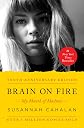

NOW A MAJOR MOTION PICTURE STARRING CHLOË GRACE MORETZ A “captivating” ( The New York Times Book Review ), award-winning memoir and instant New York Times bestseller that goes far beyond its riveting medical mystery, Brain on Fire is a powerful account of one woman’s struggle to recapture her identity. When twenty-four-year-old Susannah Cahalan woke up alone in a hospital room, strapped to her bed and unable to move or speak, she had no memory of how she’d gotten there. Days earlier, she had been on the threshold of a new, adult life: at the beginning of her first serious relationship and a promising career at a major New York newspaper. Now she was labeled as violent, psychotic, a flight risk. What happened? In an “unforgettable” ( Elle ), “stunningly brave” (NPR), and breathtaking narrative, Susannah tells the astonishing true story of her descent into madness, her family’s inspiring faith in her, and the lifesaving diagnosis that almost didn’t happen. “A fascinating look at the disease that…could have cost this vibrant, vital young woman her life” ( People ), Brain on Fire is an unforgettable exploration of memory and identity, faith and love, and a profoundly compelling tale of survival and perseverance. Review: Riveting retell of a science fiction-like disease - Brain on Fire is a riveting book that brings to light a terrifying disease. Susannah Cahalan describes her unbelievable journey though anti-NMDA receptor encephalitis. She manages to describe not only the emotional turmoil that both she and her family experienced, but also the biological mechanisms behind her disease. I thought that this book was unbelievably good. Cahalan has a writing style that captures the reader's attention and makes them feel as though they are living out her life. She manages to bring a tremendous amount of feeling to the book, considering the amount of memory loss she endured. She takes the reader though all stages of the disease though interviews with hospital staff and family and describing videos of herself that the NYU hospital kept. The book is broken up into three main parts: before she went to the hospital, she month long stent at NYU, and her recovery at her mother's home. Before being admitted to the hospital: Cahalan starts the book by describing what many people with the disease experience as symptoms. Her flu-like symptoms and paranoia are not enough to get her admitted to the hospital and she gets diagnosed with psychological disorders. It is clear in the beginning that she is making a break from reality and her personality is changing. It is hard for the reader to tell what is Cahalan's true self and what is the disease. Cahalan admits in the book that she could not longer tell the difference between what is going on in her mind and what is reality. During her hospital stay: It is impressive how much information Cahalan has on this time of her life, seeing as she remembers almost none of it. The book takes a dramatic turn as Cahalan can only report on her conditions through other people's eyes. There are parts of these chapters where she describes what was captured on video tape, this allows the reader to feel as if they are actually in the hospital room with Cahalan. Recovery: Cahalan's recovery might be the most tragic part of this book. She can fully remember who she used to be, but cannot seem to regain that old self. It is amazing to see the transformation she goes though not only physically, but mentally. As the book progresses, she regains her fine motor skills and cognitive function. It is during this part of the book that the reader begins to wonder if she will ever make a full recovery. Cahalan describes this part of the book in such detail, that the reader feels as if they are to recovering form anti-NMDA receptor encephalitis. "In essence, I was gone. I wish I could understand my behaviors and motivations during this time, but there was no rational consciousness operating, nothing I could access anymore, then or now." This quote from Cahalan truly explains her break from reality. She does not recognize the person she had become while the doctors where struggling to diagnose her and she has no personal memories to help her. She truly brings into the light the fear that this disease has cause hundreds of people and families. It has only recently been discovered and while there is a cure and over 75% people make a full recovery, there are still many doctors that do not know to look for it. "...I no longer struggled for the right words, didn't have to push myself to make small talk, and had reclaimed my old sense of humor." It is astounding that Cahalan lost so much of her self in the time, which her disease was running rampant. She lost physical abilities, cognitive function and her personality; the very essence of who she is. As she recounts her recovery and struggle to become who she once was, she allows the reader inside very private parts of her life. This makes her story very relatable, even for people who do not know someone suffering with this or a similar disease. I would recommend this book for anyone looking for a more dramatic read. It is impossible to put down once you start reading. The chapters are very short; normally just a few pages long and is perfect for a read who tends to frequently put books down. I got half way through the book without even realizing it. The book is perfect for anyone looking to feel as if they are in another world. This disease is almost something straight out of science fiction, but Cahalan is able to bring it down to a relatable level. Her story is a compelling one and is one that should be shared with people all over the world so that people with is disease can be diagnosed and treated. Review: Fascinating true story about Illness, Family and Perseverance - I searched a lot about medical science. I had to look up some words -- which I like because I'm into learning new things. I could relate to the autoimmune aspects. The brain aspect was very mysterious. As the author wondered how many people were misdiagnosed because of this fast moving "Brain on Fire" so did I. It lingers in the mind of the reader. I would have loved to know more about Susannah's family but that's not what the book was really about.
| Best Sellers Rank | #19,152 in Kindle Store ( See Top 100 in Kindle Store ) #1 in Neurology (Kindle Store) #2 in Medical Diseases (Kindle Store) #8 in Biographies of Medical Professionals (Kindle Store) |
L**W
Riveting retell of a science fiction-like disease
Brain on Fire is a riveting book that brings to light a terrifying disease. Susannah Cahalan describes her unbelievable journey though anti-NMDA receptor encephalitis. She manages to describe not only the emotional turmoil that both she and her family experienced, but also the biological mechanisms behind her disease. I thought that this book was unbelievably good. Cahalan has a writing style that captures the reader's attention and makes them feel as though they are living out her life. She manages to bring a tremendous amount of feeling to the book, considering the amount of memory loss she endured. She takes the reader though all stages of the disease though interviews with hospital staff and family and describing videos of herself that the NYU hospital kept. The book is broken up into three main parts: before she went to the hospital, she month long stent at NYU, and her recovery at her mother's home. Before being admitted to the hospital: Cahalan starts the book by describing what many people with the disease experience as symptoms. Her flu-like symptoms and paranoia are not enough to get her admitted to the hospital and she gets diagnosed with psychological disorders. It is clear in the beginning that she is making a break from reality and her personality is changing. It is hard for the reader to tell what is Cahalan's true self and what is the disease. Cahalan admits in the book that she could not longer tell the difference between what is going on in her mind and what is reality. During her hospital stay: It is impressive how much information Cahalan has on this time of her life, seeing as she remembers almost none of it. The book takes a dramatic turn as Cahalan can only report on her conditions through other people's eyes. There are parts of these chapters where she describes what was captured on video tape, this allows the reader to feel as if they are actually in the hospital room with Cahalan. Recovery: Cahalan's recovery might be the most tragic part of this book. She can fully remember who she used to be, but cannot seem to regain that old self. It is amazing to see the transformation she goes though not only physically, but mentally. As the book progresses, she regains her fine motor skills and cognitive function. It is during this part of the book that the reader begins to wonder if she will ever make a full recovery. Cahalan describes this part of the book in such detail, that the reader feels as if they are to recovering form anti-NMDA receptor encephalitis. "In essence, I was gone. I wish I could understand my behaviors and motivations during this time, but there was no rational consciousness operating, nothing I could access anymore, then or now." This quote from Cahalan truly explains her break from reality. She does not recognize the person she had become while the doctors where struggling to diagnose her and she has no personal memories to help her. She truly brings into the light the fear that this disease has cause hundreds of people and families. It has only recently been discovered and while there is a cure and over 75% people make a full recovery, there are still many doctors that do not know to look for it. "...I no longer struggled for the right words, didn't have to push myself to make small talk, and had reclaimed my old sense of humor." It is astounding that Cahalan lost so much of her self in the time, which her disease was running rampant. She lost physical abilities, cognitive function and her personality; the very essence of who she is. As she recounts her recovery and struggle to become who she once was, she allows the reader inside very private parts of her life. This makes her story very relatable, even for people who do not know someone suffering with this or a similar disease. I would recommend this book for anyone looking for a more dramatic read. It is impossible to put down once you start reading. The chapters are very short; normally just a few pages long and is perfect for a read who tends to frequently put books down. I got half way through the book without even realizing it. The book is perfect for anyone looking to feel as if they are in another world. This disease is almost something straight out of science fiction, but Cahalan is able to bring it down to a relatable level. Her story is a compelling one and is one that should be shared with people all over the world so that people with is disease can be diagnosed and treated.
M**R
Fascinating true story about Illness, Family and Perseverance
I searched a lot about medical science. I had to look up some words -- which I like because I'm into learning new things. I could relate to the autoimmune aspects. The brain aspect was very mysterious. As the author wondered how many people were misdiagnosed because of this fast moving "Brain on Fire" so did I. It lingers in the mind of the reader. I would have loved to know more about Susannah's family but that's not what the book was really about.
J**C
A riveting and relatable journey through brain trauma
I just finished Brain on Fire: My Month of Madness, and I appreciated its emotional punch. I recommend this memoir to anyone who has ever felt lost in their own mind. Susannah Cahalan's story of her terrifying descent into autoimmune encephalitis is told with raw honesty and gripping detail, turning what could have been a dry medical tale into a page-turner that I read quickly. As someone who survived a traumatic brain injury several decades ago, I found myself nodding along to many of her experiences. Our conditions were worlds apart. Mine from a shooting accident, hers from a rare brain inflammation, but her confusion, anxiety, and the frustration of not being believed or understood are elements many of us have experienced in different forms, and it's helpful to have someone articulate it as well as Susan. I appreciated how she weaves science into the narrative, and the factual insights into encephalitis and the diagnostic process were eye-opening. Still, there were a couple of spots where the data dives pulled me out of her personal narrative and could have been trimmed to keep the emotional flow even tighter. Those are minor concerns, and overall, this was a solid and unique look at a nightmare medical scenario that fortunately had a happy ending.
S**G
Beautifully-Haunting Read
The book tells the story of Susannah and her fight against a mental illness that took over her brain and, yes, set it on fire. The story begins in the middle of our protagonist’s normal life and follows her daily routine as we see her slowly begin to be taken over by her illness. We are pulled into the madness right along with her because of the familiarity of her life prior to the madness. Susannah is relatable, which causes a bigger impact in the middle of the novel when she becomes someone completely different. Through-out her manic state, we suffer with her because we are as frustrated as she is about the fact that no one can pinpoint a cause factor. The feeling of being powerless draws our attention and begs to ask the question, “what if this happened to me?” The story calls attention to the lack of knowledge surrounding mental illnesses and it brings awareness to this issue in a beautifully haunting way. It is evident that one of the author’s main goal was to raise awareness for mental illnesses and diseases. The author does an incredible job presenting the fear and emotional toll that mental illness can have on an individual. She helps her readers by providing definitions and back stories to some of the medical terms and illnesses that are mentioned throughout the novel. This helps readers who are not familiar with psychology, become more knowledgeable about the topic. Her book can be read by almost everyone, which appeals to the message of the story; many people are suffering from illnesses that take over their mind, and they might not even know it. More research needs to be done on the field in order to help the lives of many. The novel is beautifully written, and it portrays a realistic and believable narrative that focuses on the disease itself and is not over-shadowed by other elements. I found the reading to be enjoyable as well as educational and have already started recommending it to friends.
G**D
This book lead to my sons diagnoisis
I will be forever grateful to Susannah Cahalan for writing this book. It was brought to my attention by a friend and reading it was what lead us to a diagnosis of Autoimmune Encephalitis for my son. This neurological disease has only been identified in the past twelve years and is not widely understood. It is often misdiagnosed as mental illness due to the neuro-psychotic nature of some of the symptoms. The six months proceeding my son's diagnosis were their own kind of hell, and I am not being mellow dramatic when I say that in writing this book, Susannah gave my son his life back. Without it I have no doubt that he would have been institutionalized. If you have any interest in the brain, medicine, or just enjoy a good medical drama please read this book. Not only is it a gripping medical story, but it raises awareness of an obscure and difficult to diagnose neurological disease. We need all the help we can get to raise awareness of Autoimmune Encephalitis and reading this book is a great place to start. Thank you from the mother of an Autoimmune Encephalitis warrior
E**N
Interesting Story / About 50 Pages Too Long
An interesting true story about a young girl who had a psychotic break due to a viral brain infection. It was an interesting read, but I would say it was about 50 pages too long. Had she stopped at 200 pages, it would have ended the story nicely. I felt dragged along at the end. Also, it was hard to relate to her in the beginning because she just sounded like a brat - although her behavior was due to the beginning of the infection in her brain. It is crazy to think how vulnerable we all are and how close to madness we all live. Luckily this girl’s illness was caught & cured, but how many others were never diagnosed with this vastly unknown (in the early 2000’s) illness and were left to rot in hospitals and institutions? It was a miracle that her illness WAS discovered when it was. It’s a good read & an interesting story. Even more interesting? Look up her story on YouTube. She even has a Ted Talk.
J**N
Glory be to God. Thanks to the author for sharing this story.
I am truly grateful that the author decided to share her experience in this gripping story. I stumbled upon this book purely by chance. I had a really scary "close call" experience similar to what the author had that forced me to reevaluate my entire world view. A bit of background about myself, I was raised in a religious family and stayed religious most of my childhood. However as I grew up, got educated, and turned into an adult I become more of an agnostic. I had more faith in science than the bible and discounted it just as a book of moral guidance among all other religions. I stopped believing in spirit and even questioning whether God truly exists. Not heeding the bible and curious by nature, I started dabbling into "New Age" stuff - crystals, auras, reading about out of body experience, astral projection, energy attunement, etc. Until one day I had an episode almost like the seizure mentioned in the book - luckily enough my parents, who are steadfast Christian, was with me at the time. They called upon Jesus name and I didn't quite lose my consciousness though the experience was extremely baffling and terrifying to me. They asked me to renounce all those esoteric stuff yet I was stubborn at the time and thought that they were unrelated. Yet I could feel the influences on my brain from time to time and they would get worse. I would get major mood swings and off-balanced with increasing dissolving sense of self. Went to a full medical and neurological checkup, everything was fine. Finally I called upon Jesus in desperation and threw away all those esoteric stuff. Interestingly enough, the day after that I got significantly better. Then I asked myself, was it just a pure coincidence? Was there any scientific explanation to this? I wanted to believe in Jesus 100% but I had lingering doubts. Then I stumbled upon this book. In my mind I thought "Here's a book that could provide a plausible explanation for my episodes using medical science without needing to explain away using spirituality. I've always had an autoimmune disease in the form of dermatographism so that could be the cause behind it." After reading the book, I realized without a shred of doubt that it wasn't a coincidence at all and that it was truly God's power that liberated me. For those who haven't read the book yet, there might SPOILERS in this paragraph so you have been warned. I came to this conclusion because I was probably about at the same place as the author in terms of world view before the whole thing happened. More or less agnostic, wanted to believe in spirituality but didn't really totally buy into it. When I started reading I was hoping there would be no mention of spirituality involved in it at all and that the cause of the disease would be due to something else. How wrong I was. The author dabbled in the esoteric Wiccan art through her friend which opens the gateway to demonic hosts. The other dead giveaway was in the scrawling of "People are desperate, they'll do anything". That was an automatic writing channeling from unclean spirits. It wasn't her nor was it her subconscious nor inflamed brain. Finally she got better after somebody prayed for her "God, cure this young lady". The timing and the chance encounter with Dr.Najjar was nothing short of a miracle. Instead of reinforcing my scientific worldview it completely turned on its head and instead reinforced my spiritual worldview. I felt extremely compelled to share this testimony to others so that more people can come to know the truth in God and get saved through Jesus Christ and not falling for the deception of the devil. As it is written "For our struggle is not against flesh and blood, but against the rulers, against the authorities, against the powers of this dark world and against the spiritual forces of evil in the heavenly realms." May God bless you.
D**4
SUPERBLY WRITTEN!
Having just completed "Brain On Fire...", the harrowing account of one young woman's brain ravaged by a once considered rare disease, I am reminded of how fortunate we are in this country. Though the list of complaints regarding American health care is a lengthy one, ours is clearly head and shoulders above all others. Ms. Cahalan chose the high road post-recovery. While some often opt to exist in a quagmire of self-pity and depression over what was once had and now lost, Susannah embraces her new self. Countless positives emerge from her negative experience. I must mention the segment towards the end, when the author studies a photo of herself. She is unable to identify the piece of herself she perceives to be missing. What was lost? Ms. Cahalan's innocence. Her illness took a large piece of her young adulthood, forcing her to mature quickly. Just saying. There is no hesitation on my part to recommend this book. It's impact will vary; those who have been diagnosed (like me) with a neurological/autoimmune disease may be able to find some sort of peace with their experience. Others will be blown away. As a physician, I must debate the author's view regarding Dr. Bailey. Yes, he judged. He generalized using one swift and broad stroke, then cast Susannah aside with the other young adults of today who he perceives party as hard as they work. Without argument this is unacceptable patient mismanagement. However, in Dr. Bailey's defense there is something known as the 'evolution of disease'. Every disease well-known to us today such as AIDS, SLE, Multiple Sclerosis and Lyme Disease (to name a few) all began as a cluster of unrelated symptoms. All were once unstudied and unheard of, slowly evolving into something warranting a name. This now named disease process gradually becomes recognized and increasingly researched (with funding). This results in the rising number of diagnosis made. The previously unheard of disease now becomes one that is known....as did the author's encephalitis. A handful of cases grew into dozens, hundreds, then thousands. There was a time when Parkinson's Disease was unheard of. Schizophrenics were once viewed as demon-possessed. Crohn's Disease was a questionable condition attributed to bowel hyperactivity of primarily anxious women. Diabetes was an unforeseen star on a future horizon. People cannot fathom the staggering number of diseases in medicine. Physicians are well-trained in their recognition and treatment of as many afflictions as possible. What I'm saying is this: Though there are times when true misdiagnosis is glaringly obvious (Dr. Bailey), those times are a far cry from the medical professional not being aware of a newer disease in the making. This can mean the difference between life and death, thus highlighting the need for multiple medical opinions. Two, three or even four brains are better than one. An unknown evolves into a well known. Awareness follows. We cannot ask for or demand more.
M**O
un libro che esplora salute e malattia. da leggere
E' la commovente storia vera di una ragazza giovane la cui vita viene improvvisamente messa sotto scacco da una malattia invalidante, sconosciuta e senza evidente riscontro medico. La protagonista sta male, e si arriva all'estremo del non essere creduta. Per fortuna che qualcuno le crede e trova da un dettaglio la soluzione al problema. Lieto fine. Consigliato agli ammalati e a coloro che gli sono vicini perché spesso non capiamo quanto può essere grande ed inascoltata la loro sofferenza.
T**O
memoir and reportage
以前から気になっていた本だが、2012年の出版というから、もう6年も経っている。闘病記というのが苦手なせいだが、著者がmemoir and reportageと宣言していることからもわかるように、感傷的な回想録ではない。 著者はNY post紙の若手の記者である。徐々に自分の身体の不調に気づいていく。腹部の違和感、左腕のしびれ、さらには精神症状から、てんかん発作へ。病院では「検査に異常なし」と言われるも、どんどん自分が自分でなくなっていく感覚。アルコールの過剰摂取の所為とされながらも、家族の剣幕でようやくてんかんセンターのある病院へ入院できた。そして、そこにいた向学心の高い神経内科医によって、まだ発見されて間もない新しい病気「NMDA受容体脳炎」が原因であることが明らかにされていく。幸運にも治療によって次第に回復していくのであるが、病気の激しかった時のことはほとんど記憶に残っていない。家族や友人、関わった人たちに取材して、自分の記憶として呼び戻せない過去を再構築していく。 現役のジャーナリストでもあり、浮かび上がってきた問題に対する切り口は鋭い。患者、家族の繊細かつ複雑な思いをリアルに表現し、困難な問題に直面した医療者側の姿勢も単に感情的に非難するのではなく、医療現場の現実も踏まえて分析しようとする。 難病によってもたらされた記憶の切断点を境に、「かつての」、そして、「新しい」自己と深く向き合い、自分の賦与された才能で同じ境遇の人を救わんとする意思は、今やこの病気の知名度を考えると、世の中に多大なる影響を与えたものと推察すると同時に、著者に心からの敬意を表したい。
C**N
SofiaCaay
Me ha encantado. No puedo esperar a la película. Es una historia muy buena. Muy bien narrado. Todo Muy real.
A**E
A gripping medical novel
“If it took so long for one of the best hospitals in the world to get to this step, how many other people were going untreated, diagnosed with a mental illness or condemned to a life in a nursing home or a psychiatric ward?” (151) How many, indeed? And how many actually die? “Brain on Fire” is a great book, in which Susannah Callahan, a young journalist at the New York Post, describes her experience with a mystery illness, causing, among other things, seizures, hallucinations, and paranoia. When doctors can’t find the cause of her problems, they quickly turn to psychological explanations or, in one case, just diagnose alcohol abuse without any good reason. This particular patient though has been very lucky in finding a doctor who believes in her and finds out what is wrong with her in the end. The author does a splendid job narrating her symptoms, her anguish, and her long road to discovery, while at the same time providing fascinating insights to the fields of neurology and auto-immune diseases. The book is gripping and the author is very likeable. She also reflects on the fact that it is most likely her privileged social position that has saved her life. She has a good job, is white, highly educated, has very supportive and affluent parents, and, last but not least, a good health insurance. It is frightening how even someone like this threatens to fall through the net of the health care system, which is, as she says, not designed to deal with difficult diseases that take lots of time and effort to diagnose and treat. Some more context on the practices leading to misdiagnoses and the injustices and inequalities of the US health care system in particular would have been great. Still, this is a splendid book!
H**R
Very insightful
Previously had loved the film, truly loved reading the book too - so grateful for Cahalan telling her story
Trustpilot
3 weeks ago
2 months ago