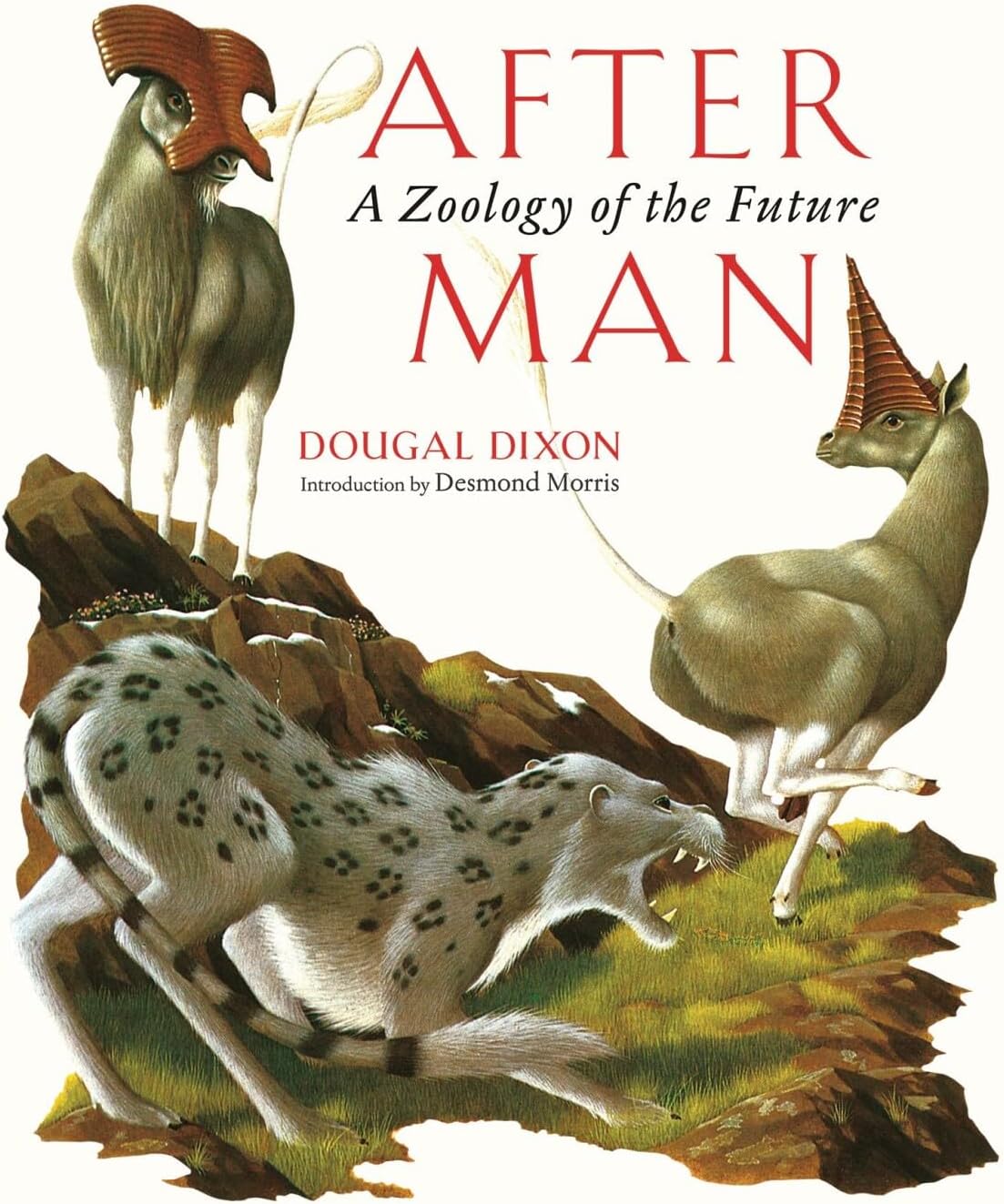
After Man: A Zoology of the Future
Product ID: 101937894
Desertcart purchases this item on your behalf and handles shipping, customs, and support to South Africa.
desertcart.com: After Man: A Zoology of the Future: 9781911081012: Dixon, Dougal: Books Review: Beautiful *and* Intelligent - I've been sharing this book with my biology students as something to read when they're done with tests. It is an excellent tool for grasping the foundations of evolution. Dixon overviews the basics of evolutionary theory in clear and precise language at the beginning, and then provides amazingly beautiful (and in some cases, nightmarish) illustrations of what the future might hold for us. Or rather, not for us, since he posits that our species dies out, which is admittedly a little depressing. Similarly to Vonnegut's Galapagos , Dixon hypothesizes that a large brain might not actually be an evolutionary advantage, but rather a disadvantage. Through the disappearance of humanity he shows how our destruction of the environment is causing wholesale destruction of countless species, and causing damage to our own. It is only when our species disappears, and the earth has 50 million years to recover, that evolution can continue again. I love the drawings, particular of naked Sandsharks that look like something from the spice worms of Dune, Striger cats that have prehensile tails and grasping paws, Predator Rats, Swimming Monkeys, the penguin become 12 meter whale-like plankton-eating Vortex, Slobbers who catch insects with their slobber, and look like a marsupial bundle of moss, and bipedal walking screaming 1.5m tall bats, the Night Stalkers. Some of these ideas may sound outlandish- a good number of them certainly are. But the best part is Dixon gives solid evolutionary theory for how each would evolve, dictated by a changing environment and the raw material of previous genetic code. So we get classic island giganticism and the freedom of evolution on islands. We get the foreseeable continual development of symbiosis between antelopes and tick birds, such that now the tick birds nest in a special dorsal cleft on the antelope. And those animals that are the most successful today, such as the rodents, insectivores, and lagomorphs (especially rats and rabbits) are the ones with the greatest opportunity for diversity in the future. I would highly recommend this book for any student of evolution. It's not fact; it's simply based on sound theory. It's the best kind of science fiction, as it all could happen. It's certainly fiction, but more than fiction, as it will help you contemplate the foundational truths of evolution. Future Evolution Review: Creative, educational, and just plain fun! - "After Man" is one of the most engaging, creative books I have ever had the pleasure of reading. While one might think from its outlandish illustrations that it is a book for children, this is simply not the case. That's not to say a ten or eleven year old wouldn't enjoy this book, but there's plenty an adult can take away from it as well. Beginning with a basic review of the principles of biology and evolution, Dixon proceeds to apply them across a range of environments on an Earth 50 million years removed from mankind. The result is a menagerie of remarkable creatures. Remarkable in that they are frequently unique, even bizarre, but even more remarkable because they represent the result of a familiar creature's evolution. Dixon's world isn't a fantasyland, every creature in it holds true to the principles he so effectively explains in the first chapter. Moreover, they all fill an important ecological niche; he hasn't created 150 pages of carnivores. Rather, he presents a balanced, albeit limited, ecosystem that sheds light on the state of our own environment today. Beautifully illustrated and highly engaging, "After Man" is a must read for anyone interested in evolution and anthropology. Furthermore, this book is educational without being heavy handed. One by no means needs to be an expert to learn from and enjoy this very unique work.
| Best Sellers Rank | #1,171,257 in Books ( See Top 100 in Books ) #9,932 in Comic & Graphic Novel Publishers |
| Customer Reviews | 4.7 4.7 out of 5 stars (702) |
| Dimensions | 9.25 x 0.67 x 11.06 inches |
| ISBN-10 | 1911081012 |
| ISBN-13 | 978-1911081012 |
| Item Weight | 2.01 pounds |
| Language | English |
| Print length | 128 pages |
| Publication date | May 24, 2018 |
| Publisher | Breakdown Press Ltd |
J**I
Beautiful *and* Intelligent
I've been sharing this book with my biology students as something to read when they're done with tests. It is an excellent tool for grasping the foundations of evolution. Dixon overviews the basics of evolutionary theory in clear and precise language at the beginning, and then provides amazingly beautiful (and in some cases, nightmarish) illustrations of what the future might hold for us. Or rather, not for us, since he posits that our species dies out, which is admittedly a little depressing. Similarly to Vonnegut's Galapagos , Dixon hypothesizes that a large brain might not actually be an evolutionary advantage, but rather a disadvantage. Through the disappearance of humanity he shows how our destruction of the environment is causing wholesale destruction of countless species, and causing damage to our own. It is only when our species disappears, and the earth has 50 million years to recover, that evolution can continue again. I love the drawings, particular of naked Sandsharks that look like something from the spice worms of Dune, Striger cats that have prehensile tails and grasping paws, Predator Rats, Swimming Monkeys, the penguin become 12 meter whale-like plankton-eating Vortex, Slobbers who catch insects with their slobber, and look like a marsupial bundle of moss, and bipedal walking screaming 1.5m tall bats, the Night Stalkers. Some of these ideas may sound outlandish- a good number of them certainly are. But the best part is Dixon gives solid evolutionary theory for how each would evolve, dictated by a changing environment and the raw material of previous genetic code. So we get classic island giganticism and the freedom of evolution on islands. We get the foreseeable continual development of symbiosis between antelopes and tick birds, such that now the tick birds nest in a special dorsal cleft on the antelope. And those animals that are the most successful today, such as the rodents, insectivores, and lagomorphs (especially rats and rabbits) are the ones with the greatest opportunity for diversity in the future. I would highly recommend this book for any student of evolution. It's not fact; it's simply based on sound theory. It's the best kind of science fiction, as it all could happen. It's certainly fiction, but more than fiction, as it will help you contemplate the foundational truths of evolution. Future Evolution
J**N
Creative, educational, and just plain fun!
"After Man" is one of the most engaging, creative books I have ever had the pleasure of reading. While one might think from its outlandish illustrations that it is a book for children, this is simply not the case. That's not to say a ten or eleven year old wouldn't enjoy this book, but there's plenty an adult can take away from it as well. Beginning with a basic review of the principles of biology and evolution, Dixon proceeds to apply them across a range of environments on an Earth 50 million years removed from mankind. The result is a menagerie of remarkable creatures. Remarkable in that they are frequently unique, even bizarre, but even more remarkable because they represent the result of a familiar creature's evolution. Dixon's world isn't a fantasyland, every creature in it holds true to the principles he so effectively explains in the first chapter. Moreover, they all fill an important ecological niche; he hasn't created 150 pages of carnivores. Rather, he presents a balanced, albeit limited, ecosystem that sheds light on the state of our own environment today. Beautifully illustrated and highly engaging, "After Man" is a must read for anyone interested in evolution and anthropology. Furthermore, this book is educational without being heavy handed. One by no means needs to be an expert to learn from and enjoy this very unique work.
P**A
My twin boys LOVE this book, and they also have the encyclopedia from...
My twin boys LOVE this book, and they also have the encyclopedia from Dougal Dixon. There is a video on youtube uploaded from a TV show in Japan that produced an animated version, I believe it was based on the first edition [this is the 2nd edition or updated content]. Anyway I WISH I could find a DVD of that show, it was low-grade animation, mostly clay-mation type BUT it was very entertaining, I thought the creatures looked really cute especially the 2 or 3 bat versions since I love bats so much. I hope someday to see a DVD from Japan if not from the USA of that exact TV show airing. On youtube it has English dubbing, please look for it, I bet your kids will really like it especially if they are into claymation, stop motion animation and or 'wild'-looking creatures.
M**O
Almost like a science book...
What would happen if mankind disappeared and the animals of Earth went back to following the rules of evolution? This book will show you. Each part of the book deals with another region of the Earth; deserts, glasslands, polar regions and so on. See meat-eating predators evolved from rats and bats, large grazers and browsers developed from fast breeding rabbits and the sea going creatures descended from penguins. Like the book 'Man After Man', the book starts off with science chapters that in this case do their best to explain evolution, the food chain and the history of life on Earth. Unlike 'Man After Man' it is not set up like a story, but a true non-fiction text book, like one you might have in a class room or while out camping. It also has maps and gives you information on the environments and what changes have happened to the Earth during the 50 million years. With just over 120 pages and full of color pictures, I wish there had been more! 'Man After Man' felt longer because it had more text and less pictures.
と**楽
五千万年後の地球には現生の動物から進化をとげたこんな動物がいるかもしれない、というコンセプトで、生物進化の驚きとすばらしさを謳った本です。 一見、珍奇さが売りのような本ですが、実際に読んでみると正しい動物学の知識に基づいており、突飛に思える動物の姿にも自然な説得力があります。 奔放な想像力と生物学的な説得力とがうまくバランスがとれており、優れたエンターテイメントとして読むことができました。
K**R
Not only is this a fascinating bestiary of animals that do not (yet) exist, it's also a fantastic primer on the basics of ecological niches and evolutionary development. A seminal work in the field of fantastical or alternative history (or in this case future) animals, it is unreservedly recommended as a work of art, fiction and basic science reading.
K**A
I bought this as a gift for my Mother. She was over the moon happy. Great quality, no damages in shipping. Just takes a bit to ship, but that might depend on where it’s being shipped. I was made aware of how long it’d take so there wasn’t an issue there.
D**6
Excelente libro de evolución especulativa de la fauna del futuro. Ilustraciones muy bonitas.Llego rápido y en buenas condiciones
K**N
This book was recommended by a teacher but was a bit underwhelmed colours were a bit dull and content not what I was imagining.
Trustpilot
2 weeks ago
2 days ago